

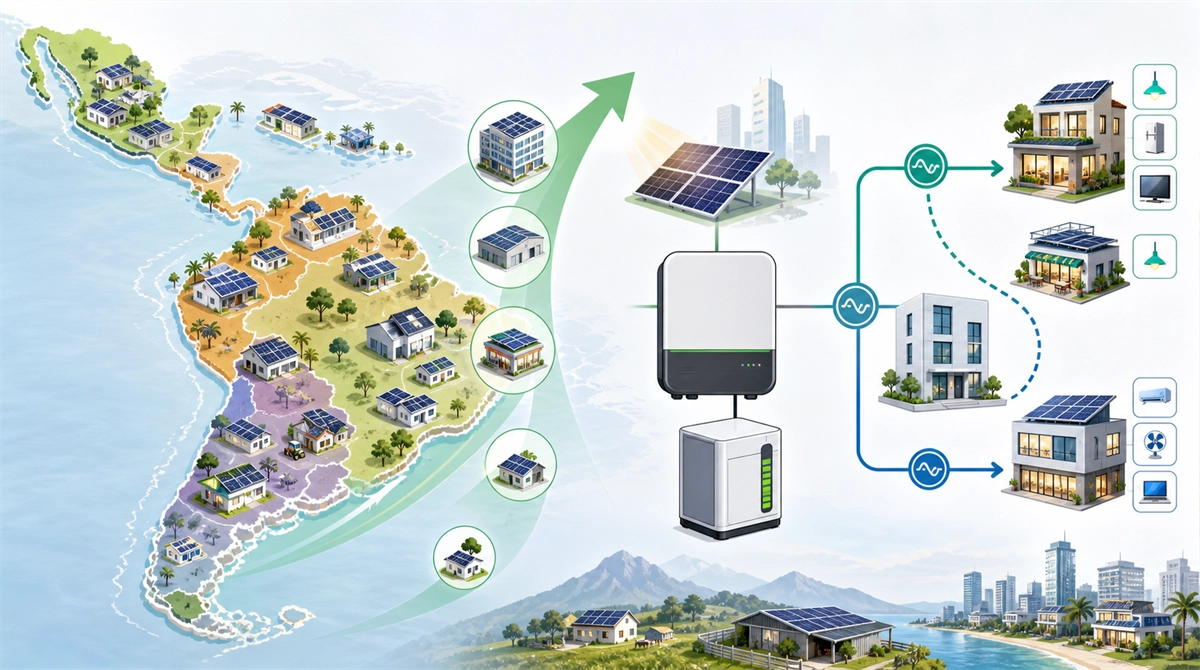
Across Latin America and nearby island markets, reliable electricity remains a real concern for many households, small businesses, farms, and remote facilities. The region’s shift is easy to see in the numbers: distributed solar generation grew from about 1 GW in 2017 to 31.8 GW by 2023, and in Brazil alone distributed solar reached roughly 40 GW by mid-2025 — about 43% of all new capacity added since 2018. For distributors, installers, and project buyers, that growth is creating strong demand for solar inverters, lithium batteries, and 120/240V-compatible storage systems.
This post looks at what drives backup power demand in Latin America, why voltage compatibility matters, and what buyers weigh when choosing a system.
Key Takeaways
- Regional distributed solar rose from ~1 GW (2017) to 31.8 GW (2023); Brazil alone reached ~40 GW by mid-2025 (EIA / Onred).
- Backup power is shifting from an emergency option to part of long-term energy planning.
- 120/240V split-phase compatibility matters in island and North-America-influenced markets.
- Buyers weigh essential-load backup, battery compatibility, solar input, generator support, and expansion.
Why Is Backup Power Becoming More Important in Latin America?
Backup power is moving from an emergency option to part of long-term energy planning, driven by grid instability, high electricity costs, and storm exposure. Many markets face voltage fluctuation, scheduled outages, or limited rural grid coverage.
For residential users, unstable power affects lighting, refrigeration, communication devices, water pumps, and appliances. For small businesses, it interrupts daily operations, payment systems, cooling equipment, and service work. As solar and battery storage become more accessible, more users want integrated systems that combine solar generation, battery storage, utility charging, and backup output.
Why Is Solar Storage Moving from Optional to Practical?
In the past, many solar systems were designed mainly to reduce electricity bills or provide basic off-grid power. Today, more customers want solar systems that also provide backup power when the grid fails. That is a different design goal, and it changes the sales conversation.
This shift is increasing demand for hybrid solar inverters and battery energy storage systems. A well-designed system stores solar energy during the day, supplies power at night, and provides backup during outages. For distributors and project buyers, customers are no longer asking only about panel capacity or inverter price. They ask whether the system can support essential loads, lithium batteries, generators, and future expansion.
Why Does 120/240V Compatibility Matter in Some Projects?
Many Latin American countries use different grid standards, but 120V, 220V, and 120/240V applications still appear in specific markets and projects. This is especially relevant in areas influenced by North American electrical systems, island markets, imported appliances, and mixed-voltage loads.
In these applications, a 120/240V-compatible inverter system can support a wider range of loads, including standard household appliances and higher-voltage equipment. That makes it useful for backup power systems, residential solar storage, small commercial applications, and remote buildings. If your market uses split-phase power, see our guide on single-phase vs split-phase inverters to understand the 120/240V dual-hot design.
For buyers, the key point is not only the inverter output voltage. Evaluate the full system by load demand, battery capacity, solar input, installation environment, and local electrical requirements.
Which Application Scenarios Are Most Common?
Different customers need different solutions depending on load type, installation environment, and power stability. The table maps common scenarios to the system points that matter most.
| Application Scenario | Common Power Needs | System Considerations |
|---|---|---|
| Residential homes | Lighting, refrigerators, routers, fans, TVs, selected appliances | Battery capacity, essential-load backup, solar charging, safe install |
| Small shops and offices | POS, cooling, office devices, service equipment | Stable output, backup duration, surge load, easy maintenance |
| Farms and remote buildings | Water pumps, tools, lighting, security, basic appliances | Off-grid capability, generator support, solar input, expansion |
| Island or coastal areas | Essential loads, emergency power, refrigeration, communication | Backup reliability, battery storage, storm-outage planning |
| Mixed-voltage applications | 120V and 240V appliances or imported equipment | Voltage compatibility, load balance, wiring, local standards |
What Do Customers Weigh When Choosing a Backup System?
Product selection should not focus only on rated power. A reliable backup system depends on compatibility, installation flexibility, and long-term service support.
1. Stable Output for Essential Loads
Customers want to keep important loads running during outages — lights, refrigerators, routers, fans, water pumps, security systems, or business equipment. Before choosing a system, calculate both continuous and surge loads. Motors, compressors, and pumps often need much higher starting power than their running power.
2. Battery Compatibility
Lithium batteries, especially LiFePO4, are more common in solar storage due to long cycle life, safety performance, and suitability for repeated charging. A good inverter solution should support suitable battery voltage, charging current, BMS communication, and battery protection. For chemistry trade-offs, see lead-acid vs lithium-ion batteries.
3. Solar Input Flexibility
Many projects need flexible PV input because roof space, sunlight direction, and installation conditions vary. Inverters with a suitable MPPT design can improve solar energy use and simplify system planning.
4. Generator Support
In areas with long outages or unstable weather, solar and battery storage may need to work alongside generators. Generator-compatible inverter systems add flexibility for backup planning.
5. Parallel Expansion
Some customers start small and expand later. Parallel capability helps increase capacity when more power is needed, especially for larger homes, small businesses, or light commercial projects.
6. Clear Technical Documentation
For installers and distributors, clear documentation is essential. Wiring diagrams, protection requirements, battery compatibility, communication settings, and installation guidance reduce project risk and improve customer satisfaction.
What Opportunities Does This Create for Distributors?
The growth of backup power demand creates opportunities for local distributors, solar installers, and project companies. Instead of selling individual products, many customers now prefer complete energy solutions that include an inverter, battery, solar input, monitoring, and technical support.
This creates a stronger need for suppliers who can provide stable products, flexible configuration, OEM/ODM support, and practical system guidance. A clear product portfolio helps serve different customer groups, from small residential backup systems to larger solar storage projects.
Why Does Supplier Experience Matter?
Backup power systems are different from ordinary consumer products. Once installed, they must operate safely and reliably under different load conditions, grid conditions, temperatures, and battery configurations.
So customers should evaluate not only the product price, but also the supplier’s experience in inverter design, battery integration, system application, technical support, and after-sales response. For B2B buyers, working with an experienced manufacturer can reduce communication costs, improve product matching, and support long-term market development.
Techfine’s View on Latin America Backup Power Demand
Techfine expects backup power and solar energy storage to keep playing an important role in Latin America and nearby markets. As electricity demand grows and users seek more stable energy, inverter and battery systems will matter more for residential, commercial, and off-grid applications.
For markets with unstable supply, mixed-voltage applications, or strong backup demand, choosing the right inverter and battery configuration is essential. Techfine can support customers with solar inverters, lithium batteries, and energy storage solutions for different scenarios — whether the plan is product distribution, solar storage projects, or customized OEM/ODM cooperation.
Conclusion
Backup power demand in Latin America is being driven by grid instability, rising energy needs, fast solar adoption, and the growing use of battery storage. In some markets and projects, 120/240V-compatible storage systems add flexibility for homes, businesses, and remote applications.
For customers, the most important step is choosing a system that matches local voltage requirements, load conditions, battery configuration, solar input, and long-term service needs. For distributors and project buyers, this trend is an opportunity to offer more comprehensive and reliable solar storage solutions.
Sources
- Regional distributed solar ~1 GW (2017) to 31.8 GW (2023) — Onred, via Dialogue Earth.
- Brazil distributed solar under 1 GW (2018) to ~40 GW by mid-2025, ~43% of capacity additions — U.S. Energy Information Administration (EIA), data-as-of 2025.
Looking for Solar Energy Storage Solutions for Latin America?
Contact Techfine to discuss your target market, voltage requirements, battery configuration, backup load, and product planning needs. We can help you evaluate suitable inverters and energy storage solutions for residential, commercial, and off-grid applications.
FAQ: Latin America Backup Power
Do I need a 120/240V split-phase inverter for Latin American projects?
Not always. Many Latin American markets use single-voltage grids, but 120/240V split-phase becomes relevant in island markets, areas influenced by North American systems, and projects with mixed 120V and 240V appliances. Check the local grid standard and the specific appliances before choosing.
Are lithium batteries better than lead-acid for Latin American backup systems?
For daily cycling and solar storage, LiFePO4 batteries usually offer longer cycle life, deeper usable capacity, and lower maintenance. Lead-acid may still suit budget-sensitive or occasional-use backup. The right choice depends on budget, how often the system cycles, and local temperature conditions.
How do I size a backup system for a home or small business?
Start with a load list: which devices must run during an outage, their running watts, and their surge watts at startup. Motors, pumps, and compressors need extra surge headroom. Then match inverter power, battery capacity for the required backup hours, and solar input for daytime recharging. A supplier or installer can help confirm the configuration.
Can Techfine support OEM/ODM projects for Latin American distributors?
Yes. Techfine works with distributors and project buyers on inverter and battery selection, and on OEM/ODM cooperation such as branding and configuration. Share your target market, voltage requirement, typical load profile, and monthly quantity, and we can suggest suitable models and options.