
Nigeria is one of Africa’s most important markets for backup power products. About 40% of Nigerians — roughly 80 million people — still lack access to electricity, and businesses that are connected often receive only part of the power they need. For importers, wholesalers, and energy solution providers, this creates steady demand for solar inverters, battery storage, online UPS systems, and hybrid solar solutions.
This guide explains what actually drives backup power demand in Nigeria, which product categories fit which buyers, and what importers should check before sourcing.
Key Takeaways
- About 40% of Nigeria’s population (~80 million people) lacks access to electricity (World Bank, 2025).
- The national grid has roughly 13,000–13,500 MW installed, but users often receive only about a third of that.
- Nigeria spends an estimated ~$22bn per year on fuel for generators (Energy Commission of Nigeria, via Al Jazeera).
- Match products to the load and usage scenario; do not use one inverter model for every application.
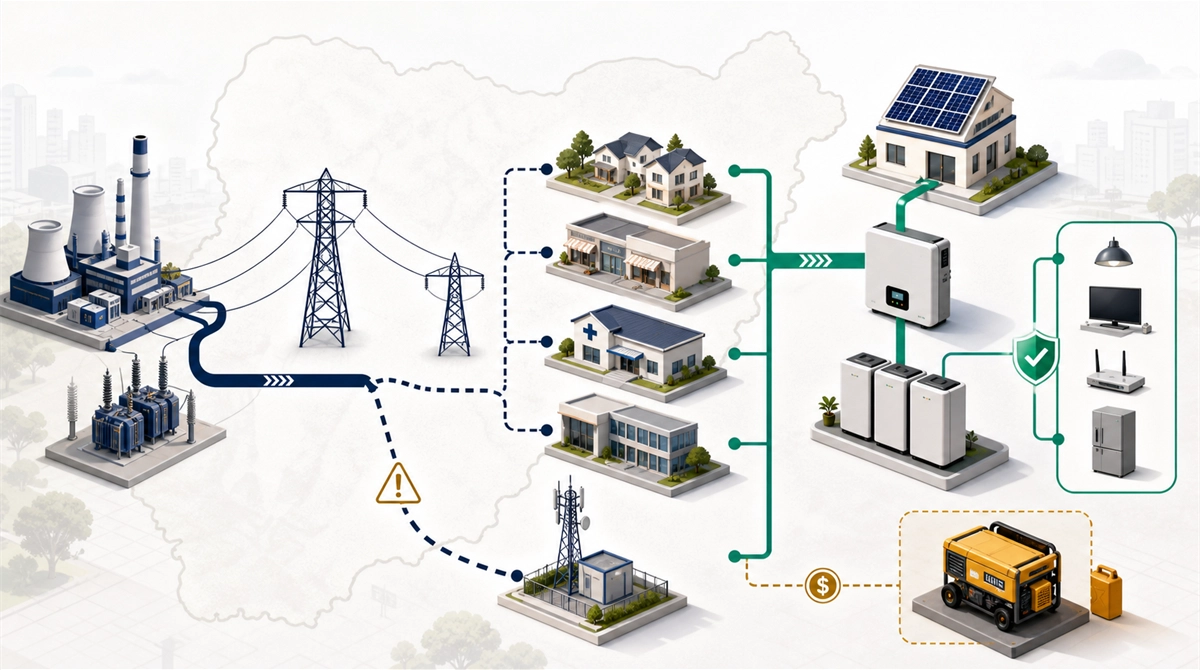
Why Is Backup Power Demand So Strong in Nigeria?
Backup power demand in Nigeria is driven by an unreliable grid, heavy generator dependence, and rising fuel costs, not only by rural electrification needs. The gap between installed capacity and delivered power is the core problem.
On paper, the national grid has an installed capacity of roughly 13,000–13,500 MW. In practice, businesses and households often receive only about a third of that, and the grid still suffers system collapses and aging transmission lines. This is why so many users treat backup power as a necessity, not a luxury — it keeps lights, fans, refrigerators, POS machines, computers, medical equipment, security systems, and communication devices running during outages.
What Are the Main Factors Driving Demand?
Four structural factors keep this market strong. They also explain why buyers increasingly ask for reliable systems, not only the lowest price.
1. Unstable Grid Electricity
Frequent outages and voltage instability are the top reasons households and businesses look for backup systems. In many areas, users receive electricity for only limited hours per day, while others see sudden blackouts or voltage swings. This makes inverters, batteries, voltage stabilizers, and UPS systems highly relevant.
2. High Dependence on Fuel Generators
Petrol and diesel generators have been common in Nigeria for years — in homes, shops, markets, offices, banks, hospitals, and small factories. But generators bring high running costs, noise, maintenance, fuel-supply issues, and emissions. Nigeria spends an estimated ~$22 billion per year on generator fuel (Energy Commission of Nigeria). As fuel costs rise, many end users look for cleaner, more cost-effective alternatives, especially solar inverters and battery backup.
3. Growing Interest in Solar and Battery Storage
Solar power is more attractive because it reduces dependence on both the grid and fuel generators. A solar inverter with battery storage can provide daytime solar charging and nighttime backup. This is especially useful for residential users, retail shops, small offices, clinics, schools, farms, and telecom-related applications.
4. Business Continuity Needs
For commercial users, a power interruption directly affects revenue. Shops lose customers when POS machines fail. Offices stop when computers and routers shut down. Clinics and laboratories need stable power for medical and testing equipment. So many buyers now ask for reliable systems that reduce downtime and protect equipment.
Which Backup Power Products Fit the Nigerian Market?
Different users need different solutions, so importers should match the product category to the real load and usage scenario. Using one product for every application is the most common sourcing mistake.
| Product Type | Main Application | Typical Buyer Need |
|---|---|---|
| Off-grid solar inverter | Homes, shops, rural buildings, small businesses | Daily backup with solar charging |
| Hybrid solar inverter | Homes, offices, commercial solar systems | Flexible use of solar, grid, battery, generator input |
| LiFePO4 battery | Solar storage and long backup time | Longer cycle life, lower maintenance than lead-acid |
| Online UPS | Servers, banks, hospitals, telecom, labs | Stable, clean power for sensitive equipment |
| Line-interactive UPS | Computers, routers, POS, office equipment | Short-term backup and basic protection |
| All-in-one solar storage system | Residential and small commercial users | Easy installation and integrated storage |
For the difference between hybrid, off-grid, and grid-tie designs, see our guide on hybrid vs grid-tie inverters. To weigh battery chemistries, see lead-acid vs lithium-ion batteries.
Which Application Scenarios Are Most Common?
Residential Backup Power
Many households need backup for lights, fans, TVs, refrigerators, routers, phone charging, and basic appliances. For this segment, importers may focus on compact inverter systems, wall-mounted LiFePO4 batteries, and all-in-one solar storage systems.
Small Shops and Retail Businesses
Small shops need power for lighting, POS machines, refrigerators, freezers, security cameras, and internet routers. These users care about price, backup time, battery durability, and easy maintenance.
Offices and Commercial Buildings
Offices need stable electricity for computers, printers, routers, servers, and communication systems. Both solar backup systems and UPS solutions may be needed: the UPS protects sensitive equipment while the inverter and battery support longer backup time.
Medical and Laboratory Use
Clinics, pharmacies, and laboratories need more stable power for medical devices, cold storage, testing equipment, and computers. For these applications, importers should pay attention to output waveform, transfer time, protection functions, and system reliability.
Telecom and Security Systems
Telecom sites, CCTV systems, access control, and communication equipment often need continuous power. These applications usually require reliable batteries, stable DC/AC conversion, and good protection against unstable grid conditions.
What Should Importers Check Before Sourcing?
1. Match Product Capacity with Local Loads
One common mistake is choosing products only by price or rated power. In Nigeria, many users run inductive loads such as refrigerators, pumps, fans, and compressors, which need higher surge capacity at startup. Check not only rated power, but also surge power, battery voltage, charging current, PV input range, and overload protection.
2. Choose the Right Battery Technology
Lead-acid batteries are still used because of their lower initial cost. But LiFePO4 batteries are more attractive for users who want longer cycle life, deeper discharge, lower maintenance, and better long-term value. For importers, LiFePO4 systems can be positioned as a higher-value solution for residential solar backup, commercial backup, and long-hour storage.
3. Pay Attention to Heat and Environment
Nigeria has hot and humid regions, and many systems are installed in challenging environments. Product design should consider heat dissipation, dust protection, stable operation, and a suitable working temperature range. For outdoor or semi-outdoor installs, check enclosure protection — see IP21 vs IP65 inverters.
4. Consider After-sales Support and Spare Parts
Backup power products are not one-time consumer goods. Consider warranty terms, technical support, spare parts availability, repair guidance, and product training. A supplier that provides technical documents, troubleshooting support, and spare parts is more suitable for long-term B2B cooperation.
5. Build Product Lines for Different Buyer Levels
The market includes both price-sensitive buyers and higher-end commercial users. Importers can build a portfolio covering entry-level backup systems, mid-range solar inverter solutions, and higher-reliability UPS or storage systems. This helps distributors serve different customer groups without relying on one product category.
Recommended Product Direction for Nigerian Importers
| Market Segment | Suggested Product Direction | Key Selling Points |
|---|---|---|
| Home backup | Off-grid inverter + LiFePO4 battery | Reliable backup, solar charging, lower generator use |
| Small business | Hybrid inverter + battery storage | Longer backup time, supports daily operation |
| Office and IT | Online UPS + battery pack | Clean power, fast protection, stable output |
| Commercial solar | High-capacity hybrid inverter system | Solar priority, generator compatibility, scalable design |
| Remote or rural users | Solar inverter + PV + battery system | Off-grid operation, reduced fuel dependence |
Conclusion
Nigeria’s backup power demand rests on long-term structural needs: an unstable grid that delivers only part of its ~13,000 MW capacity, heavy generator dependence, rising fuel cost pressure, and growing interest in solar and battery storage. For importers, this market is not only about selling inverters or batteries. It is about providing practical energy solutions for homes, businesses, institutions, and commercial users.
Importers who want to enter or expand in Nigeria should focus on reliable product quality, suitable capacity matching, battery compatibility, after-sales support, and product lines that serve different customer levels.
Techfine provides solar inverters, UPS systems, LiFePO4 battery solutions, and integrated energy storage products for global B2B customers. For importers, wholesalers, and project buyers looking for backup power solutions, Techfine can support product selection, OEM/ODM cooperation, and technical guidance for different market applications. Share your typical load profile and target segment, and we can help match inverter and battery options.
Sources
- Electricity access: about 40% of Nigerians (~80 million people) lack access — World Bank, “Expanding Nigeria’s mini grid market,” March 2025.
- Grid installed capacity ~13,000–13,500 MW, with users receiving about a third — BusinessDay / Nairametrics, data-as-of 2026.
- Generator fuel spending ~$22bn/yr — Energy Commission of Nigeria, via Al Jazeera.
FAQ: Backup Power in Nigeria
Can a solar inverter replace a generator in Nigeria?
In many small and medium applications, a solar inverter with battery storage can significantly reduce generator use. Whether it can fully replace a generator depends on load size, backup-time requirement, solar panel capacity, battery capacity, and installation conditions. For high continuous loads or long outages, some buyers keep a generator for backup and use solar plus battery for daily needs.
Is a LiFePO4 battery better than a lead-acid battery for Nigerian backup systems?
LiFePO4 batteries usually offer longer cycle life, deeper usable capacity, and lower maintenance than lead-acid. The initial cost is higher, but the long-term value is often better for users who need frequent backup power. Lead-acid can still suit budget-sensitive or occasional-use systems.
What inverter capacity is suitable for Nigerian homes?
Small homes may use lower-capacity inverter systems for lights, fans, TV, router, and phone charging. Larger homes with refrigerators, pumps, or multiple appliances need higher-capacity inverters and larger battery banks. The final selection should be based on an actual load calculation.
Do commercial users still need a UPS if they already have a solar inverter?
Yes, in many cases. A solar inverter provides longer backup power, while an online UPS protects sensitive equipment from voltage fluctuation, frequency instability, and transfer interruption. For servers, medical equipment, banking systems, and communication devices, UPS protection is still important alongside a solar backup system.