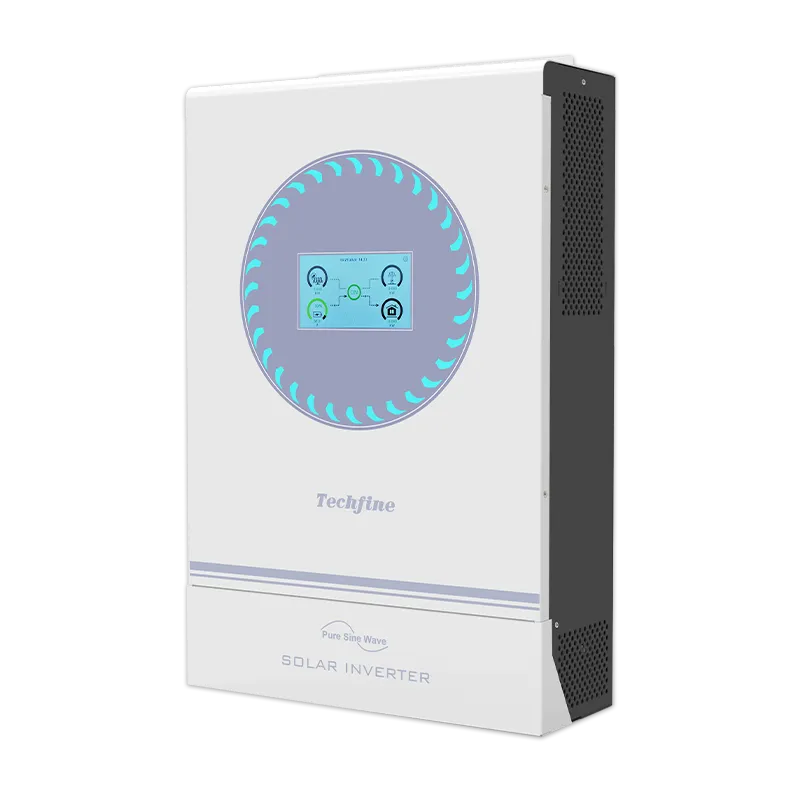

The best solar inverter for a project in India depends on what the system needs to do. For daytime generation with a working grid, look at on-grid models. For power cuts or a site without dependable grid supply, compare battery-based off-grid or hybrid options.
Buyers can know the major brands and still struggle to get clear, comparable quotes. At Techfine, we make inverters for other brands. We wrote this guide to make that next step easier.
First, the guide compares brands and product lines for on-grid, off-grid and hybrid systems. It then looks at the model details, quotes and support arrangements that can change your choice. The final section covers supply and private-label terms for business buyers.
How the brands in this guide are chosen
The selection draws on Indian market reports, product catalogues and documented sales or project activity in India. For example, JMK Research lists Sungrow and Sineng as the two largest suppliers by Indian inverter shipments in Q2 2026. That provides market context; it doesn’t establish which model will suit a particular site. JMK’s quarterly update.
The tables group products by the job they do. Indian catalogues help identify rooftop and backup options, while model documents let buyers compare electrical requirements and features. A brand can appear in several groups. Table order is not a quality ranking.
On-grid solar: rooftop systems and larger projects
On-grid inverters suit systems that use solar power alongside the electricity grid. A standard grid-tied system switches off during a grid outage, so buying solar panels and an on-grid inverter alone won’t give you backup power. Backup needs a system designed to operate safely when the grid is down. DOE’s explanation of solar and backup power.
For rooftop projects, these ranges give you useful starting points:
| Brand | Product lines to compare | Where to focus |
|---|---|---|
| Sungrow | SG4.0/5.0/6.0RS-L and CX-P2 ranges | The RS-L range covers smaller systems; CX-P2 includes larger commercial options such as the three-phase 125kW SG125CX-P2. Match the series to the site’s size and supply. |
| Solis | S6-GR1P(4–5)K-S, S5-GR3P(5–20)K and S5-GC(25–50)K | Single-phase rooftop, three-phase rooftop and larger commercial ranges. Compare the number of independent MPPT inputs against the proposed panel layout. |
| Luminous | NXI and NXI T | These are grid-tie ranges within a brand that also sells backup products. Ask for the NXI model and phase configuration suited to the installation. |
An MPPT tracks the panels’ operating point to extract power. Separate trackers give the designer more flexibility when panel groups face different directions. The final string layout still needs to fit the inverter’s voltage and current limits.
For larger solar projects
Large projects also compare string and central inverters. Sineng’s SP-350K-H1 is a high-power string example with an 800V rated AC connection. FIMER’s PVS980-58 is a central-inverter range for multi-megawatt plants; FIMER has also documented its use in an Indian project in 2020.
At this scale, the project engineer needs to compare the inverter, transformer, plant controls and service scope together. A small rooftop quotation and a central-inverter proposal cover very different equipment.
Off-grid and backup power: compare the battery setup
For a shop, office or home that needs power through outages, start with the loads that must stay on and how long they need to run. Then choose the inverter and battery system around that requirement.
The solar panel, battery and inverter sizing guide shows how to turn that load list into a starting specification.
Some products in this group can charge from both solar and the mains. They may be sold as solar PCUs, or power conditioning units. That ability to accept mains power does not by itself mean they can export solar electricity to the grid.
| Brand | Reference product or range | Useful distinction |
|---|---|---|
| Luminous | NXG PRO; Solarverter PRO for other capacity needs | NXG PRO 1kVA/12V is a single-battery off-grid model with an MPPT solar charger. Select the battery voltage and capacity for the actual load. |
| Microtek | SOLAR PCU 2335/24V | This model uses PWM solar charging and a 24V battery system, with solar and mains charging options. Its controller and panel requirements differ from MPPT models. |
| UTL Solar | Gamma+ 1650 | A 1400VA, 12V model with UTL’s rMPPT controller. The product page identifies it as off-grid and states that it cannot export to the grid. |
| Growatt | SPF ES / ES LITE | Off-grid models with remote monitoring options. Specify the full version and ask which monitoring device, battery settings and manual go with it. |
Read the output rating separately from the panel rating. A value in VA describes apparent power; the load also needs to fit the inverter’s continuous W rating. Likewise, a stated PV input capacity tells you about the panels the unit can accept, not the AC load it can run.
This is especially useful when comparing a compact solar PCU with a larger off-grid inverter. Ask the supplier to show the supported continuous load and starting load for your equipment, along with the battery setup used for that calculation.
Hybrid solar: choose the inverter and battery together
A hybrid system combines solar generation and battery storage with a grid connection. For backup, the design also needs to specify which circuits the inverter will supply during an outage.
The word “hybrid” covers products with quite different battery and phase requirements:
| Brand | Product line or example | What changes the choice |
|---|---|---|
| Deye | SUN-5K-SG04LP1-EU-SM2 | A single-phase model with a 40–60V battery input range in Deye’s India brochure. Keep the full model suffix on the quotation. |
| GoodWe | ES G2 | Single-phase, low-voltage hybrids. Closely named versions have different battery current limits, as the model comparison below shows. |
| SOFAR | HYD 5–20KTL-3PH | Three-phase hybrids with a published 180–800V battery range. These call for a different battery arrangement from the low-voltage examples. |
| Solis | S6-EH1P(3–10)K-L-PLUS | A single-phase, low-voltage storage range that includes generator support. Compare its backup and generator requirements with the planned system. |
| Luminous | Hybrid TX | The Indian catalogue includes single-phase and three-phase hybrid products. Specify the TX variant, battery configuration and output required. |
The Deye and SOFAR examples show why a shortlist needs more than a power figure. A battery intended for a 40–60V inverter cannot simply be moved to an inverter requiring 180–800V. The inverter and battery need to be selected as a working pair.
Even within the right voltage range, ask for the exact battery model, the applicable compatibility document and any required communication settings. SOFAR’s datasheet explicitly refers buyers to its compatible-battery list. A matching voltage is only one part of the check.
For a three-phase backup system, also ask how much load each phase can carry during an outage. The total power rating alone won’t tell you whether the planned distribution of loads will work.
Check the exact model before asking for a final quote
Once a few product lines fit the job, the next comparison is between complete model numbers. Small differences in the name can point to a different electrical limit.
Check what a model suffix changes
GoodWe’s ES G2 page lists GW5000M-ES-20 and GW5000-ES-20. Both use a 40–60V battery range, but their maximum continuous charge and discharge currents are 60A and 120A respectively. GoodWe’s model specifications.
That matters when sizing battery-powered backup. If you need the system to carry a substantial load after sunset, ask for the available battery-only output with the proposed battery. The battery’s own current limit also matters. “GoodWe 5kW hybrid” leaves too much unspecified for a final order.
Check output at the site’s temperature
Sineng’s SP-350K-H1 page lists AC output of 352kW at 30°C, 320kW at 40°C and 295kW at 50°C. These are published values for that specific model. Sineng’s output table.
For a hot installation site, use the relevant temperature condition when comparing equipment. A broad operating-temperature range only tells you where a product can operate; the output figures or derating curve show how much power it can deliver under those conditions.
Check the rest of the system fit
Give the installer, engineer or supplier enough information to confirm:
- PV input: panel model, proposed string layout, MPPT voltage range and current limits.
- Backup load: continuous demand, motor or compressor starting demand, required runtime and phase arrangement.
- Monitoring: the device, connection method and access needed by the owner or service team.
- Installation conditions: expected temperature, location and the clearances required by the model’s manual.
- Project documents: the exact model’s datasheet, manual and documents required for the intended installation and grid connection.
A clear answer names the model and the condition it supports. “Battery compatible” or “suitable for India” is too broad to settle these questions.
Compare the quote and the warranty together
Send shortlisted suppliers the same requirements. Ask them to price the inverter, required accessories, battery equipment where applicable, delivery and any installation or commissioning work separately. That gives you a common basis for comparing the total.
Suppose two suppliers quote hybrid inverters with the same power rating for the same job. Offer A includes a monitoring dongle and explains the return procedure. Offer B lists the inverter and warranty period, with the dongle priced separately.
If remote monitoring is required, include the dongle in both totals. If it isn’t needed, leave it as an option. Then ask who diagnoses a fault, where a unit goes for repair or replacement, and who pays the shipping. Offer A’s extra detail makes it easier to assess; the detail itself doesn’t prove that its terms are better.
Published warranty information also comes in different forms:
| Example | What the document tells you | What to settle before ordering |
|---|---|---|
| Luminous NXG PRO 1kVA/12V product page | Lists a 36-month warranty for that model. | Obtain the applicable service terms, including the claim route and any costs outside the product warranty. |
| Deye India brochure | The selected model’s warranty entry varies with the installation location and refers to the warranty policy. | Get the policy and coverage period that apply to the model supplied for India. |
| GoodWe global warranty, April 2026 | Sets out the start date, claim route, hardware cover and conditional support for transport and on-site labour. | Confirm the authorized supply channel, installation destination and any additional agreement for the order. |
For example, GoodWe’s standard terms start cover at the earlier of first installation or six months after production. They direct claims through the supplying distributor or installer, with a route to escalate to GoodWe. A distributor holding stock therefore needs to understand the start date before promising a full period of cover to its own customers.
Keep the applicable terms with the quotation. A product-page warranty label and a complete service agreement answer different parts of the buying decision.
Buying for distribution or your own brand
If you’re choosing a range to sell, plan for repeat supply as well as the first shipment. Once the electrical specification is clear, agree on the product name, labels, carton artwork and documents your customers will receive.
Keep an approved sample and written specification as the reference for later orders. Agree which changes need approval, who updates the manuals and how your team will work with the manufacturer when a customer reports a fault.
Our inverter after-sales checklist covers the photos, fault codes and site measurements to collect before a warranty return.
For repeat supply, ask about quantities, delivery schedules, spare parts and replacement arrangements. Put those terms in the order alongside the product specification. This helps your sales and service teams describe the same product and make promises the supply agreement supports.
At Techfine, we start private-label projects with an existing inverter platform. We then confirm which branding, packaging and configuration options the model supports for your order.
If you’re buying for distribution or your own brand, share your target market, application, power and battery requirements, estimated quantity and branding needs through our inverter private-label service.