
Solar inverter protection is the group of hardware, firmware, sensors, and installation devices that help an inverter respond to abnormal voltage, current, temperature, wiring, battery, grid, and surge conditions. It does not make a bad installation safe, but it gives the system defined ways to limit damage and shut down when needed.
For buyers in weak-grid markets, protection features are not brochure details. Voltage swings, overloads, wrong wiring, dust, heat, and unstable grids are common causes of returns.
Key Takeaways
- Modern inverters are not only DC-to-AC converters; DOE notes they can also provide grid-support functions such as voltage and frequency response (DOE, data-as-of 2026).
- UL 1741 covers inverters, converters, controllers, and interconnection equipment for distributed energy resources (UL Standards, revised 2026-05-21).
- IEEE 1547 addresses interconnection and interoperability requirements for distributed energy resources, including islanding behavior (IEEE, active standard).
- Protection features vary by inverter model. Do not claim a certification or function unless the datasheet confirms it.
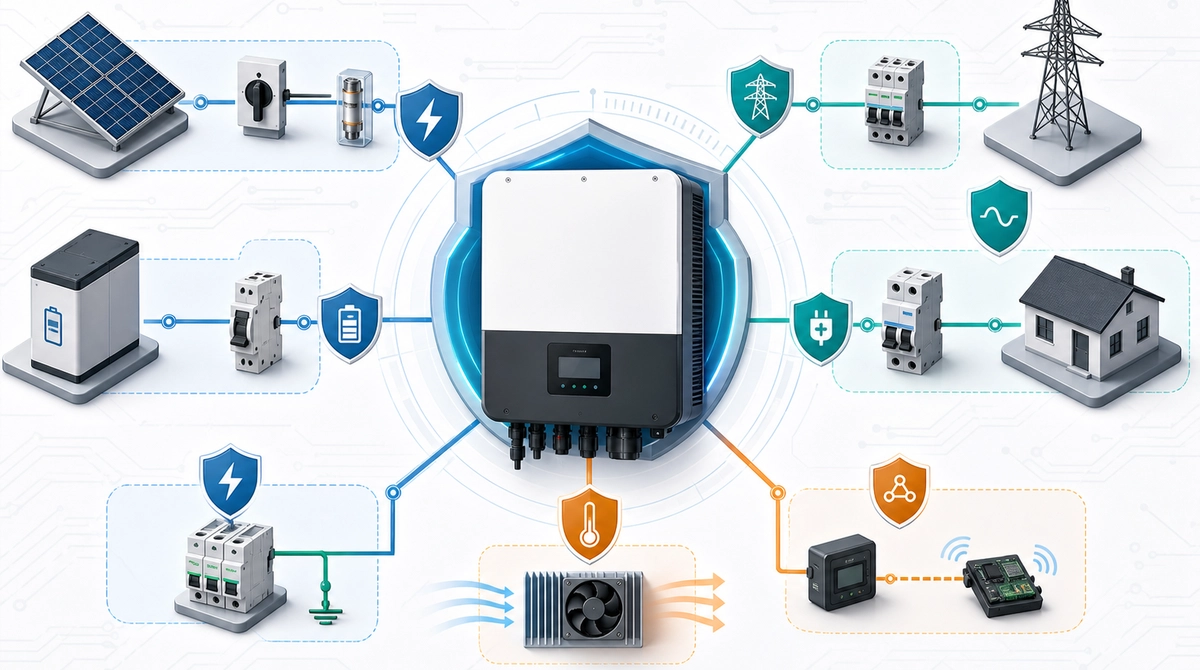
What Is Solar Inverter Protection?
Solar inverter protection means the inverter can detect defined fault conditions and respond by limiting output, warning the user, disconnecting, or shutting down. It can protect the inverter itself, connected loads, the battery, PV input, and grid-interactive equipment.
Protection is not one feature. It is a stack. A complete design may include input limits, output overload logic, short-circuit response, thermal derating, surge devices, battery communication, grid-interconnection protection, and fault-code reporting.
For importers, the best question is not “does it have protection?” Ask which faults are detected, what the inverter does, which faults are shown on the display, and what installers should check before restarting.
Which Input-Side Protections Matter?
Input-side protection helps prevent PV, battery, or wiring faults from damaging the inverter before power is converted. This is where reverse polarity, overvoltage, overcurrent, and insulation problems often appear.
| Input risk | What the inverter or system detects | Why buyers should care |
|---|---|---|
| PV overvoltage | PV string voltage above input limit | Can damage MPPT input components |
| Reverse polarity | Positive and negative wired incorrectly | Common installation mistake |
| PV overcurrent | Current beyond input design | Can overheat conductors or electronics |
| Battery over/under voltage | Battery outside operating window | Can trigger shutdown or battery damage |
| BMS communication fault | Battery cannot send valid limits | Can stop charging/discharging |
The MPPT voltage range is especially important. A PV string that looks correct at 25°C can exceed voltage limits in cold weather because open-circuit voltage rises as temperature falls. That is why installers must check the product manual, not only panel wattage.
How Does Overload and Short-Circuit Protection Work?
Output-side protection responds when the AC load demands too much current or a fault creates an abnormal current path. The inverter may alarm, limit output, trip, or shut down depending on the fault and model.
Overload is common in residential backup systems. A buyer may connect a pump, refrigerator, air conditioner, and lighting at the same time. The running watts may look acceptable, but the startup surge can exceed the inverter’s short-term rating.
Short-circuit protection is more severe. It should disconnect quickly to reduce damage risk. The inverter’s response must coordinate with breakers, wiring size, grounding, and local code. Do not treat inverter protection as a replacement for proper AC distribution design.
For practical troubleshooting, see solar inverter problems and solutions and how to read a solar inverter display.
What Is Anti-Islanding Protection?
Anti-islanding protection helps a grid-interactive inverter stop energizing the grid when the utility grid is down. This matters for utility-worker safety and for correct distributed-energy operation.
UL 1741 and IEEE 1547 are commonly discussed in this context. UL 1741 is a standard for inverters and related interconnection equipment, while IEEE 1547 defines interconnection and interoperability requirements for distributed energy resources. IEEE 1547.1 covers conformance test procedures (IEEE, published 2020-05-21).
This does not mean every inverter has every certification. It also does not mean a user should change anti-islanding settings in the field. Grid-interactive settings should follow the certified model, local utility requirements, and installer procedure.
How Do Surge and Lightning Protection Fit In?
Surge protection helps reduce damage from transient voltage spikes, but it is usually a system-level design, not only an inverter feature. External surge protective devices, grounding, bonding, cable routing, and site exposure all matter.
Inverter internal protection may help with smaller transients. Lightning-induced surges or poor grounding can exceed what the inverter alone can handle. Outdoor PV arrays, long cable runs, and high-lightning regions need a clearer protection plan.
For B2B orders, ask whether the inverter includes built-in surge components and what external SPD arrangement the installation manual recommends. Also ask whether surge damage is excluded from warranty if protection devices are missing.
Why Do Thermal and Environmental Protections Matter?
Thermal protection prevents the inverter from operating beyond its internal temperature limits. The inverter may reduce output, increase fan speed, display a warning, or shut down until the temperature falls.
Hot countries expose weak product design quickly. A model that works in a test room may struggle in a dusty shop, metal cabinet, or outdoor wall with direct sun. Enclosure rating and cooling design must work together.
If your market has dust, rain, or outdoor mounting, compare protection features with enclosure planning. Our guide to IP21 vs IP65 inverters explains why a higher IP rating can help site protection but still needs correct ventilation and cable sealing.
Solar Inverter Protection Summary Table
A useful protection table should connect each feature to the fault it handles and the buyer action it requires. Avoid vague claims such as “full protection” unless the datasheet lists the exact functions.
| Protection type | Fault it addresses | Inverter response | Buyer action |
|---|---|---|---|
| PV overvoltage | String voltage too high | Alarm or shutdown | Check Voc and cold-weather design |
| Reverse polarity | Wrong DC wiring | Block start or fault | Verify polarity before power-up |
| Battery low/high voltage | Battery outside range | Stop charge/discharge | Match inverter and battery settings |
| Overload | Load exceeds rating | Alarm, derate, or trip | Check continuous and surge watts |
| Short circuit | Abnormal AC fault | Fast shutdown/trip | Coordinate breakers and wiring |
| Anti-islanding | Grid outage in grid-tie mode | Stop exporting | Follow utility/grid code rules |
| Surge protection | Transient voltage spike | Clamp or absorb surge where designed | Add external SPD where required |
| Thermal protection | Over-temperature | Fan, derate, or shutdown | Keep clearance and clean airflow |
| BMS communication | Battery data missing | Limit or stop operation | Verify protocol and fault code |
What Should Buyers Ask Before Ordering?
Buyers should request the protection list, fault-code table, wiring manual, and certification documents before marketing a solar inverter. A short catalog line is not enough for installers who must diagnose faults in the field.
Ask the supplier for:
- input voltage and current limits
- overload and surge behavior
- short-circuit response
- thermal derating rules
- battery/BMS communication behavior
- anti-islanding/grid-interconnection documents where relevant
- external SPD and grounding recommendations
- fault-code table and restart procedure
- warranty exclusions for wiring, water ingress, overload, and surge damage
For maintenance planning, read our solar inverter maintenance tips. Protection works better when installers keep vents clean, check cable terminals, and record fault codes before resetting the inverter.
FAQ: Solar Inverter Protection
Does every solar inverter have anti-islanding protection?
No. Anti-islanding applies to grid-interactive equipment, not every off-grid inverter. If the inverter connects to the utility grid, check the model’s grid-interconnection certification and local utility requirements. Do not assume a feature from the product category alone.
Does overload protection mean I can connect any appliance?
No. Overload protection is a last line of defense, not a sizing method. The inverter still needs enough continuous power and surge capacity for the loads. Pumps, refrigerators, compressors, and air conditioners can trip undersized systems.
Is surge protection built into the inverter enough?
Not always. Built-in surge components may help with smaller transients, but PV systems in lightning-prone or long-cable installations often need external surge protective devices, grounding, and correct cable routing. Follow the product manual and local electrical rules.
Can I claim UL or IEC compliance if the inverter has protection features?
No. Protection features are not the same as certification. Only claim UL, IEC, TUV, RoHS, or other certifications when the exact model has verified documents. If a post mentions UL 1741 or IEEE 1547, treat them as standards context, not Techfine compliance claims.
How can Techfine help with inverter protection planning?
Techfine can help distributors match inverter categories to market voltage, load type, battery plan, and installation environment. For OEM/ODM projects, share the target protection requirements, fault-code needs, enclosure conditions, and certification documents required in your market.