
A solar inverter should be treated as a replaceable power-electronics component, not a 25-year system component. For planning, a 10–15-year service-life range is more realistic for many solar inverters, while actual life depends on heat, loading, grid quality, installation, and maintenance. PV modules commonly outlast the inverter that serves them.
For distributors and project buyers, this affects spare-parts planning, warranty discussions, service training, and the product mix you offer.
Key Takeaways
- DOE described typical PV power-electronics lifetimes as about 10 years; NREL materials describe 15 years as a more reasonable inverter-life target.
- Heat, poor ventilation, dust, moisture, voltage events, and sustained high load can shorten service life.
- A warranty is a commercial commitment, not a guarantee that every unit will last exactly that long.
- Record fault codes and installation conditions before replacing an inverter.
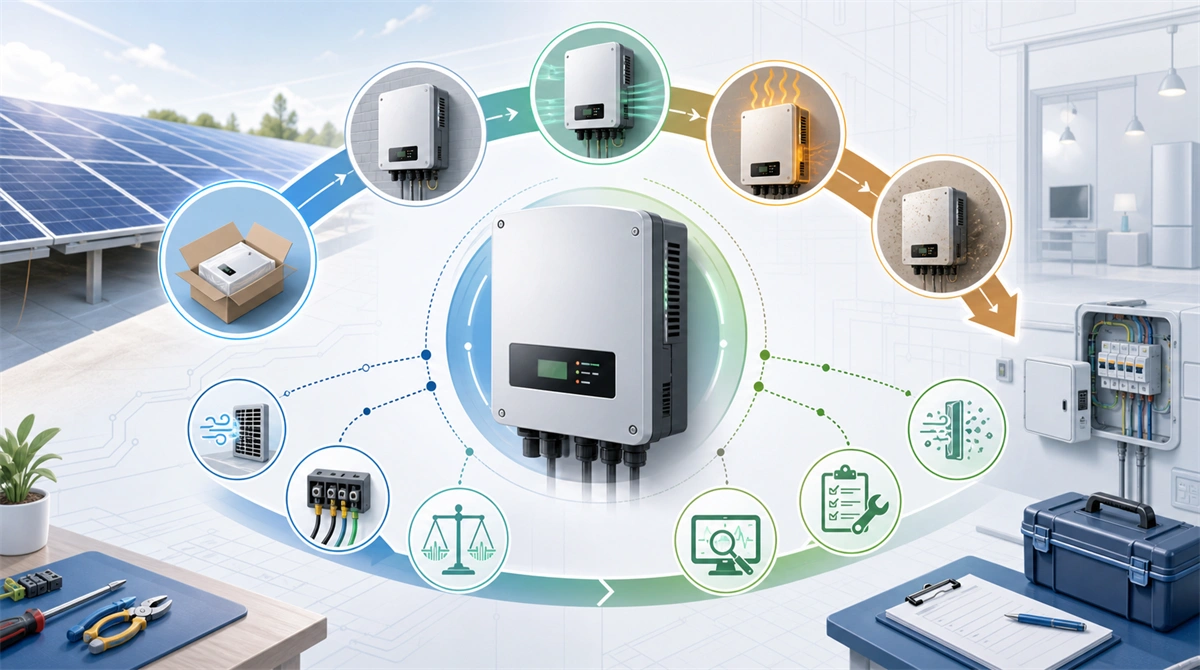
What Is a Realistic Solar Inverter Lifespan?
A practical planning range is about 10–15 years for many inverters, not a universal 25-year promise. The exact result depends on the model and operating conditions. The U.S. Department of Energy has described typical PV power-electronics lifetimes as about 10 years. NREL has also noted that 15 years is a more reasonable life target than 20 years for inverters.
This does not mean every inverter fails on schedule. A well-designed unit in a cool, clean, correctly sized installation can run longer. A unit in a hot metal cabinet, dusty shop, or weak-grid location may need service sooner.
Does Inverter Type Change Expected Service Life?
Type changes the stress profile, but it does not create a fixed lifetime. A buyer should assess product design, installation environment, loading, service access, and warranty support together.
| Inverter type | Typical buyer consideration | Check before buying |
|---|---|---|
| String inverter | Centralized PV conversion | Heat management, PV input limits, service access |
| Hybrid inverter | PV, battery, grid or generator inputs | Battery communication, charge settings, backup-load profile |
| Off-grid inverter | Independent or weak-grid loads | Surge capacity, battery match, spare-parts plan |
| Microinverter | Distributed module conversion | Site access and manufacturer service process |
| Central inverter | Larger C&I or utility system | Maintenance contract and replacement lead time |
For a basic architecture overview, see what an inverter is and how it works.
Which Conditions Shorten Inverter Life?
Heat is one of the most important lifetime risks because it stresses electronic components and fans. NREL field analysis found more inverter failures where residential units were installed on hotter, south-facing exposures.
- Blocked air vents, dust buildup, or direct sun on the enclosure
- Repeated overloads or motor starts beyond the inverter’s surge design
- PV strings designed too close to the maximum input voltage
- Poor cable terminals, undersized conductors, or incorrect grounding
- Battery voltage or BMS communication faults in hybrid systems
- Grid voltage events, lightning exposure, and missing external surge protection
- Moisture ingress or an enclosure rating unsuitable for the location
For enclosure selection, read IP21 vs IP65 inverters. Protection features help, but they do not replace correct system design; see solar inverter protection.
How Can Buyers Extend Inverter Service Life?
Most life-extension work is basic installation discipline and early fault investigation. Distributors should give installers a repeatable checklist rather than relying on a generic “maintenance-free” claim.
| Maintenance area | What to check | Why it matters |
|---|---|---|
| Installation location | Shade, clearance, airflow, no direct water path | Reduces heat and moisture stress |
| Air vents and fans | Dust, obstruction, unusual fan noise | Prevents thermal derating or shutdown |
| DC and AC terminals | Torque to manual, discoloration, corrosion | Finds resistance and heat buildup early |
| PV and battery settings | Voltage range, charge profile, communication status | Avoids operation outside design limits |
| Fault history | Date, code, load, weather, grid condition | Separates root cause from symptom |
| Surge and grounding | SPD status and grounding per design/local code | Reduces external-event damage risk |
Do not open energized equipment or tighten live terminals. A qualified installer should follow the exact model manual and local electrical rules.
What Are the Signs an Inverter Needs Investigation or Replacement?
Repeated fault codes, abnormal shutdowns, overheating, or a sustained production drop justify investigation, but they do not prove the inverter is the cause. Check the PV array, battery, grid supply, cable connections, and load before ordering a replacement.
Escalate for qualified service when you see repeated thermal shutdowns, burning smell, damaged enclosure, persistent isolation or ground faults, fan failure, visible terminal heat damage, or a fault that remains after the manual’s approved restart procedure. Do not keep resetting a recurring fault without recording it.
For symptom-first triage, use solar inverter problems and solutions and how to read a solar inverter display. Our solar inverter maintenance guide gives a distributor-friendly recurring checklist.
Warranty Life Is Not Service Life
A warranty period and expected field life are related, but they are not the same thing. The warranty states the supplier’s remedy conditions. It may exclude installation errors, water ingress, surge damage, unapproved battery settings, or operation outside the manual.
Before placing a B2B order, ask for the exact warranty document, fault-code guide, installation manual, repair route, spare-parts availability, and whether local service training is available. This matters more than a broad lifespan claim.
Conclusion
Solar inverters commonly need replacement before solar modules. Plan around a 10–15-year range, then reduce avoidable stress through correct sizing, ventilation, wiring, protection, and fault logging. The exact model datasheet and warranty remain the final reference.
Techfine works with distributors and OEM/ODM partners on product matching for weak-grid and solar-storage applications. Share your market voltage, typical load profile, battery plan, and service capability to discuss a suitable inverter range.
Sources
- U.S. Department of Energy, Extending Solar Energy System Lifetime with Power Electronics: typical PV power-electronics lifetime about 10 years, accessed July 2026.
- NREL, PV Inverter Reliability Workshop report: inverter lifetimes around 10–12 years discussed in 2024 workshop material.
- NREL, PV Inverter Reliability: power-electronics lifetime and reliability background.
FAQ: Solar Inverter Lifespan
Can a solar inverter last 20 years?
Some inverters may operate beyond 15 years, but a 20-year life should not be assumed for every model or site. Heat, electrical stress, installation quality, grid conditions, and service history change the outcome. Buyers should use the exact model warranty and datasheet for commercial planning, while keeping a replacement or spare-parts strategy for longer projects.
Does a hybrid inverter last less than a string inverter?
Not automatically. A hybrid inverter handles additional battery and backup functions, so battery settings, communication, thermal design, and load profile matter more. A correctly matched hybrid system can operate reliably; a poor battery match or repeated overload can shorten service life. Compare the exact product manuals rather than relying on the category alone.
Does cleaning an inverter extend its life?
Keeping vents clear and checking for dust, corrosion, or unusual fan noise can reduce avoidable thermal stress. Cleaning should follow the model manual and should never involve opening energized equipment. Cleaning cannot correct an undersized inverter, poor wiring, or a defective component.
What should an importer request for after-sales service?
Request the installation manual, fault-code table, warranty terms, repair process, spare-parts list, and service-training material before launch. Also confirm who diagnoses units in the local market and what evidence is required for a warranty claim. These documents matter as much as a quoted lifespan.