
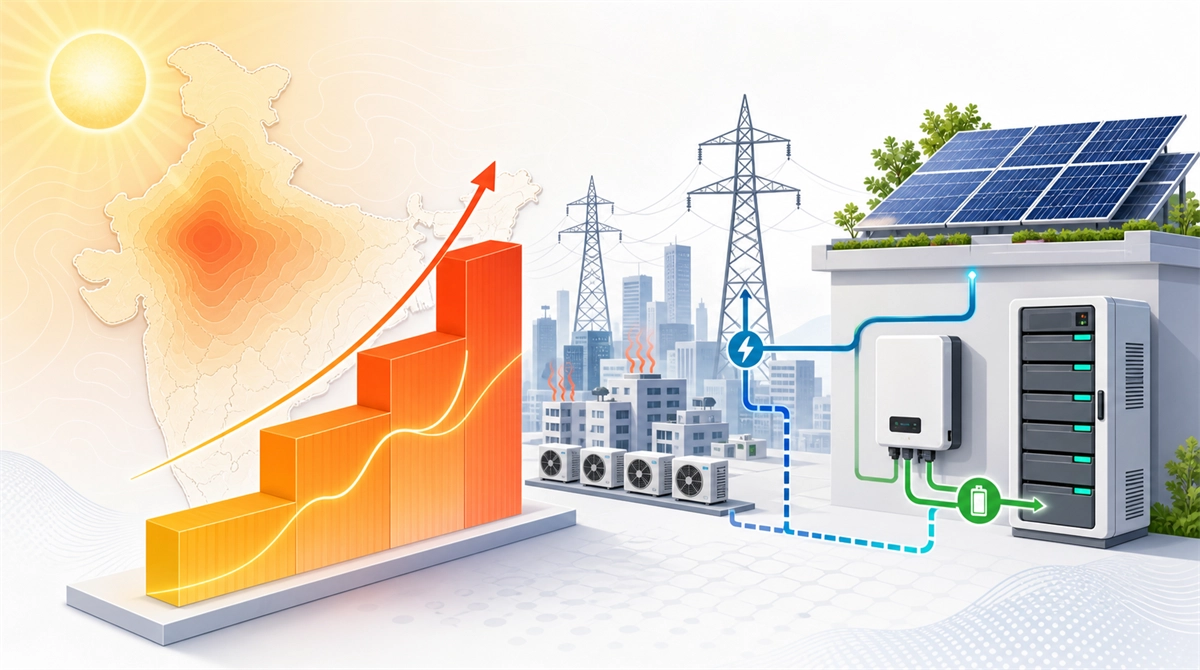
In May 2026, India’s peak power demand reached a record 270.82 GW, the highest level ever recorded, driven by an extreme heatwave with temperatures between 40°C and 47°C. For importers, distributors, and project buyers, this is a clear market signal: power reliability is becoming a stronger buying factor in hot-climate markets, and demand for solar backup and battery storage is rising with it.
This post looks at what the heatwave data actually shows, why it drives solar backup demand, and which product categories importers should prepare for hot-climate markets like India.
Key Takeaways
- India’s peak power demand hit an all-time high of 270.82 GW on 21 May 2026, the 4th consecutive record day (ET EnergyWorld, data-as-of May 2026).
- May 2026 electricity consumption rose about 11.5% year-on-year to 164.98 billion units.
- Heatwave-driven demand strengthens the case for hybrid inverters, off-grid inverters, and LiFePO4 battery storage in hot-climate markets.
- Match products to real loads and grid conditions; do not sell one model for every market.
How High Did India’s Power Demand Go During the 2026 Heatwave?
India’s all-India peak power demand set new records on four consecutive days in May 2026, topping out at 270.82 GW on 21 May. The rise was driven mainly by cooling load during the heatwave.
The official sequence from the Grid Controller of India and the Ministry of Power shows how fast demand climbed:
| Date (May 2026) | Peak power demand | Note |
|---|---|---|
| 19 May | 260.45 GW | First record of the sequence |
| 20 May | 265.44 GW | Second consecutive record |
| 21 May | 270.82 GW | All-time high, 4th straight record day |
India’s electricity consumption rose about 11.5% year-on-year to 164.98 billion units in May 2026, up from a 230.99 GW peak in the same month a year earlier. The demand was met by a coal-dominant generation mix, with grid operators managing the load during solar hours.
For the solar industry, the takeaway is not the weather itself. It is the growing need for reliable household, commercial, and project-level backup power in markets where peak demand now outpaces comfortable grid margins.
Why Do Heatwaves Increase Solar Backup Demand?
During extreme heat, electricity use rises quickly and unevenly, which puts local distribution networks under stress even when national generation is adequate. Cooling equipment runs longer, refrigeration works harder, and water pumps run more often.
When many users increase consumption at the same time, local grids can see voltage fluctuation, short outages, or unstable supply during peak hours. National capacity can be sufficient while a specific feeder or district still fails.
This is where solar inverters and battery storage become more valuable. A well-designed solar backup system stores solar energy during the day and supplies battery power in the evening, during outages, or under unstable grid conditions. In a market that just set a demand record, that value proposition is easier to sell.
What Does This Mean for Solar Product Importers?
Heatwave-driven power stress creates demand across several product categories, but the key is matching the product to the real load and grid condition. Selling one model everywhere leads to poor system matching and higher after-sales pressure.
Hybrid Solar Inverters for Backup Applications
Hybrid solar inverters combine solar input, battery storage, and grid power in one system. In areas with unstable supply, users often prefer a system that supports both self-consumption and backup. These suit residential users, small businesses, rural homes, shops, clinics, and office backup.
Off-Grid Solar Inverters for Weak-Grid Areas
In some regions the problem is not only short outages but weak or unreliable grid access. Off-grid solar inverter systems support users who need independent power for lighting, fans, water pumps, communication equipment, and basic loads. This fits rural markets, island areas, farms, and telecom-related applications.
LiFePO4 Battery Storage for Longer Backup Time
Battery storage matters more when users need power for several hours, not a short emergency. Compared with lead-acid batteries, LiFePO4 batteries offer longer cycle life, lower maintenance, and better suitability for repeated charge-and-discharge. For importers, LiFePO4 storage can be positioned as a higher-value product. For a fuller comparison, see our guide on lead-acid vs lithium-ion batteries.
Which Products Fit Which Application?
The table below maps common Indian-market applications to a starting product direction. Final sizing should always follow a real load calculation.
| Application | Main power challenge | Recommended direction |
|---|---|---|
| Residential homes | Cooling load plus power cuts in hot weather | Hybrid solar inverter + LiFePO4 battery |
| Small shops and offices | Lighting, POS, routers, fans need stable power | Hybrid inverter with battery backup |
| Rural or weak-grid areas | Unstable grid access or frequent outages | Off-grid solar inverter + battery bank |
| Clinics, telecom, security | Essential loads need longer backup time | Solar storage system with LiFePO4 battery |
| Small commercial projects | Reduce grid dependence, improve resilience | Hybrid solar inverter system |
Why Are LiFePO4 Batteries Suited to Hot-Climate Backup?
In hot-climate markets, batteries may need to charge and discharge frequently through the summer, so cycle life matters more than headline price. When outages happen several times a week, or users rely on solar every day, a longer-cycle chemistry lowers the real cost per year.
LiFePO4 batteries handle daily cycling better than lead-acid and hold up under repeated use. For importers, that makes LiFePO4 storage easier to sell as a long-term value product rather than only a low-cost backup option.
When selecting battery products for India or similar hot-climate regions, buyers should check:
- Battery cycle life and warranty terms
- Compatibility with hybrid and off-grid solar inverters
- BMS protection functions (see our guide on what a BMS does)
- Communication support such as CAN or RS485
- Scalable capacity for different backup requirements
- Supplier experience in OEM or ODM projects
How Should Importers Choose Products for Heatwave Markets?
Avoid selecting products only by rated power or price. In heatwave-driven markets, the real decision depends on backup time, battery compatibility, local voltage conditions, and after-sales support.
Before importing solar inverters or batteries, clarify a few points:
- What are the most common household or commercial loads in the local market?
- Do customers need short backup, or several hours of backup power?
- Is the local grid generally stable, weak, or frequently interrupted?
- Will the system be used mainly for self-consumption, backup, or both?
- Does the supplier support OEM branding, documentation, and technical guidance?
These questions help build an accurate product portfolio rather than buying random inverter and battery models that may not fit local demand. If your market is a full country program, our India solar inverter market guide covers brand landscape and selection in more depth.
How Does Techfine Support Solar Importers?
Techfine is a solar inverter and LiFePO4 battery manufacturer supplying importers, wholesalers, distributors, and project buyers. Our range covers hybrid solar inverters, off-grid solar inverters, LiFePO4 storage batteries, and related solar energy solutions.
For hot-climate and weak-grid markets, we can support buyers with:
- Hybrid solar inverters for residential and small commercial backup
- Off-grid solar inverters for weak-grid and independent power
- LiFePO4 battery storage systems for longer backup time
- OEM and ODM cooperation for local brand importers
- Technical support for system matching and product selection
- Bulk order support for wholesale and project-based purchasing
Conclusion
India’s May 2026 heatwave pushed peak power demand to a record 270.82 GW and showed how quickly extreme weather can strain local power systems. For solar importers, the trend points to stronger demand for hybrid inverters, off-grid inverters, and LiFePO4 battery storage.
As more households and businesses look for stable backup power, solar storage is becoming part of energy security in hot-climate markets. Importers who prepare the right product portfolio earlier will be better positioned to serve customers during peak-demand seasons.
If you are sourcing solar inverters or LiFePO4 storage for the Indian market, share your target loads, market voltage, and backup-time requirements, and Techfine can help match suitable products.
Sources
- Ministry of Power / Grid Controller of India — peak demand 270.82 GW on 21 May 2026; 260.45 GW (19 May), 265.44 GW (20 May); May consumption 164.98 BU (+11.5% YoY). Reported by ET EnergyWorld and The Hindu, data-as-of May 2026.
- Heatwave temperature range 40–47°C, May 2026, per Livemint.
FAQ: India Heatwave and Solar Storage Demand
Is a hybrid solar inverter better than an off-grid inverter for unstable-grid areas?
It depends on the application. A hybrid solar inverter is usually better for users who still have grid access and want to combine solar power, battery storage, and grid backup in one system. An off-grid inverter suits weak-grid or no-grid areas where the system must run independently. For importers, hybrid inverters are often easier to promote in urban and suburban markets, while off-grid inverters fit rural, farm, island, or remote applications.
What inverter features should importers prioritize for markets with grid instability?
Prioritize wide input voltage range, battery compatibility, solar charging performance, protection functions, communication support, and parallel capability. In markets with frequent voltage fluctuation or power cuts, stable performance matters more than headline rated power. For project buyers, communication protocols such as CAN or RS485 also matter when matching LiFePO4 batteries.
How can importers avoid choosing the wrong solar storage product for India?
Avoid selecting products only by price or rated power. Segment the market by application: household backup, small commercial backup, rural weak-grid systems, and project-based storage. Each segment may need different inverter power, battery capacity, installation method, and after-sales support. One general model for every market usually leads to poor system matching and higher after-sales pressure.
How can OEM or ODM support help importers in hot-climate markets?
OEM and ODM support lets importers build their own brand, adjust product appearance, prepare localized manuals, and match specifications to local requirements. In competitive markets, selling only standard products can lead to price competition. A customized portfolio helps importers build channel identity and improve long-term customer retention.