
A solar charge controller needs less maintenance than a generator, but it is not maintenance-free. Most controller returns begin with installation, wiring, ventilation, battery-setting, or PV-array problems rather than an internal controller failure. A simple inspection routine helps distributors and installers find these problems earlier.
This guide is a service checklist for MPPT and PWM controller systems. Always use the exact model manual and local electrical rules as the final instruction.
Key Takeaways
- Inspect terminals, cable condition, enclosure ventilation, PV input, battery settings, and fault history on a regular schedule.
- Do not change charging voltages, battery type, or firmware without the exact model manual and battery supplier guidance.
- Record the fault code, load, PV condition, battery voltage, and weather before restarting or returning a unit.
- A controller cannot compensate for an oversized PV string, weak battery, undersized cable, or corroded terminal.
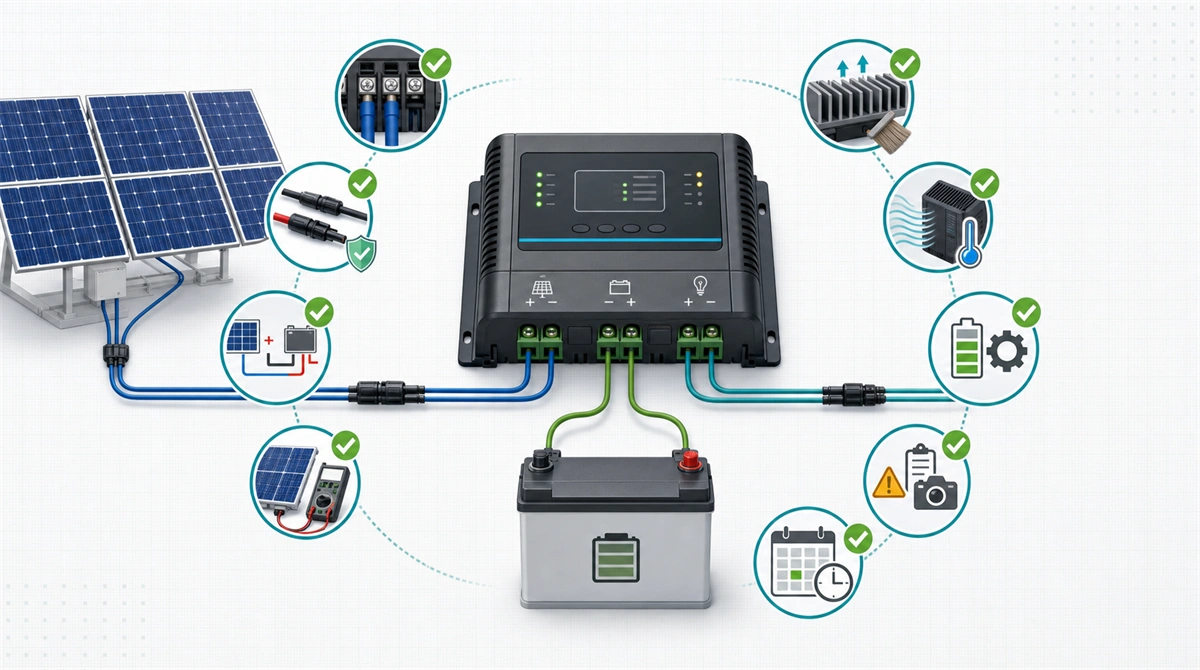
Why Does Solar Charge Controller Maintenance Matter?
The controller manages power between the PV array and battery, so small wiring or setting errors can create charging problems, heat, shutdowns, or premature battery wear. This is especially important in hot, dusty, or weak-grid markets where systems may receive limited service after installation.
Maintenance is not about opening the controller. It is about checking its environment and recording system conditions before a fault becomes a warranty claim.
What Should Be Checked on Each Service Visit?
A useful visit checks the system around the controller, not only the controller display. Disconnect and isolate equipment only as instructed by the exact product manual and local electrical procedure.
| Check area | What to inspect | Why it matters |
|---|---|---|
| Enclosure and location | Dust, direct sun, water path, blocked ventilation | Heat and moisture can cause derating or faults |
| Terminals and cables | Loose screws, discoloration, corrosion, damaged insulation | Resistance creates voltage drop and heat |
| PV input | Array voltage/current within controller limits | Oversized strings can damage the input stage |
| Battery connection | Correct polarity, voltage, cable size, terminal condition | Weak or wrong battery links cause charging errors |
| Charging settings | Battery chemistry, absorption/float settings, temperature sensor if used | Wrong settings shorten battery life |
| Display and logs | Date, fault code, PV voltage, battery voltage, load state | Gives technicians a reproducible fault record |
How Often Should Controllers Be Inspected?
The schedule should match the site environment and service contract. Dusty, hot, coastal, farm, and high-lightning locations may need more attention than clean indoor systems.
- At commissioning: document PV Voc, battery voltage, polarity, settings, cable routing, grounding, and displayed operating status.
- Every 3–6 months: visually inspect enclosure, ventilation, cable condition, and error history.
- After storms, flooding, lightning events, or major grid faults: check for surge damage, water ingress, damaged PV wiring, and recorded faults before restart.
- Before a warranty return: collect photos, settings, fault codes, PV/battery measurements, load details, and installation conditions.
Do not set a universal torque value or cleaning method in a generic checklist. Follow the model manual for both.
Why Are Battery Settings So Important?
The wrong battery profile can damage battery life even when the controller itself appears to work normally. Flooded, AGM, GEL, and lithium batteries do not automatically use the same charge settings.
Confirm the battery chemistry, nominal system voltage, charging limits, temperature-compensation requirement, and any BMS communication before commissioning. For the battery context, read what a lead-acid battery is and AGM vs GEL batteries.
Never copy a setting from a different battery model. For lithium systems, use the battery supplier’s documented charge/discharge limits and the exact controller compatibility instructions.
What Should a Technician Record Before Resetting a Fault?
A reset can erase the evidence needed to identify the real cause. Before restarting, record the displayed error code and the system condition at the time of failure.
- Controller model and firmware version, if the manual exposes it
- Fault code or indicator pattern
- PV voltage and current, battery voltage, and load condition
- Battery chemistry and configured charging profile
- Time, weather, temperature, and whether a grid or generator event occurred
- Photos of wiring, terminals, enclosure, and display
This information makes remote support faster and helps distinguish a controller fault from a PV, battery, wiring, or load problem.
How Does Maintenance Differ for MPPT and PWM Controllers?
The field inspection basics are similar, but the sizing and configuration checks differ. MPPT controllers use a DC-DC conversion stage and are often chosen where array voltage differs from battery voltage. PWM controllers are simpler and are commonly used where panel and battery voltage are closely matched.
For selection context, read MPPT vs PWM solar charge controllers. For array and controller sizing, use how to size an MPPT solar charge controller. A maintenance visit is also a good time to see whether the installed controller is appropriate for the application.
When Should a Controller Be Removed From Service?
Remove the system from service and use a qualified technician when there is heat damage, burning smell, damaged insulation, persistent fault indication, water ingress, or a fault that remains after the approved manual procedure. Do not bypass protection, bridge terminals, or repeatedly reset a fault without diagnosis.
For distributors, clear return evidence and a consistent service form reduce unnecessary returns. When building a product line, compare technical documentation and service support alongside the hardware; see how to choose a solar charge controller and our solar charge controller manufacturer guide.
Conclusion
Solar charge controller maintenance is mainly disciplined inspection: keep the enclosure ventilated, inspect cables and terminals, verify PV and battery settings, and log faults before resetting. This protects the controller, battery, and after-sales margin.
Techfine supports distributors and OEM/ODM partners with product matching and technical documentation. For a controller project, share the PV array, battery chemistry, system voltage, target environment, and expected order volume.
Sources
- U.S. Department of Energy, Solar Integration: Inverters and Grid Services Basics, accessed July 2026 — system integration background.
- Exact wiring, torque, charge setting, firmware, environmental, and protection requirements must follow the specific controller and battery manufacturer manuals.
FAQ: Solar Charge Controller Maintenance
Can I clean a solar charge controller with water?
No. Do not spray water into or onto a controller. Follow the exact manual for cleaning and isolate equipment before performing any approved maintenance. The safe method depends on the enclosure, installation location, and whether the system is energized.
Why does a controller show a battery fault when the battery is new?
A new battery can still have incorrect polarity, loose terminals, a wrong charging profile, an incompatible voltage, or a BMS communication issue. Record the fault code and measure the battery at the controller terminals before assuming the controller has failed.
How often should an MPPT controller be serviced?
There is no one schedule for every site. Commissioning checks are essential, then a 3–6-month visual inspection is a reasonable starting point for many systems. Hot, dusty, coastal, or storm-exposed sites may need more frequent checks. Follow the product manual and service contract.
Can Techfine help distributors prepare a maintenance checklist?
Yes. For an OEM/ODM or distribution project, Techfine can help review the target PV range, battery chemistry, system voltage, field environment, and documentation needs. Final maintenance steps must still match the exact model manual and local electrical requirements.