
Bank sizing produces a figure a buyer can defend in a quotation: a DoD-only baseline of nominal kilowatt-hours. It is the starting number for an order, not the order quantity itself. This guide shows the calculation in five steps — daily load, autonomy days, depth of discharge, bank voltage, module strings — and ends at a preliminary module count, with the arithmetic visible throughout. Before ordering, verify that count against conversion and standby losses and the model’s series/parallel permission. The off-grid and backup-power procurement guide covers bank sizing as part of the larger line-building sequence.
We manufacture the storage side of these systems: the LB, LC, and LR LiFePO4 battery lines of Guangdong Techfine Electronic Co., Ltd. The method itself is chemistry-neutral and applies to any bank, lead-acid included. Every worked example shows its inputs and arithmetic, so you can recompute each result yourself. The shortcut rules many buyers quote from memory — three-times-daily, 20/80 — are restated below with their reference points and definitions.
Key Takeaways
- Size usable energy, not nameplate: daily kWh × autonomy days ÷ usable depth of discharge — one defensible chain to a DoD-only baseline. Measure the daily load, set autonomy days for the climate, and take the usable-depth band from the chemistry — the exact limit comes from the model’s manual.
- The same nominal bank delivers different usable energy by chemistry: the lead-acid convention commonly keeps about 50% in service, LiFePO4 commonly 80–100%.
- Autonomy days are a weather decision. Extended-overcast and monsoon markets commonly need 2–5 days, and a fixed multiplier hides that choice.
- Our LB, LC, and LR lines are rated for 5,000 or more cycles, against a common 3,000–6,000 range for LiFePO4.
- Use the baseline in each quote as kWh and as amp-hours at your chosen voltage. Before ordering, reconcile it against conversion and standby losses and confirm the model’s series/parallel permission.
What Does Battery Bank Sizing Actually Mean?
Bank sizing means sizing usable energy: the kilowatt-hours a bank can deliver across a discharge, which is smaller than its nameplate unless the chemistry tolerates full depletion. Three quantities define the whole method, and a quotation that mixes them cannot be checked.
Nominal kWh is the nameplate at full charge. Usable kWh is what the bank may deliver before reaching its depth-of-discharge limit. Chemistry sets that fraction; step 3 lists the working values. Amp-hours express the same energy against a stated voltage; without that voltage, you cannot tell how much energy the figure represents.
One labeled example makes the unit visible: 100 Ah at 12.8 V is 1.28 kWh of storage, and the same 100 Ah at 48 V is 4.8 kWh. The components guide explains the bank’s role inside the wider system; this page is about the capacity figure itself.
Step 1: Start From a Real Daily Load Number
The bank answers one question: how many dark or overcast days must it power the site on its own? The answer starts with the daily load in kilowatt-hours. Build it as an audit: each appliance’s wattage × running hours, summed across the loads that matter.
The load list comes from your customers: the appliances they run and the hours they run them. An assumed load produces a wrong bank size in one of two directions: inflated loads lead to an oversized bank and an oversized order, and rounded-down loads leave the site short in its worst week. Check the audit line by line, because every later number in the method — the baseline, the amp-hours, the module count — starts from its kilowatt-hours.
The worked example: a small off-grid shop in a monsoon market — lighting, a refrigerator, fans, a television, a phone-charging point — audited at 2 kWh per day. That 2 kWh is a labeled example input. The full array calculation and the critical-load audit for backup design each have their own guide.
Step 2: Set Days of Autonomy for Your Climate
Autonomy days are a weather decision before they are a battery decision: the count of consecutive low-sun days the bank alone must cover. Set it for the worst low-sun season your market faces; the formula converts the days into kilowatt-hours.
The working ranges are design parameters to set per market: buyers in solar-dominant climates commonly choose a single day, mixed climates two, and extended-overcast, monsoon, or harmattan regions 2–5 days.
| Weather regime | Commonly sized autonomy |
|---|---|
| Solar-dominant, long clear seasons | 1 day — the bank carries the night |
| Mixed, occasional overcast | 2 days |
| Extended overcast, monsoon, harmattan | 2–5 days |
The sizing formula, with step 3’s depth input made explicit, is:
nominal bank kWh = daily kWh × autonomy days ÷ usable depth of discharge.
Run the worked example for two monsoon days on a LiFePO4 bank at 80% usable depth: 2 kWh × 2 days ÷ 0.8 = 5 kWh nominal. The same shop on lead-acid at the 50% convention needs 2 × 2 ÷ 0.5 = 8 kWh — the chemistry choice sets the bank size before any brand is compared.
Define the measurement point: the daily-load figure is load-side consumption, and the formula compares it directly with the bank’s usable DC energy after depth of discharge. It excludes inverter conversion losses, battery-side losses, and the standby draw of the inverter and BMS — so the result is a DoD-only baseline, the starting number for an order. Before ordering, verify it against the target inverter’s efficiency, the battery’s energy efficiency, and the system’s self-consumption; the system calculation guide provides the full reconciliation.
The three-times-daily shortcut specifies no reference point: three times daily consumption, read against usable energy, is three days of autonomy; read against lead-acid nameplate, it is a day and a half. Naming the days and the depth makes the number auditable; a bare multiplier hides both.
Step 3: Apply Depth of Discharge by Chemistry
Chemistry sets how much of the bank’s capacity you can use. The lead-acid convention keeps discharge near half of nameplate — commonly about 50% — because repeated deep cycling shortens service life. LiFePO4 banks commonly operate at 80–100% usable depth, with the exact limit set by the model’s battery management system. Same load, same days, different bank size.
Step 2 already showed it: meeting the same 4 kWh usable requirement takes 5 kWh of LiFePO4 nameplate or 8 kWh of lead-acid. The chemistry choice has a second criterion: cycle life. LiFePO4 modules commonly deliver 3,000–6,000 cycles, and our LB-series, LC-series, and LR-series lines are rated at 5,000 or more. Read the cycle rating alongside the warranty period each quotation offers.
The figure below compares both conventions on a single 10 kWh nameplate.
The 20/80 rule’s precise scope is in the FAQ below.
Step 4: Choose Bank Voltage: 12V, 24V, or 48V
Voltage is chosen before amp-hours are counted, because bank voltage fixes the current a given power draws. The relation is I = P ÷ V: at the same power, a 48 V bank draws a quarter of the current of a 12 V bank. The conductors carry that current, and the breakers and the battery management system are rated for it. The power-flow guide calculates that current through the whole system.
Choose the voltage tier from the site’s power demand and its cable runs. At a few hundred watts over short runs, a 12 V bank keeps currents modest and conductors small; larger continuous draws and longer cable runs point to the 48 V tier. The worked example assumes the 24 V tier in between — a project choice from the site’s expected concurrent draw and the inverter platform to be quoted, not an output of the load audit. The 24 V platform guide explains that tier in full.
With voltage chosen, convert energy to amp-hours at a stated reference: Ah = kWh × 1,000 ÷ V. One class note: a 24 V-class LiFePO4 bank sits at a 25.6 V nominal, packaged either as a native 25.6 V module (our LB-series, for example) or as two 12.8 V modules in series where the model permits. The LFP tiers run 12.8, 25.6, and 51.2 V under the 12/24/48 V labels.
The worked requirement of 5 kWh at 25.6 V is therefore 5,000 ÷ 25.6 ≈ 195 Ah. The bank’s operating range must also sit inside the inverter’s stated DC input window — the inverter sizing guide covers that check.
Step 5: From kWh to Modules, Strings, and Order Quantities
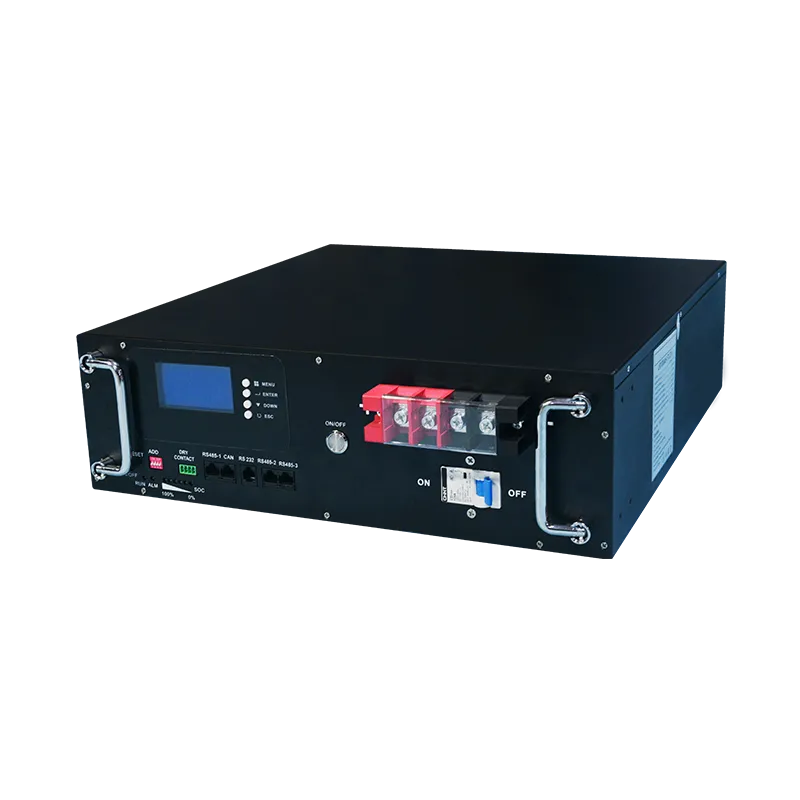
The last step converts kilowatt-hours into a count of modules in series and parallel. You can use that count as a preliminary screen for the order quantity. Module arithmetic works from one datasheet line — here a hypothetical 12.8 V, 100 Ah (1,280 Wh) LiFePO4 module, a size class available in our LP-series 12 V line.
The requirement was 5 kWh nominal. Four modules give 4 × 1.28 = 5.12 kWh, arranged as 2S2P: two modules in series make a 25.6 V string, and two strings in parallel make the bank. That bank is 5.12 kWh nominal and 200 Ah, clearing the 195 Ah requirement with a small margin. Banks ship in whole modules, so the count rounds up. The four-module figure is the preliminary screen the DoD-only baseline produces; the final order quantity comes after the loss and self-consumption reconciliation from step 2 and the model’s series/parallel permission.
Series and parallel permission is model-specific. Whether a module may sit in a series string, how many parallel strings it allows, and the matching criteria its manual specifies all come from the maker’s records for the exact model. To expand an operating bank later, repeat the same check: the maker’s permission plus a health check on the existing modules.
Before ordering: require the battery maker’s written series and parallel permission for the exact model, and the parallel-string limit it states.
The module count is also the starting point for the supply terms. Minimum order quantities on our platforms are confirmed per project and not published. Certificate coverage applies to named models — on our lines, EN IEC 62619 covers the LC230-512 battery (LC-series). For shipment planning, ask the supplier for the packout fields: units per package, package dimensions and gross weight, pallet configuration, and the container type for the shipping route. What the bank adds to a landed system price is covered in the distributor cost guide. The inverter sizing guide determines how much battery a 3,000-watt inverter requires.
The Sizing Reference Table
Read your row. Each cell is the DoD-only baseline in nominal kilowatt-hours; you can re-derive each cell from its row and column — daily load × autonomy days ÷ the chemistry’s usable depth.
| Daily load | Autonomy | Lead-acid baseline (÷ 0.5) | LiFePO4 baseline (÷ 0.8) |
|---|---|---|---|
| 2 kWh | 2 days | 8 kWh | 5 kWh |
| 2 kWh | 3 days | 12 kWh | 7.5 kWh |
| 5 kWh | 2 days | 20 kWh | 12.5 kWh |
| 5 kWh | 3 days | 30 kWh | 18.75 kWh |
| 10 kWh | 2 days | 40 kWh | 25 kWh |
| 10 kWh | 3 days | 60 kWh | 37.5 kWh |
The worked row — 2 kWh, 2 days, LiFePO4 — gives about 417 Ah at 12 V, 208 Ah at 24 V, or 104 Ah at 48 V class voltage. At an LFP string’s actual nominal, the amp-hour figure differs again. The interactive calculator for this method is in the system calculation guide.
FAQ: Battery Bank Sizing
What is the 20/80 rule for batteries?
There is no single standard definition. One reading is a charge-window practice: keep state of charge between roughly 20% and 80%. Another reads the phrase as permission to discharge about 80% of nameplate. For sizing a bank, take the allowable depth of discharge from the model’s manual instead: about half for lead-acid by convention, and commonly 80–100% for LiFePO4, where 80% depth of discharge is the conservative end of the band (LB-series).
How much battery capacity do I need to go off-grid?
Calculate the required nominal capacity as daily kWh × autonomy days ÷ usable depth of discharge — a DoD-only baseline to reconcile against conversion and standby losses before ordering. The worked example’s small shop needs 2 × 2 ÷ 0.8 = 5 kWh of LiFePO4 nameplate, or 8 kWh on lead-acid at the 50% convention. Each input is visible, which is what makes the figure defensible.
How do you calculate the size of a battery bank?
Work through five steps: audit the daily load, set autonomy days for the climate, apply usable depth by chemistry, convert to amp-hours at the bank voltage, round into modules and strings. The core formula produces the DoD-only baseline: nominal kWh = daily kWh × days ÷ usable depth. The worked chain runs 2 kWh × 2 days ÷ 0.8 = 5 kWh, then four 1,280 Wh modules in 2S2P — 5.12 kWh, 200 Ah at 25.6 V. For the full calculation, panels and inverter included, use the system calculation guide.
How many batteries do I need for an off-grid solar system?
Divide and round up: bank kWh ÷ module kWh, then arrange the count in series and parallel as the model permits. In the worked example, the calculation gives four 1,280 Wh modules in 2S2P — 5.12 kWh at 25.6 V — because three modules fall short of the 5 kWh requirement. Order that quantity only after the pre-order loss reconciliation and the model’s series/parallel permission. For the inverter-driven floor — how much battery a 3,000-watt inverter requires — the inverter sizing guide provides the calculation.
The Short Version for Buyers
Start from the actual daily consumption of the appliances, set autonomy days for the worst weather your target market experiences, and apply the allowable depth of discharge for the chemistry. Then choose a bank voltage compatible with the inverter’s DC input window, convert the kilowatt-hours to amp-hours, and round up to whole modules in series and parallel.
The module count is a preliminary figure. Before ordering, verify it against the inverter’s efficiency, the battery’s energy efficiency, and standby draw, and confirm the model’s series/parallel permission. Then give suppliers the requirement in both kilowatt-hours and amp-hours at your voltage, and ask each quotation to show its arithmetic.
If you are specifying a battery line for a market like this, discuss your bank requirements and order quantities with our team. The required capacity in kilowatt-hours, the system voltage, and your expected monthly order volume are enough to start.