
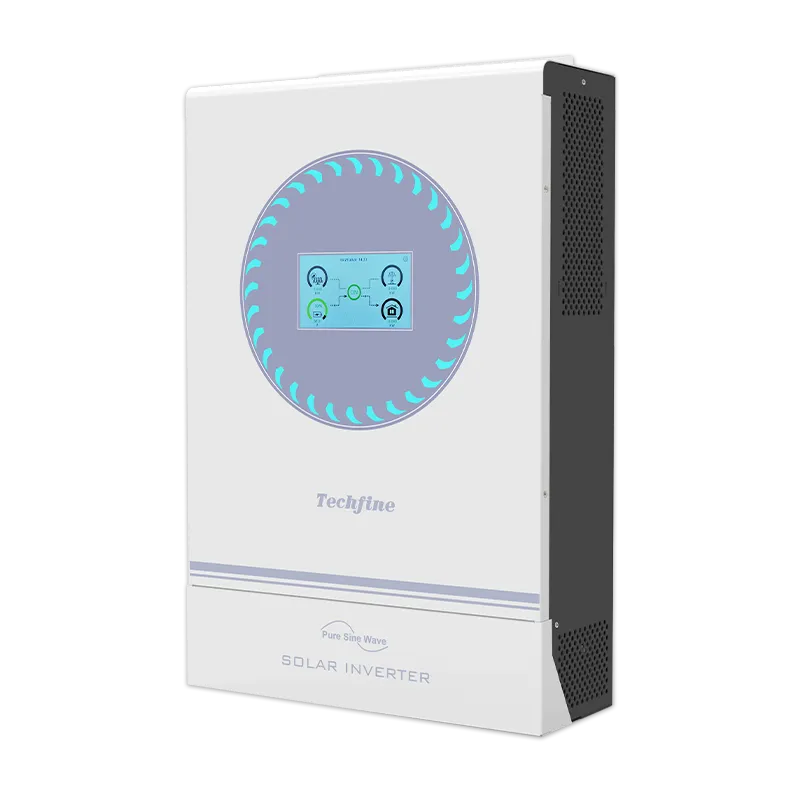
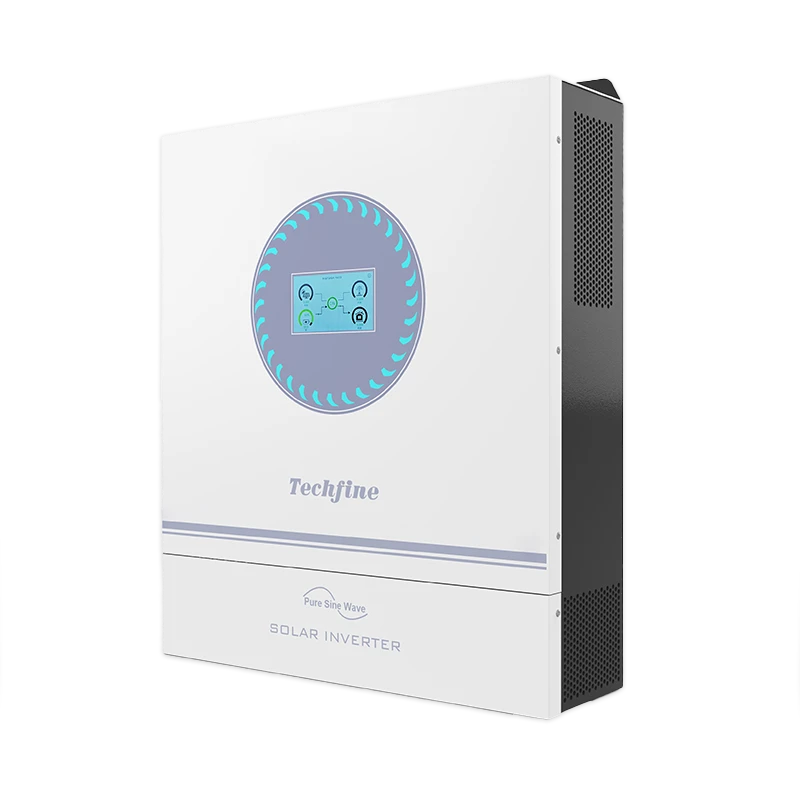
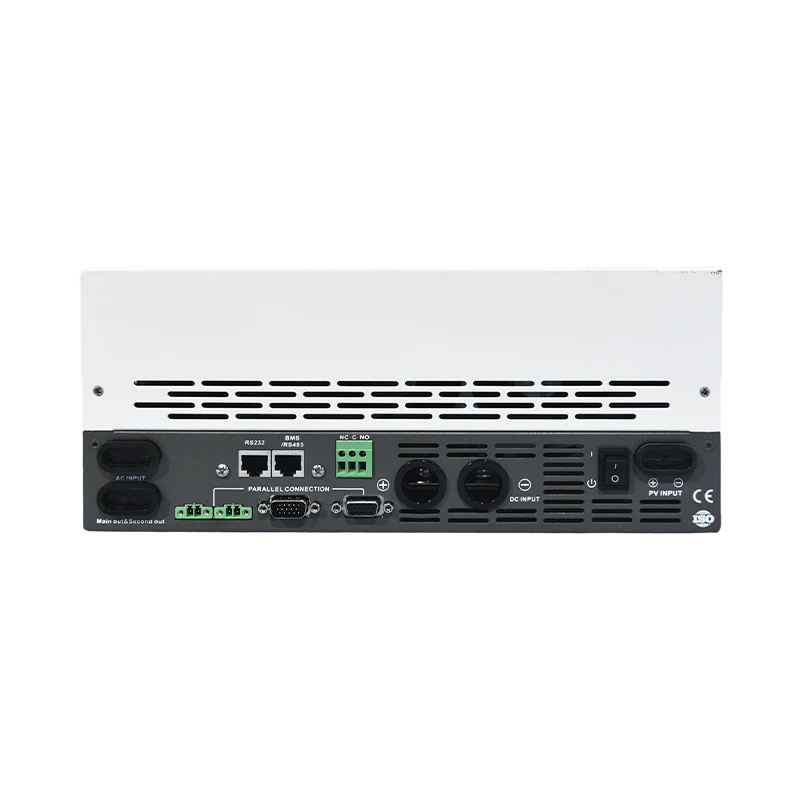
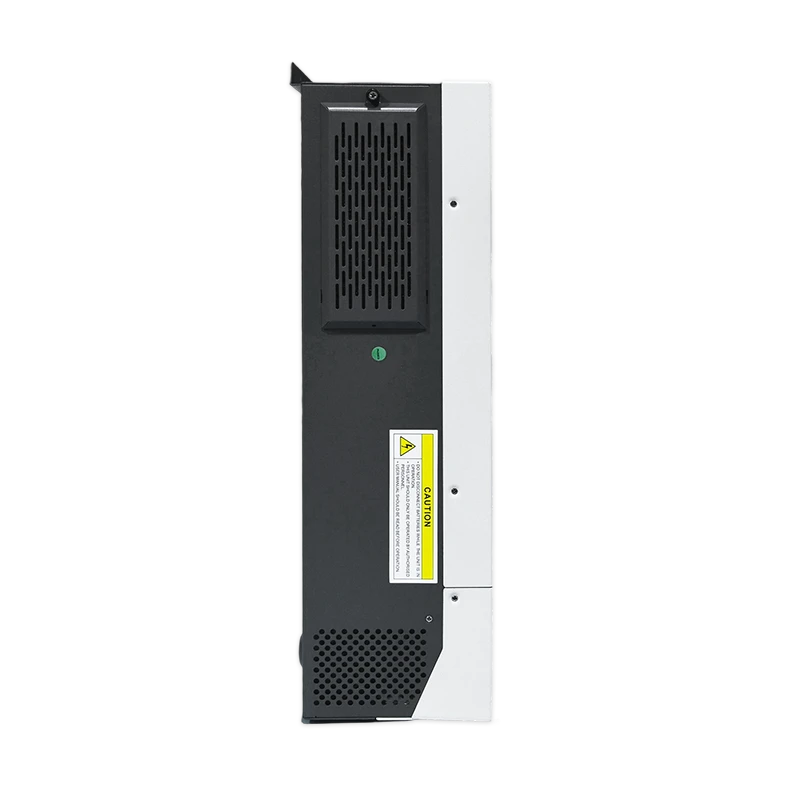
BH-series 4kW–11kW hybrid solar inverter with Touchable Screen Dual AC output | Techfine

BH Ultra · Product gallery

SOLAR + STORAGE · 4–11 kW

BH Ultra
Touchscreen Hybrid Inverter

See your solar system clearly, then put it to work your way. BH Ultra brings energy flow, battery status and load control to a colour touchscreen—with an RGB ring that makes operating status easy to recognise.

Colour touchscreen   ·   RGB status ring   ·   Dual output

Explore 4 models

Select a model to see its ratings below.

6.2kWRated output
48VBattery system
8.5kWMaximum PV input

SYSTEM OVERVIEW

Where the power goes

Use solar to power your loads and charge your battery. Bring in utility or generator support when you need it.

Hybrid inverter system: solar and AC sources feed the inverter, battery storage charges and discharges, and AC power supplies the loads. Hybrid inverter system: solar and AC sources feed the inverter, battery storage charges and discharges, and AC power supplies the loads. BH-series 4kW–11kW hybrid solar inverter with Touchable Screen Dual AC output | Techfine

BH ULTRA

Store energy for later. Charge your battery when power is available, then draw on it during battery-powered operation.

Choose the right capacity. Match your connected loads to the output rating of your chosen BH Ultra model.

BH inverter front panel shown as a product branding reference

Colour touchscreen + RGB status ring

TOUCHSCREEN CONTROL

Follow the energy.
Tap into the detail.

See what is powering your system

Follow solar input, battery activity, utility power and connected loads together. Tap an energy node on the screen to see its operating details.

PV

Solar generation

Battery

Charge and discharge

AC source

Utility input

Loads

Power demand

RGB STATUS RING

Know the state.
At a glance.

A colour cue from across the room. Detailed information when you step closer. The illuminated ring and touchscreen work together to keep you informed.

DC

Blue means battery-powered operation

Recognise DC operation from the blue ring, then use the touchscreen to check battery voltage, SOC and the power your loads are drawing.

The DC indicator uses a blue display with a flashing light.

DUAL OUTPUT

Give essential loads their own circuit

Keep lighting and other essentials on the main output. Put loads that can wait on the second circuit, then choose when they disconnect and reconnect. Every BH Ultra model includes this control.

Set cut-off and recovery conditions on the touchscreen using battery voltage, timing or SOC. SOC control uses a battery with compatible BMS communication.

The main circuit remains powered while the second circuit is paused at its cut-off condition. The main circuit remains powered while the second circuit is paused at its cut-off condition.

The main circuit stays on. The second pauses at your chosen cut-off condition.

Both circuits share the inverter’s total output capacity.

SOLAR INPUT & EXPANSION

Choose the capacity. Leave room to grow.

4 / 6.2 kW

One MPPT, 27 A input

Connect up to 6.5 kW of PV on the 4 kW model, or 8.5 kW on the 6.2 kW model. The battery systems are 24 V and 48 V respectively.

8.6 / 11 kW

Two independent MPPTs

Two solar inputs, each rated at 27 A. The 8.6 kW model accepts 2 × 6.5 kW of PV; the 11 kW model accepts 2 × 7.5 kW.

48 V MODELS

Parallel up to 9 units

Build a larger system with the 6.2, 8.6 or 11 kW parallel models. The 4 kW / 24 V model operates as a single inverter.

THE DETAILS, SIDE BY SIDE

Technical specifications

Compare the four BH Ultra models by rated output, battery voltage, solar input and expansion support.

Scroll sideways to compare all models.

BH-series specifications
SpecificationBH4024SMHBH6248SMHBH8648SMHBH11048SMH
Output
Rated output power4000 W6200 W8600 W11000 W
Output voltage220 / 230 / 240 V AC ±5%220 / 230 / 240 V AC ±5%220 / 230 / 240 V AC ±5%220 / 230 / 240 V AC ±5%
Output frequency50 / 60 Hz ±0.1%50 / 60 Hz ±0.1%50 / 60 Hz ±0.1%50 / 60 Hz ±0.1%
Output waveformPure sine wavePure sine wavePure sine wavePure sine wave
Peak apparent power8000 VA12400 VA17200 VA22000 VA
Transfer time10 ms (computer equipment); 20 ms (household equipment)10 ms (computer equipment); 20 ms (household equipment)10 ms (computer equipment); 20 ms (household equipment)10 ms (computer equipment); 20 ms (household equipment)
Controllable second outputYesYesYesYes
AC input
WiringL + N + PEL + N + PEL + N + PEL + N + PE
Nominal input voltage220 / 230 / 240 V AC220 / 230 / 240 V AC220 / 230 / 240 V AC220 / 230 / 240 V AC
Input voltage range90–280 V AC ±3 V (Normal); 170–280 V AC ±3 V (UPS)90–280 V AC ±3 V (Normal); 170–280 V AC ±3 V (UPS)90–280 V AC ±3 V (Normal); 170–280 V AC ±3 V (UPS)90–280 V AC ±3 V (Normal); 170–280 V AC ±3 V (UPS)
Input frequency50 / 60 Hz (auto-sensing)50 / 60 Hz (auto-sensing)50 / 60 Hz (auto-sensing)50 / 60 Hz (auto-sensing)
Battery & charging
Battery system voltage24 V48 V48 V48 V
Constant charging voltage28.2 V DC56.4 V DC56.4 V DC56.4 V DC
Float charging voltage27 V DC54 V DC54 V DC54 V DC
Maximum solar charging current120 A120 A150 A150 A
Maximum AC charging current100 A100 A150 A150 A
Maximum combined charging current120 A120 A150 A150 A
Solar input
MPPT trackers1122
Maximum PV input power6500 W8500 W13000 W15000 W
PV power per tracker6500 W8500 W2 × 6500 W2 × 7500 W
PV input voltage range60–500 V DC60–500 V DC90–500 V DC90–500 V DC
Maximum PV open-circuit voltage500 V DC500 V DC500 V DC500 V DC
Maximum PV input current27 A27 A27 / 27 A27 / 27 A
Grid operation
Grid output voltage220 / 230 / 240 V AC220 / 230 / 240 V AC220 / 230 / 240 V AC220 / 230 / 240 V AC
Grid voltage range100–280 V AC100–280 V AC100–280 V AC100–280 V AC
Grid frequency range47–53 ±1 Hz / 57–62 ±1 Hz47–53 ±1 Hz / 57–62 ±1 Hz47–53 ±1 Hz / 57–62 ±1 Hz47–53 ±1 Hz / 57–62 ±1 Hz
Power factor>0.99>0.99>0.99>0.99
Maximum DC/AC efficiency98%98%98%98%
Control & expansion
DisplayColour touchscreen + RGB status ringColour touchscreen + RGB status ringColour touchscreen + RGB status ringColour touchscreen + RGB status ring
Battery communicationLithium battery BMS communicationLithium battery BMS communicationLithium battery BMS communicationLithium battery BMS communication
Remote monitoringExternal WiFi module (optional)External WiFi module (optional)External WiFi module (optional)External WiFi module (optional)
Parallel operationNot supportedUp to 9 unitsUp to 9 unitsUp to 9 units
Installation
Dimensions (L × W × H)483 × 313 × 143 mm483 × 313 × 143 mm570.8 × 471 × 148.2 mm570.8 × 471 × 148.2 mm
Operating temperature−10°C to +50°C−10°C to +50°C−10°C to +50°C−10°C to +50°C
Storage temperature−15°C to +60°C−15°C to +60°C−15°C to +60°C−15°C to +60°C
Operating humidityNon-condensingNon-condensingNon-condensingNon-condensing
Noise<50 dB<50 dB<50 dB<50 dB

TAKE A CLOSER LOOK

Product resources

BEFORE YOU CHOOSE

A few useful answers.

What can I see on the touchscreen?

Start with the live power-flow overview, then open the solar, battery, mains or load page for more detail. Solar records cover today, this month, this year and total generation. Connect a compatible lithium battery to view BMS information, including SOC and charging status.

Which models have two MPPT trackers?

BH8648SMH and BH11048SMH have two independent MPPT trackers, each with a 27 A input rating. BH4024SMH and BH6248SMH use one MPPT tracker. Check the PV voltage and power limits for the model you select.

Can I expand the system with more inverters?

The 48 V models—BH6248SMH, BH8648SMH and BH11048SMH—support parallel operation with up to nine units. BH4024SMH is a 24 V standalone model. Choose a matching parallel configuration for the system.

How does the second output manage loads?

Place priority loads on the main circuit and less urgent loads on the second. Set the second output’s cut-off and recovery conditions on the touchscreen. Voltage and timing controls are available directly; SOC control uses compatible battery communication. The two circuits share the total inverter rating.

Do I need WiFi to use the touchscreen?

No. The front touchscreen provides local status, energy records and settings. Add the optional external WiFi module when you want remote monitoring.

Let’s build your energy system.

Tell us about your system and the model you have in mind.

Discuss your project

Leave a message.