
Here’s the decision in one paragraph: if your property has a single-phase grid connection and your solar system is under roughly 10kW, a single-phase inverter is the right choice. If the site has a three-phase supply, runs motors or heavy equipment, or the system will grow past 10kW, choose a three-phase inverter. Everything below is the detail behind that answer: costs, grid rules, and the cases where it isn’t obvious.
Key Takeaways
- The supply decides first: you cannot install a three-phase inverter on a single-phase grid connection.
- Practical cutover is around 8-10kW. Below it, single-phase is cheaper; above it, three-phase avoids current and export-limit problems.
- Many utilities cap solar export per phase (commonly around 5kW). Three-phase spreads generation across three lines.
- Three-phase is not the same as split-phase (120/240V, Americas). Different markets, different hardware.
What’s the Technical Difference?
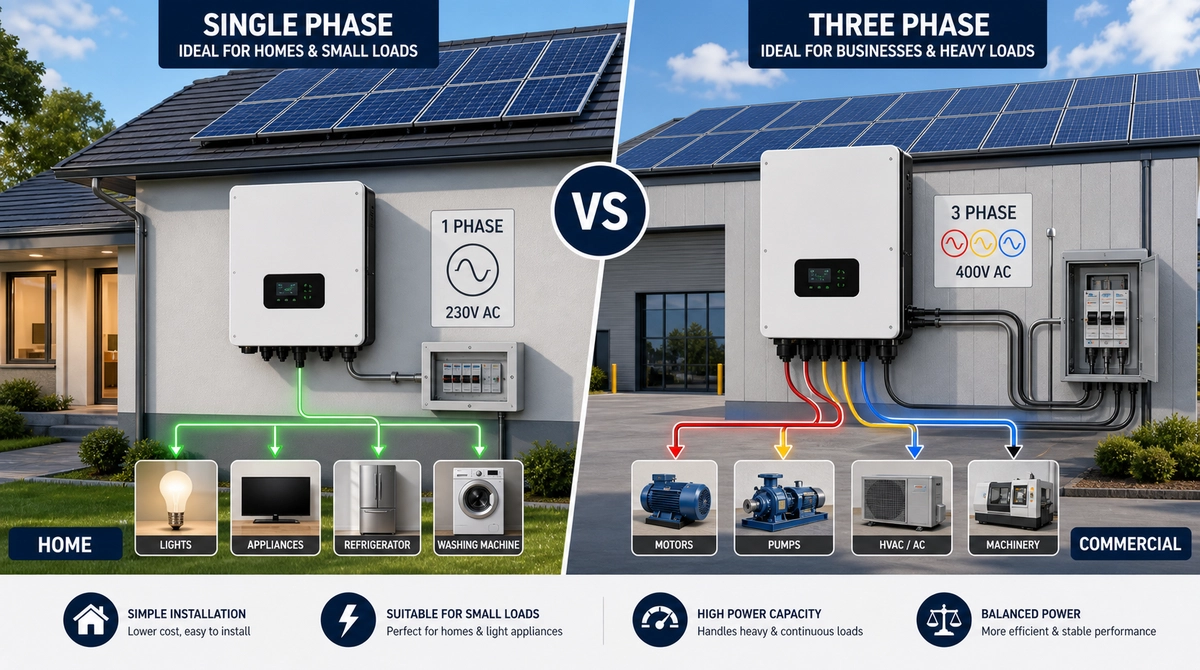
A single-phase inverter produces one AC output waveform, typically 220-240V. A three-phase inverter produces three waveforms spaced 120 degrees apart, typically 380-415V line-to-line at 50Hz. Because the three phases overlap, power delivery is nearly constant, while single-phase power dips to zero 100 times per second and relies on the load not noticing.
For most buyers the physics matters less than the consequences: three-phase moves three times the power at the same current per line, runs industrial motors directly, and keeps large systems inside utility limits. How the six-switch bridge inside actually works is covered in our guide to what a three-phase inverter is.
What Is a Single-Phase Solar Inverter Best For?
Homes, apartments, and small shops with a single-phase grid connection and total solar capacity up to roughly 10kW. That covers the majority of residential systems worldwide.
Why it wins in that range:
- Lower cost. Fewer power stages, simpler electronics, cheaper installation.
- Matches the supply. Most homes only have single-phase service, which settles the question by itself.
- Simpler service. One output circuit to test and one set of spare parts to stock, which distributors appreciate.
The limits show up as systems grow. High power on one phase means high current, thicker cables, and, in many markets, a utility export cap per phase, commonly around 5kW, though the exact figure varies by country and utility. Check local rules before sizing a large single-phase system.
What Is a Three-Phase Solar Inverter Best For?
Commercial and industrial sites, farms with pumps, and any property that already has a three-phase supply or loads above roughly 10kW. In weak-grid markets, three-phase hybrids also carry backup duty for workshops and cold storage, where an outage costs real money.
Its advantages compound at scale:
- Capacity. From 10kW up to megawatt scale without per-phase current problems.
- Motor loads. Pumps, compressors, and machinery need three-phase output; single-phase inverters can’t run them.
- Balanced export. Generation spreads across three lines, which keeps utilities happy and avoids single-phase export caps.
- Voltage stability. Balanced three-phase output reduces voltage rise on any one line, a common grid-connection complaint with large single-phase systems.
The trade-off is price and complexity: a three-phase inverter costs more upfront and needs a three-phase board and professional installation.
Cost, Capacity, and Grid Rules Compared
Below about 8kW, single-phase usually wins on total installed cost; above 10kW, three-phase usually wins on everything else. Between those numbers, the local utility’s export rules often make the decision for you.
| Decision factor | Single-phase | Three-phase |
|---|---|---|
| Grid connection required | Single-phase service | Three-phase service |
| Typical system size | 1-10kW | 10kW-MW scale |
| Motor / machinery loads | Small motors only | Full support |
| Utility export limits | Capped per phase (often ~5kW) | Spread across 3 phases |
| Upfront cost | Lower | Higher (lower per kW at scale) |
| Installation | Simple | Professional, 3-phase board |
| Typical buyer | Homeowner, small shop | C&I site, farm, workshop |
Two edge cases worth naming. A home with a three-phase connection but small loads can still use a single-phase inverter on one phase, subject to export limits and phase-balance rules. And a growing business on single-phase service should price the supply upgrade to three-phase before buying a second single-phase inverter; in our OEM projects the upgrade is often the cheaper path over five years.
Don’t Confuse Three-Phase with Split-Phase
Split-phase is 120/240V dual-hot single-phase, the standard in North America and much of Latin America. It is not a two-phase or three-phase system. If your market runs 120/240V outlets, you need a split-phase inverter, not a three-phase one. The distinction trips up importers regularly, so we’ve covered it separately in single-phase vs split-phase inverters.
For grounding in the basics before you compare further, our overview of what an inverter is covers types and terminology, and complete storage systems pair either inverter type with LiFePO4 battery banks.
FAQ: Single-Phase vs Three-Phase Solar Inverters
Can I install a three-phase inverter on a single-phase supply?
No. The inverter needs all three phases present to connect. If you want three-phase capacity, the utility must upgrade your service first. The reverse works: a single-phase inverter can sit on one phase of a three-phase supply.
At what system size should I switch to three-phase?
Around 8-10kW for most markets. Below that, single-phase is cheaper and simpler. Above it, per-phase current, voltage rise, and utility export caps all start working against single-phase designs. If your utility caps export at 5kW per phase, that number becomes your practical ceiling.
Is a three-phase inverter more efficient?
Peak conversion efficiency is similar between well-made units of either type. The real efficiency argument for three-phase is electrical: lower current per line means lower cable losses on big systems, and balanced output avoids voltage-rise curtailment, which costs more energy in practice than a decimal of inverter efficiency.
Do three-phase inverters work during power cuts?
Grid-tie models shut down in an outage. Hybrid three-phase models with batteries keep supplying loads, which is why they’re the default for workshops and clinics in load-shedding markets. Specify the unbalanced-output rating if your backup loads sit mostly on one phase.
Which one do I need for a 120/240V market?
Neither, strictly speaking: 120/240V markets use split-phase inverters. Three-phase applies there only to commercial sites with 208V or 480V three-phase service. See our split-phase comparison for the details.
Conclusion
The supply type decides first, the system size decides second, and the utility’s export rules break the ties. Single-phase inverters remain the right answer for most homes; three-phase earns its extra cost as soon as motors, scale, or export caps enter the picture.
Techfine builds both: single-phase hybrids for residential backup markets and three-phase hybrid inverters for C&I projects. If you’re putting together a product mix for your market, send us your grid voltage, typical system sizes, and monthly volume and we’ll suggest a lineup.