
The best solar inverter for home use is not the brand with the loudest ranking. It is the inverter type that matches the home’s grid stability, battery plan, load profile, voltage, and backup expectation. A stable-grid home may only need a grid-tie inverter. A weak-grid home usually needs hybrid or off-grid backup.
For distributors, this search topic is also a product-line question. The right residential inverter mix depends on whether your market has frequent outages, 110/120Vac loads, 220/230Vac loads, split-phase homes, battery demand, or price-sensitive off-grid buyers.
Key Takeaways
- DOE explains that inverters convert DC electricity from solar panels or batteries into AC electricity for loads and grid use (DOE, data-as-of 2026).
- Choose grid-tie for stable-grid savings, hybrid for grid plus battery backup, and off-grid for battery-first systems.
- Home inverter sizing must check both running watts and surge watts.
- Unsupported Top 10 model rankings are less useful than a clear selection tree.
What Type of Solar Inverter Is Best for Home Use?
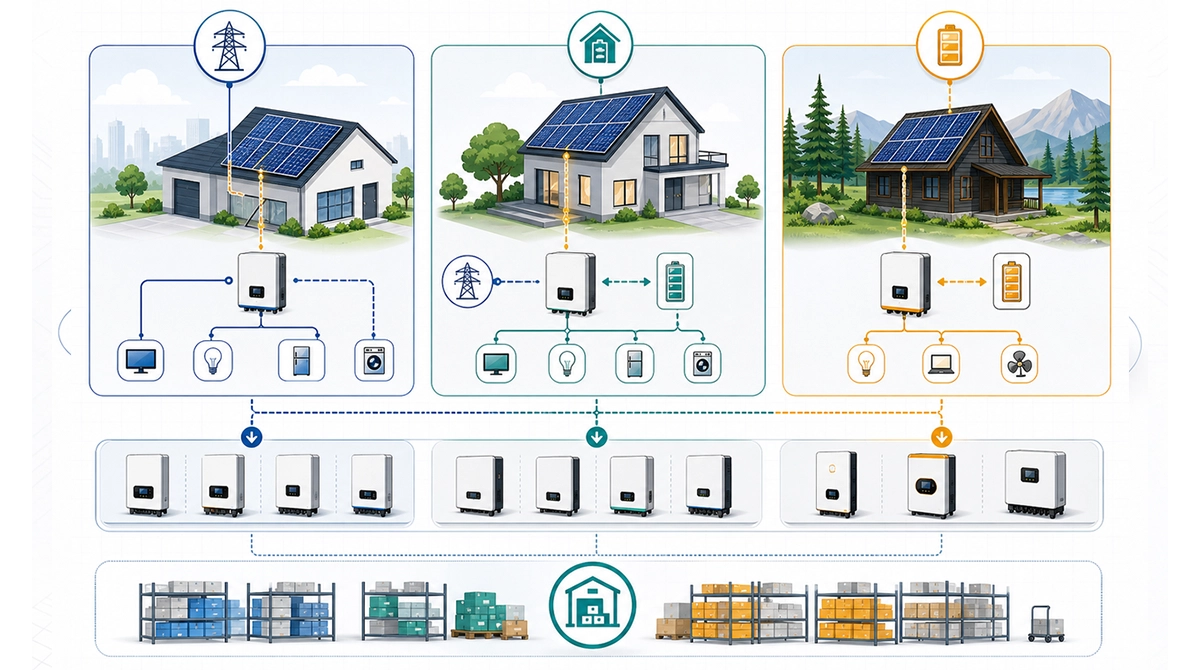
For most homes, the best inverter type depends on whether the home needs battery backup during outages. If outages are rare and the homeowner only wants lower electricity bills, a grid-tie inverter may fit. If outages are common, hybrid or off-grid models deserve priority.
| Home condition | Better inverter type | Why |
|---|---|---|
| Stable grid, no battery | Grid-tie inverter | Lower system cost and simple solar export/self-use |
| Stable grid, wants battery | Hybrid inverter | Solar, grid, and battery in one control path |
| Frequent outages | Hybrid inverter | Keeps selected loads running from battery |
| No reliable grid | Off-grid inverter | Battery-first operation |
| Small weak-grid home | Off-grid or hybrid | Depends on budget and backup requirement |
| Distributor residential line | Mix of off-grid + hybrid | Covers price and backup segments |
Energy.gov’s homeowner guide notes that solar can be paired with storage to use electricity later or during outages (Energy.gov, data-as-of 2026). That storage decision is the main fork in the inverter choice.
When Should a Home Use a Grid-Tie Inverter?
A grid-tie inverter fits homes with reliable utility power and no battery-backup requirement. It converts solar DC power into AC power for home use and grid interaction, but standard grid-tie systems usually shut down during outages for safety unless special backup equipment is installed.
Grid-tie is often the lowest-cost residential path when the local policy allows export, net billing, or self-consumption. It is not the strongest fit for weak-grid markets where customers mainly buy solar because power cuts are common.
For B2B buyers, grid-tie models can be a good category when utility rules are clear and installers know the interconnection process. If grid rules are uncertain, avoid promising export income in the article or sales material.
When Is a Hybrid Inverter Better for Home Use?
A hybrid inverter is better when the home wants solar, grid input, and battery backup in one system. It can charge batteries from solar or grid power, then supply selected loads during outages when the system is designed correctly.
Hybrid inverters are usually the strongest residential category for weak-grid markets. They let distributors sell a backup story without forcing every customer into a fully off-grid lifestyle. They also create natural add-on demand for LiFePO4 batteries, monitoring, and installation accessories.
Before stocking hybrid models, check battery voltage, battery-communication support, PV input range, output voltage, surge rating, and local service capability. For the technical difference, see our hybrid inverter vs grid-tie inverter guide.
When Should a Home Use an Off-Grid Inverter?
An off-grid inverter fits homes where the utility grid is unavailable, unreliable, or not the main power source. It is battery-first equipment, so the design must include battery capacity, PV charging, load management, and sometimes generator input.
Off-grid inverters are common in rural homes, farms, islands, telecom rooms, and areas with long outages. They can be lower cost than full hybrid systems, but the buyer must understand battery sizing and load limits.
This is where many home users overload the system. They buy an inverter by the printed watt rating, then connect pumps, refrigerators, and air conditioners with high surge current. Use our solar panel, battery, and inverter sizing guide before quoting a system.
How Do You Size a Home Solar Inverter?
A home solar inverter should be sized by simultaneous running load, startup surge, battery voltage, and future expansion margin. Do not size only from daily kWh. Daily energy tells you battery and solar-panel needs; peak watts tell you inverter size.
Use this practical sequence:
- List loads that may run at the same time.
- Add their running watts.
- Identify surge loads such as pumps, refrigerators, and air conditioners.
- Choose inverter continuous power above the running load.
- Check surge rating against the largest motor starts.
- Match battery voltage and battery discharge current.
- Leave margin for future loads.
For smaller DC battery systems, also read our 24V solar inverter setup guide. The battery voltage decision affects cable size, current, inverter choice, and installation cost.
What Should Distributors Stock for Residential Markets?
Distributors should stock by use case, not by one universal “best home inverter.” In weak-grid markets, a practical residential mix often includes entry off-grid models, hybrid inverter models, matching LiFePO4 batteries, and a small number of higher-output options for larger homes.
| Buyer segment | Suggested product lane | Stocking note |
|---|---|---|
| Price-sensitive backup | Off-grid inverter + lead-acid/LFP options | Keep setup simple and documented |
| Better weak-grid home | Hybrid inverter + LFP battery | Stronger backup story |
| Stable-grid solar home | Grid-tie or hybrid | Depends on local export rules |
| Larger residence | Higher-output hybrid/off-grid | Check surge and AC voltage |
| Americas-style market | Split-phase options where needed | Do not confuse with three-phase |
If you sell in Pakistan, India, Nigeria, Latin America, or similar weak-grid regions, local voltage and outage behavior matter more than a global ranking table. Market articles such as our Pakistan inverter landscape are useful examples, but this home-use guide should remain a selection guide.
FAQ: Solar Inverter for Home Use
Which inverter is best for a home with power outages?
A hybrid inverter or off-grid inverter is usually better than a standard grid-tie inverter when outages are common. The right choice depends on battery capacity, load size, surge demand, and whether the home still wants to use grid power when available.
Can a grid-tie inverter run during a blackout?
A standard grid-tie inverter usually shuts down during a blackout for safety unless the system includes approved backup architecture. Do not promise outage backup from a basic grid-tie system. If backup matters, compare hybrid and off-grid designs.
What size inverter does a home need?
Add the appliances that may run at the same time, then check surge loads. A home with lights and electronics may need far less surge capacity than a home with pumps, refrigerators, and air conditioners. Daily kWh sizes the battery and PV; peak watts size the inverter.
Should home buyers choose off-grid or hybrid?
Choose off-grid when there is no reliable utility grid or the system is battery-first. Choose hybrid when the home wants solar, grid input, and battery backup together. Hybrid systems can be more flexible, but they need correct battery matching and setup.
How can Techfine support home inverter distributors?
Techfine works with distributors and OEM/ODM partners on residential inverter and battery product matching. Share your market voltage, common outage length, target power range, battery preference, and monthly quantity so the product mix fits local conditions.