

An on-grid solar inverter works with the utility grid to reduce electricity bills. An off-grid solar inverter works with batteries to power loads when the grid is unavailable. If your market has frequent outages, that difference is more important than the inverter price.
For B2B buyers, the decision is not only technical. It affects battery stock, installer training, after-sales support, and which customer problems your product line can solve.
Key Takeaways
- On-grid inverters are best for stable-grid sites where bill reduction and grid export are the goal.
- Off-grid inverters are best for backup, remote sites, and weak-grid markets that need battery power.
- The U.S. DOE notes that battery storage lets solar users save energy for later, including when power goes out (Energy.gov, data-as-of 2026).
- Hybrid inverters sit between the two: they can use solar, battery, and grid in one system.
What Is an On-Grid Solar Inverter?
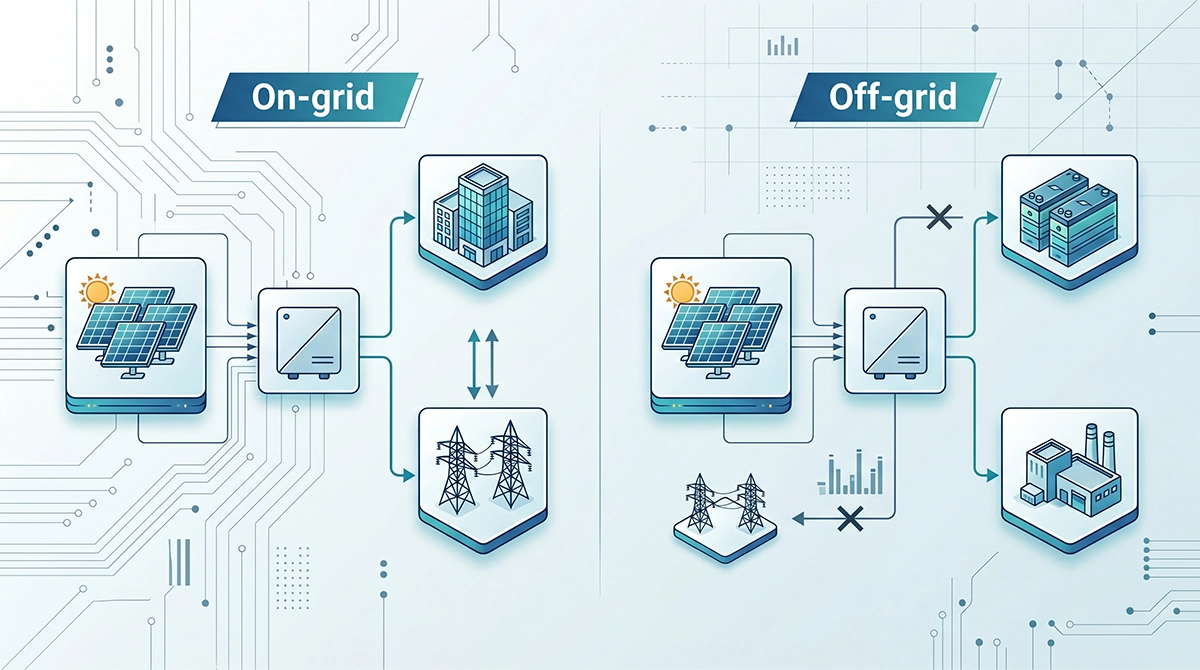
An on-grid solar inverter, also called a grid-tie inverter, converts solar DC into AC that synchronizes with the utility grid. It is designed for grid-connected systems where solar power serves local loads first and exports excess power if local rules allow.
On-grid inverters are common in residential rooftops, commercial buildings, and grid-connected PV plants. They are usually lower-cost than battery-based systems because the battery bank is not part of the standard setup.
The limit is outage behavior. A standard on-grid inverter is not a backup inverter. In most grid-tied systems, it stops supplying power during a grid outage for safety and grid-protection reasons. If customers expect backup power, do not sell a standard on-grid inverter as the answer.
What Is an Off-Grid Solar Inverter?
An off-grid solar inverter powers loads without relying on the utility grid, usually by using batteries charged from solar panels, utility input, or a generator. It is the better fit for remote sites and unstable-grid areas.
In an off-grid system, solar panels charge a battery bank through an internal or external charge controller. The inverter then converts stored battery DC power into AC for appliances, pumps, lighting, telecom equipment, or small commercial loads.
This is why off-grid inverters are common in weak-grid markets across Africa, South Asia, the Middle East, and parts of Latin America. Buyers are not only trying to reduce bills. They need power when the grid is absent or unreliable.
On-Grid vs Off-Grid Solar Inverter: Key Differences
The main difference is grid dependence: on-grid needs the grid; off-grid can keep running from batteries. The cost difference mostly comes from the battery bank and system sizing work.
| Decision point | On-grid inverter | Off-grid inverter |
|---|---|---|
| Grid connection | Required | Optional or absent |
| Battery need | Usually none | Usually required |
| Outage behavior | No standard backup | Can power loads from battery |
| Main goal | Bill reduction, export where allowed | Backup and independence |
| System cost | Lower upfront | Higher due to batteries |
| Sizing focus | PV output and grid rules | Loads, surge, battery autonomy |
| Best market | Stable-grid areas | Weak-grid or remote areas |
If you need both grid interaction and battery backup, compare a hybrid inverter vs grid-tie inverter. A hybrid inverter often solves the gap between these two categories.
Which One Fits Weak-Grid Markets?
In weak-grid markets, off-grid or hybrid systems usually fit better because customers care about backup hours, not only solar export. A low-cost grid-tie system can disappoint if the customer expected power during load-shedding.
Ask these questions before choosing:
- Does the customer need power during outages?
- Is net metering or grid export allowed and actually paid?
- How many outage hours happen per week?
- Are the main loads lights, fans, pumps, refrigerators, or motors?
- Does the site need generator input?
- Is the customer willing to maintain or replace batteries?
- Does the local installer understand battery sizing?
For importers, these answers shape inventory. A market with stable grid and strong net metering may need more on-grid models. A market with frequent load-shedding needs hybrid and off-grid solar inverter lines, plus matched batteries.
Where Does a Hybrid Inverter Fit?
A hybrid inverter combines solar, battery, and grid functions, so it can reduce bills while also providing backup power. It is often the practical middle choice when buyers want both savings and outage protection.
Hybrid systems still need careful sizing. The inverter must support the battery voltage and communication protocol. The battery must be large enough for the required backup hours. Critical loads may need a separate backup output or transfer arrangement, depending on the model.
For distributors, hybrid systems can increase average order value, but they also require better pre-sales questions. Ask about load type, surge load, grid voltage, battery chemistry, and desired backup time before quoting.
How Should You Choose?
Start with grid reliability, then battery need, then budget. That order prevents the common mistake of buying the cheapest inverter and discovering later that it cannot solve the outage problem.
| Buyer situation | Recommended direction | Reason |
|---|---|---|
| Stable grid, high daytime use, net metering allowed | On-grid | Lower cost and bill reduction |
| Remote site with no grid | Off-grid | Battery-based independent power |
| Frequent outages and solar savings needed | Hybrid | Combines grid, solar, and battery |
| Small backup loads only | Off-grid or hybrid | Size battery for essential loads |
| C&I site with motors and outage cost | Hybrid or engineered off-grid | Surge and autonomy need design |
If your buyer is choosing between system packages, link this decision to the product line. See Techfine’s hybrid solar inverter category and off-grid inverter category for the two main backup-oriented directions.
FAQ: On-Grid vs Off-Grid Solar Inverters
Can an on-grid inverter work during a power outage?
A standard on-grid inverter normally does not provide backup during a grid outage. It is built to synchronize with the utility grid. If backup power is needed, the system needs battery storage and the correct hybrid, backup, or off-grid configuration.
Is an off-grid inverter always better than an on-grid inverter?
No. Off-grid inverters are better for backup and remote power, but they cost more because batteries and sizing work are required. In stable-grid areas with useful net metering, an on-grid inverter can be the more economical choice.
Do off-grid inverters need batteries?
Most off-grid systems need batteries because the inverter must supply power when solar input is low or absent. Some systems can use generator or utility input as support, but the battery bank is usually the heart of an off-grid design.
What is the difference between off-grid and hybrid inverter?
An off-grid inverter is designed mainly for standalone battery-based power. A hybrid inverter can combine solar, battery, and grid functions. In many weak-grid markets, hybrid is preferred when customers want both grid charging and battery backup.
Which inverter should distributors stock first?
Stock depends on local grid reliability. In stable-grid markets, on-grid models may move faster. In load-shedding markets, hybrid and off-grid models usually fit buyer demand better. Ask installers what customers complain about most: high bills or no power.
A Note on Techfine
Techfine focuses on hybrid and off-grid inverter systems for weak-grid and backup markets. If you are building a product mix for import, share your market voltage, common outage length, battery preference, and monthly quantity. We can help match inverter categories to real site conditions.