
Most solar inverter problems can be narrowed down by symptom: no display, no AC output, breaker trips, overheating, PV input fault, battery fault, communication fault, or monitoring failure. Start with safe external checks first. Do not open live equipment or bypass protection devices.
For distributors and installers, a troubleshooting article should reduce service calls, not encourage unsafe repair. This guide separates what the user can check from what needs a qualified technician.
Key Takeaways
- Check the display, breaker, battery, PV input, ventilation, and error code before replacing the inverter.
- DOE notes that inverters do more than DC-to-AC conversion; they can also monitor and communicate system status (U.S. DOE, data-as-of 2026).
- Breaker trips, ground faults, and internal faults need qualified electrical inspection.
- For recurring faults, record the code, load, battery voltage, and site conditions before contacting support.
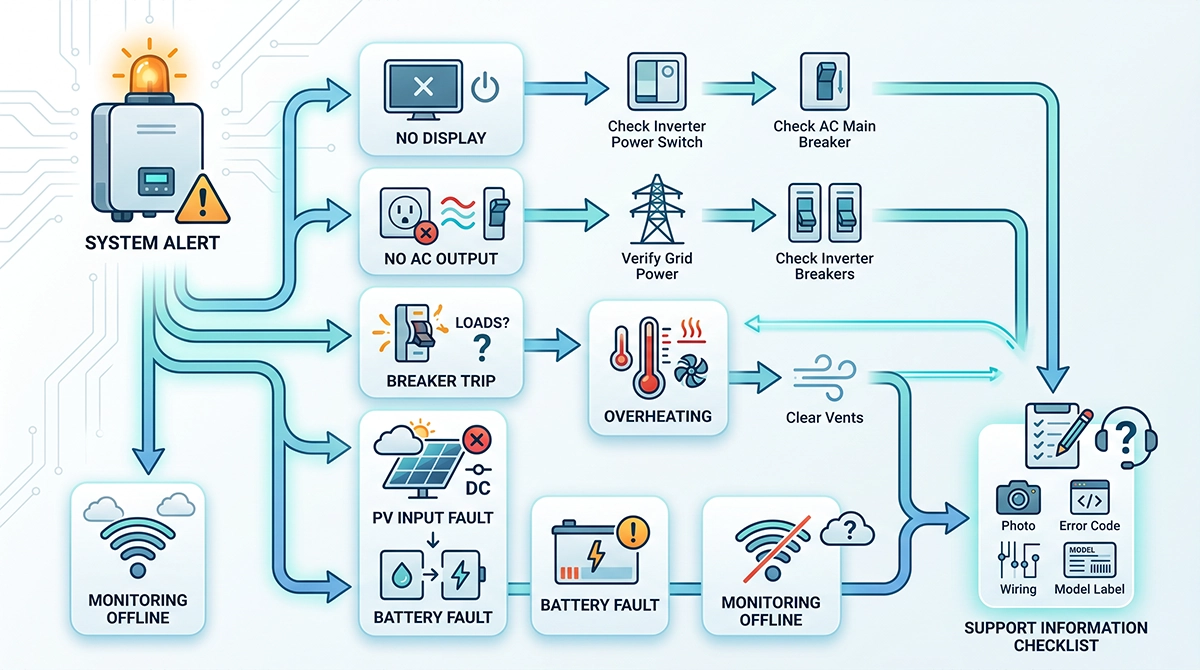
Start With the Symptom, Not the Guess
A solar inverter fault should be diagnosed from the visible symptom first, then narrowed by power source, load, wiring, battery, and environment. Guessing from one warning light often wastes time.
| Symptom | Likely causes | Safe first checks | Call a technician when |
|---|---|---|---|
| No display | DC breaker off, battery low, internal fuse, wiring fault | Check DC/AC breakers, battery voltage, display cable | Breakers trip again or no input voltage is present |
| No AC output | Overload, output breaker, inverter fault | Reduce loads, check output breaker, read error code | Output stays dead after reset |
| Breaker trips | Overload, short circuit, leakage, wrong breaker | Disconnect non-essential loads | Trip repeats or burning smell appears |
| Overheating | Blocked airflow, high ambient heat, fan fault | Clean vents, improve shade, reduce load | Fan fails or temperature fault repeats |
| PV input fault | Low PV voltage, wrong polarity, loose connector | Check array isolator and visible connectors | DC voltage testing is needed |
| Battery/BMS fault | Low battery, communication loss, wrong protocol | Check battery SOC and communication cable | BMS alarm or battery voltage is abnormal |
| Wi-Fi fault | Weak signal, wrong app, router setting | Move router closer, reset monitoring module | Power production is normal but app stays offline |
One note: if the inverter smells burnt, makes unusual noise, or has visible heat damage, stop using it and isolate the system safely.
Why Did the Solar Inverter Stop Working?
A solar inverter that stops working usually lost one of three things: DC input, AC output path, or internal operating permission from its protection system. The display or fault code tells you which direction to check.
First, look at the display. If it is blank, check whether the battery or PV input is supplying enough DC voltage. If the display is on but no AC output is present, check output breakers, load level, and overload warnings. If an error code appears, record it before resetting.
Our solar inverter display guide explains the common screen values and warning areas. If your model has a specific fault-code table, follow that manual over any generic advice.
Why Is There No AC Output?
No AC output usually points to overload, low battery voltage, output breaker trip, inverter protection mode, or an internal fault. The safest check is to reduce the load and restart according to the manual.
Try these steps:
- Turn off large loads such as pumps, compressors, kettles, and air conditioners.
- Check whether the output breaker or load breaker has tripped.
- Confirm battery voltage or SOC is above the inverter’s low-voltage cutoff.
- Check whether the display shows overload, short-circuit, or bypass mode.
- Reset only once according to the manual.
If AC output fails again, stop. Repeated restarting can worsen a wiring or internal fault.
Why Does the Inverter Trip the Breaker?
Breaker trips are not a nuisance to ignore; they usually mean overload, short circuit, leakage current, wrong breaker sizing, or grid-side voltage issues. Do not tape, bypass, or oversize a breaker to “solve” the problem.
For first checks, remove non-essential loads and see whether the trip stops. If it only happens when a motor starts, the inverter may not have enough surge capacity. If it trips with no load, suspect wiring, grounding, leakage, or internal damage.
In weak-grid markets, voltage spikes and unstable utility input can also trigger protection. That is a system-design issue, not just an inverter issue. For installation basics, see how to set up a reliable 24V solar inverter system and how to properly set up an inverter connection.
What Causes Overheating or Fan Faults?
Overheating usually comes from blocked airflow, high ambient temperature, dust, overload, or fan failure. In hot markets, a shaded and ventilated installation can matter as much as the inverter rating.
Check for dust on vents and heat sinks. Leave the clearance required by the manual. Keep the inverter out of direct sun where possible. If the inverter is inside a cabinet, make sure the cabinet itself has ventilation and enough space for heat to leave.
A fan fault is different from normal heat. If the fan does not start when the inverter is hot, or if the fan is noisy or jammed, the unit needs service. See our solar inverter maintenance tips for a preventive schedule.
What Do PV Input and Battery Faults Mean?
PV input faults point to the solar side; battery faults point to storage voltage, BMS communication, charge settings, or cable connection. Treat them as separate circuits.
For PV input, check only visible and safe items: array isolator position, obvious connector damage, shading, and whether the fault appears only at certain times of day. DC voltage testing should be done by a qualified technician.
For battery faults, check SOC, breaker position, communication cable, and whether the inverter battery type is set correctly. Lithium batteries need compatible charging and BMS protection. If the battery alarm stays active, do not force charge it.
Why Is the Wi-Fi or Monitoring Offline?
A Wi-Fi fault does not always mean the inverter stopped producing power. Monitoring can be offline while the inverter still runs normally.
Check signal strength first. Many inverters are installed in utility rooms, metal cabinets, or thick-wall buildings where Wi-Fi is weak. Move the router closer, use a repeater, or reconnect the monitoring module according to the app instructions. Also check whether the router uses a supported band and password format.
For step-by-step app and router checks, use our solar inverter Wi-Fi connection guide. Keep screenshots of the app error if you need supplier support.
What Information Should You Send to Support?
Good support starts with clear fault data. Before contacting a supplier, record the facts that help engineers separate product failure from installation or load mismatch.
Send:
- Inverter model and serial number.
- Battery model, voltage, and SOC.
- PV array voltage and configuration if available.
- Load list and estimated wattage.
- Error code or display photo.
- Breaker trip timing.
- Ambient temperature and installation location.
- Recent changes: new load, new battery, wiring work, firmware update.
For OEM/ODM distributors, this record is also useful for warranty screening. It shows whether the fault is one unit, one batch, or one installation pattern.
FAQ: Solar Inverter Problems and Solutions
Can I reset a solar inverter myself?
You can follow the reset procedure in the user manual if there is no burning smell, no visible damage, and no repeated breaker trip. Reset once after removing heavy loads. If the same fault returns, stop and call a qualified technician or supplier support.
Why does my inverter beep at night?
Night beeping often means low battery, overload, fan/temperature warning, or a stored fault code. Check the display first, then battery SOC and connected loads. If the sound repeats with normal battery voltage and light load, record the code and ask support.
Is a Wi-Fi problem the same as an inverter fault?
Not always. The inverter may still produce power while the monitoring module is offline. Check the display and local output first. Then troubleshoot router distance, app pairing, password, and module reset. If production is normal, treat it as a monitoring issue.
Why does the inverter trip only when a pump or motor starts?
Motors and compressors need surge current at startup, often several times their running wattage. If the inverter surge rating is too low, it may trip even though the running load looks acceptable. Check both continuous power and surge rating when sizing.
When should I stop troubleshooting and call a technician?
Stop when breakers trip repeatedly, wiring smells hot, the case is damaged, ground-fault warnings appear, DC voltage testing is needed, or the inverter shows an internal fault after reset. Solar and battery circuits can be dangerous even when AC output is off.
A Note on Techfine
Techfine builds hybrid and off-grid inverter systems for weak-grid and backup markets. For distributors, fewer service calls start with correct model sizing, battery matching, and installation guidance. Share your target voltage, load profile, and common fault history if you need OEM/ODM product matching.