
Lithium battery maintenance for a distributor means something different from a consumer charging guide. It is about storage state-of-charge (SOC), temperature control, terminal inspection, BMS communication, and return inspection — the steps that protect inventory value, warranty margin, and customer satisfaction.
This guide covers LiFePO4 battery maintenance from a B2B service perspective. For long-term warehousing, see our separate guide on how to store lithium-ion batteries.
Key Takeaways
- Store lithium batteries at ~40–60% SOC in a dry, temperature-controlled space; avoid storing fully charged or fully drained.
- Visually inspect the casing, terminals, BMS indicator, and voltage before dispatch, after long storage, and as part of a warranty-return check.
- Use the battery manufacturer’s exact charger and charge settings; do not copy a profile from a different chemistry or brand.
- Record storage duration, terminal voltage, ambient conditions, and any BMS event before returning a battery under warranty.
What Is Different About Lithium Battery Maintenance at B2B Scale?
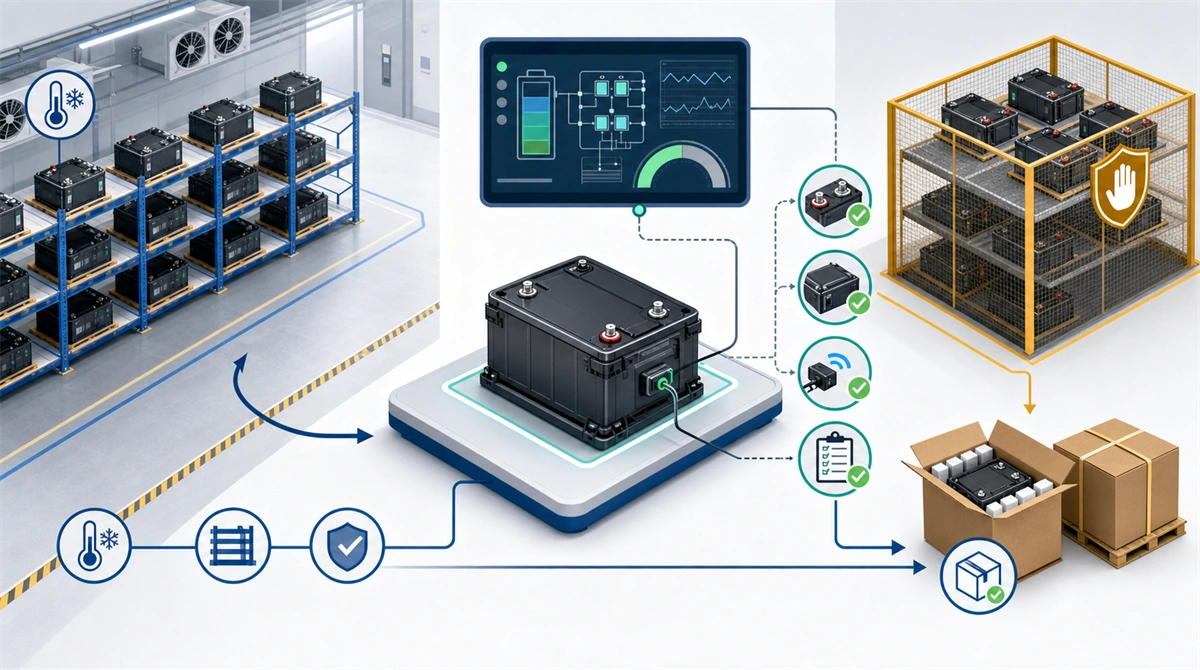
Distributors maintain batteries in storage and transit, not only in daily cycling. The inventory sits longer, moves through different climates, and must arrive at the customer in a usable state.
The maintenance task is less about daily charging and more about three control points: pre-storage preparation, periodic inspection, and pre-dispatch checkout. Lead-acid maintenance routines do not transfer directly; lithium batteries do not need topping up, but they do need BMS-aware voltage checks and temperature limits.
What SOC Should Stored Lithium Batteries Be Kept At?
A storage state-of-charge of roughly 40–60% is a commonly recommended range. Storing a lithium battery fully charged at elevated temperatures can accelerate calendar aging. Storing it near 0% SOC risks the BMS entering a protection state or deep discharge that may prevent recovery.
Check the battery manufacturer’s exact storage SOC recommendation and maximum storage duration at a given temperature. If the manual does not specify one, a 40–60% range and a 3–6-month inspection interval is a reasonable starting point for LiFePO4 batteries in trade storage.
What Should a Distributor Inspection Cover?
A quick visual and voltage check catches most storage and transit problems before the battery reaches the customer. Do not open the battery casing, and do not attempt internal repair.
| Inspection point | What to look for | Why it matters |
|---|---|---|
| Casing and label | Cracks, swelling, water marks, terminal damage | Physical damage can make a battery unsafe |
| Terminal voltage | Voltage within the expected range for the SOC | A voltage far below nominal may indicate deep discharge |
| BMS indicator or communication port | LED status, RS485/CAN response if applicable | Confirms the BMS is awake and communicating |
| Storage environment | Temperature, humidity, direct sun, pests, stacked weight | Heat and moisture are the leading storage-life risks |
| SOC before long storage | ~40–60% per manufacturer guidance | Reduces calendar aging in storage |
For batteries going into solar systems, also confirm the charge controller and inverter settings match the battery’s charge profile. Our solar charge controller maintenance guide explains the controller-side checks.
Which Temperature Ranges Should Be Respected?
LiFePO4 batteries should generally be kept within the manufacturer’s specified storage and operating temperature ranges. Storing in direct sun, a sealed container in summer, or a freezing warehouse without temperature control can damage the cells even when the battery is not in use.
Typical guidance is to avoid sustained exposure above roughly 40–45°C or below roughly -10°C in storage, but exact limits depend on the cell and pack design. For a comparison of chemistries and their temperature behavior, see lead-acid vs lithium-ion batteries.
What Should Be Checked Before a Warranty Return?
Return inspection evidence protects the distributor from absorbing costs for a site-caused failure. Before returning a battery, collect:
- Battery model, serial number, date of first use, and storage/installation location
- Terminal voltage and BMS status at the time of the reported fault
- Charge controller and inverter settings (absorption, float, current limit, temperature compensation)
- Photos of the battery casing, terminals, label, installation environment, and any visible damage
- Fault history from the BMS or inverter, if available
- Ambient temperature, installation date, and cycle history if known
A consistent return form helps the manufacturer decide whether the issue is product-related, installation-related, or storage-related. For BMS context, see what a BMS does.
How Does Maintenance Differ from Storage?
Maintenance is periodic inspection and condition management. Storage is the set of environmental and SOC conditions for longer idle periods. Use this guide for batteries that are in inventory, transit, or site stock. For warehouse storage beyond 3 months, combine these inspection points with the storage guidance in how to store lithium-ion batteries.
The two routines differ in intent: a stored battery needs the right SOC and temperature to preserve calendar life; a maintained battery needs inspection, voltage checks, and terminal condition monitoring to stay service-ready.
Conclusion
A distributor’s lithium battery maintenance program is built on three routines: keep storage SOC and temperature within the manufacturer’s limits, inspect casing and terminals before dispatch and periodically during storage, and collect consistent evidence before processing a warranty return.
Techfine provides LiFePO4 battery storage systems for B2B customers and can support OEM/ODM partners with product specifications, storage guidance, and service documentation.
Sources
- U.S. Department of Energy, Solar Integration: Inverters and Grid Services Basics, accessed July 2026.
- Exact SOC, temperature, charge, and storage limits must follow the specific battery and BMS manufacturer datasheet.
FAQ: Lithium Battery Maintenance
Can lithium batteries be stored fully charged?
Storing lithium batteries at 100% SOC for extended periods, especially at elevated temperatures, can accelerate calendar aging. A ~40–60% SOC range is commonly recommended. Check the exact battery manufacturer’s storage guidance for the specific model.
How often should stored lithium batteries be inspected?
A 3–6-month visual and voltage check is a reasonable starting point. Batteries stored in hot, humid, or unconditioned spaces may need shorter intervals. Record voltage, casing condition, and BMS status at each check.
Is a lithium battery maintenance routine the same as lead-acid?
No. Lithium batteries do not need water topping, equalization charges, or specific-gravity checks. The maintenance focus shifts to SOC management, temperature control, terminal inspection, BMS status, and charge-profile verification.
What should an importer provide for battery after-sales support?
Provide the manufacturer datasheet, recommended charge settings, storage SOC and temperature limits, BMS indicator interpretation, warranty conditions, return-inspection form, and local service contact. Consistent documentation reduces disputes and supports the distributor’s reputation.