
A lead-acid battery is one of the oldest and most widely used rechargeable battery technologies. It has been used for decades in automotive starting systems, UPS backup power, telecom systems, industrial equipment, and some solar energy storage applications.
Although lead-acid batteries are still used in many fields because of their low upfront cost and mature supply chain, modern energy storage systems are increasingly shifting toward lithium batteries, especially LiFePO4, because of their longer cycle life, lighter weight, and higher usable capacity.
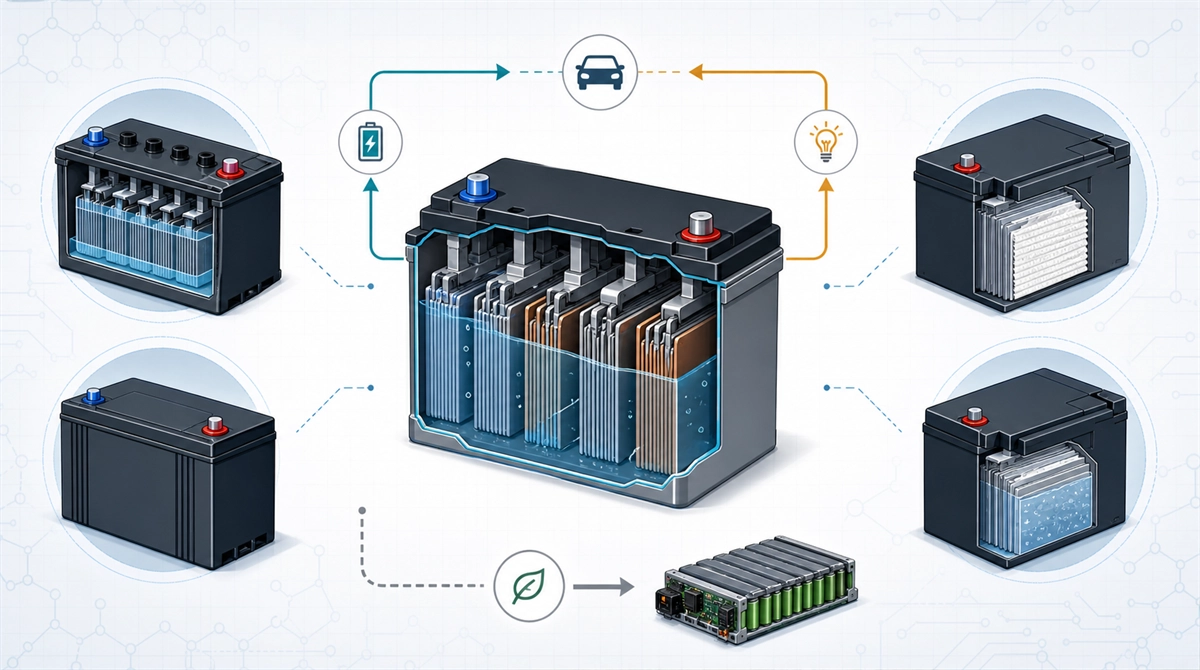
What Is a Lead Acid Battery?
A lead-acid battery stores electrical energy through chemical reactions between lead plates and sulfuric acid electrolyte. During discharge, chemical energy is converted into electrical energy. During charging, the reaction is reversed, allowing the battery to be used again.
Lead-acid batteries are known for their affordability, reliability, and wide availability. However, they are usually heavier, have lower energy density, and require more careful maintenance than lithium-based batteries.
How Does a Lead-Acid Battery Work?
A typical lead-acid battery contains positive plates made of lead dioxide, negative plates made of sponge lead, and an electrolyte solution containing sulfuric acid.
During discharge, the active materials react with the electrolyte, producing an electric current. During charging, an external charger reverses the reaction, restoring the battery’s chemical energy.
Main Types of Lead Acid Batteries
Flooded Lead Acid Battery
A flooded lead-acid battery, also called a wet cell battery, contains liquid electrolyte. It is usually more affordable, but it requires maintenance such as checking electrolyte levels and ensuring proper ventilation.
Sealed Lead Acid Battery
A sealed lead-acid battery is designed to reduce leakage and maintenance needs. It is also known as a VRLA battery, which stands for valve-regulated lead-acid battery.
AGM Battery
AGM stands for Absorbent Glass Mat. In an AGM battery, the electrolyte is absorbed into fiberglass separators. AGM batteries are maintenance-free, spill-resistant, and suitable for UPS systems, emergency backup, vehicles, and moderate cycling applications. To choose between AGM and true deep-cycle designs, see AGM vs deep-cycle batteries.
GEL Battery
A GEL battery uses a gelled electrolyte instead of a liquid electrolyte. GEL batteries are often used in applications that require stable deep-cycle performance, such as solar backup systems, telecom power, and marine applications. For a direct comparison of the two sealed types, see AGM vs GEL batteries.
Advantages of Lead Acid Batteries
- Lower upfront cost
- Mature and widely available technology
- Reliable for standby backup applications
- Easy to recycle through established recycling systems
- Available in flooded, AGM, and GEL types
Limitations of Lead Acid Batteries
- Heavy and bulky compared with lithium batteries
- Lower usable capacity
- Shorter cycle life in deep-cycle applications
- Slower charging speed
- Flooded types require maintenance
- Performance can decline faster under frequent deep discharge
Lead Acid Battery vs LiFePO4 Battery
| Feature | Lead Acid Battery | LiFePO4 Battery |
|---|---|---|
| Upfront Cost | Lower | Higher |
| Cycle Life | ~500–1,200 cycles | ~3,000–6,000+ cycles |
| Weight | Heavier | Lighter |
| Usable Capacity (DoD) | Lower (~50%) | Higher (~80–90%) |
| Charging Speed | Slower | Faster |
| Maintenance | May require maintenance | Usually maintenance-free |
| Best For | Low-cost standby backup | Solar storage and daily cycling |
Cycle-life and depth-of-discharge (DoD — how much of the battery you actually use) figures are typical industry ranges; exact numbers depend on model, temperature, and discharge depth. See lead-acid vs lithium-ion batteries for a full B2B cost and lifecycle comparison.
Is Lead Acid Still a Good Choice?
Lead-acid batteries can still be a practical choice for budget-sensitive backup systems or applications where the battery is used only occasionally. They are mature, affordable, and easy to source.
However, for solar energy storage, off-grid systems, and daily charge-discharge applications, LiFePO4 batteries are usually a better long-term solution because they offer longer service life, better usable capacity, and lower maintenance requirements.
Modern Alternative: LiFePO4 Battery Systems
For modern solar storage and backup power systems, many users now choose LiFePO4 battery systems instead of traditional lead-acid batteries.
LiFePO4 batteries are commonly paired with off-grid inverters or hybrid inverters to build reliable home, commercial, and industrial energy storage systems. If you are comparing lithium chemistries, see the different types of lithium batteries and how a battery management system (BMS) protects them.
Conclusion
Lead-acid batteries remain an important battery technology because of their low cost and proven reliability. However, they are heavier, have shorter cycle life, and offer lower usable capacity than modern lithium batteries.
If your priority is a low initial cost, lead-acid may still be suitable for basic backup use. If your goal is long service life, daily cycling, and better performance in solar storage systems, LiFePO4 is usually the better choice.