

LiFePO4 is not the opposite of lithium-ion. LiFePO4, also called LFP or lithium iron phosphate, is one type of lithium-ion battery chemistry. In solar storage, the real comparison is usually LiFePO4 vs NMC, which is nickel manganese cobalt lithium-ion chemistry.
For distributors, the choice affects safety positioning, cycle-life expectations, freight planning, warranty risk, and customer education. LFP often fits stationary solar storage better. NMC often fits applications where weight and space matter more.
Key Takeaways
- LiFePO4/LFP and NMC are both lithium-ion chemistries.
- Battery University lists typical LFP specific energy at 90-120Wh/kg and NMC at 150-220Wh/kg (Battery University, updated 2023-12-08).
- LFP is usually chosen for storage safety and long cycle life; NMC is usually chosen for higher energy density.
- IEA reported that LFP supplied more than 40% of global EV battery demand by capacity in 2023 (IEA, 2024).
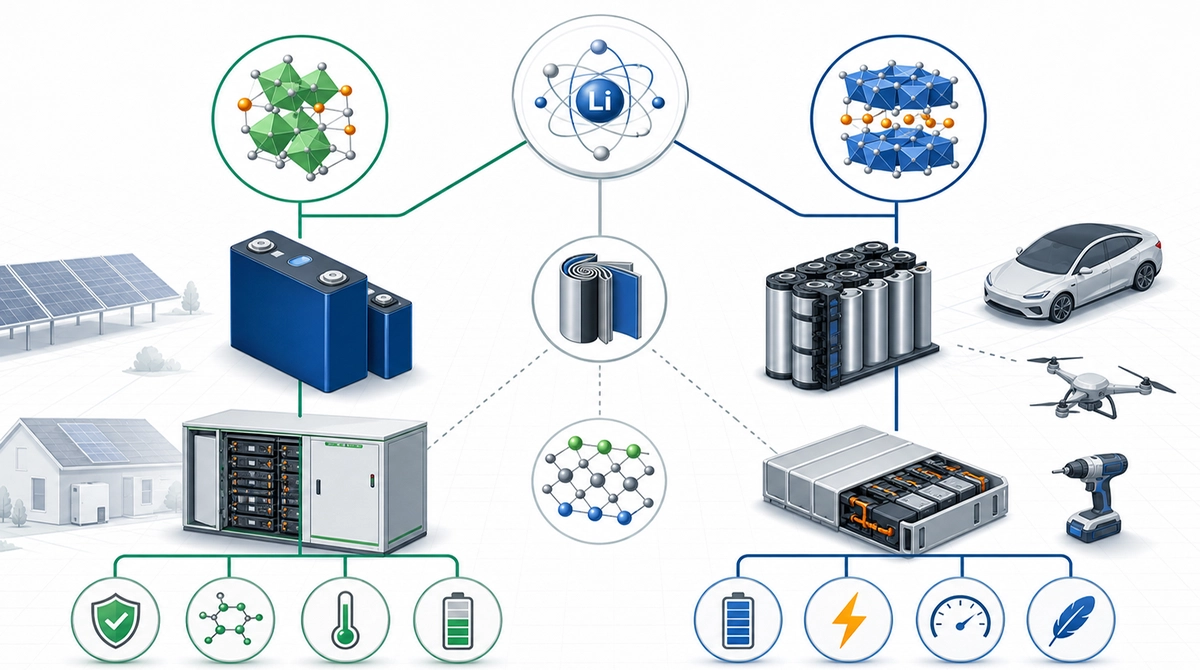
Why Is “LiFePO4 vs Lithium-Ion” the Wrong Question?
The phrase is technically wrong because LiFePO4 is already a lithium-ion chemistry. Lithium-ion is the broad family. LFP, NMC, NCA, LCO, LMO, and LTO are different members of that family.
This wording mistake matters in B2B sales. If a product page says “LiFePO4 vs lithium-ion,” buyers may think LFP is a separate battery technology. A clearer comparison is “LiFePO4 vs NMC” or “LFP vs ternary lithium,” depending on the market language.
Use this simple rule: LiFePO4 is a safer and longer-life lithium-ion option for many storage systems. NMC is a higher-energy lithium-ion option for applications where compact size and weight are important.
What Is a LiFePO4 Battery?
A LiFePO4 battery uses lithium iron phosphate cathode chemistry, which is valued for thermal stability, long service life, and stable cycling. Battery University lists LFP at 90-120Wh/kg typical specific energy and 2,000+ cycles under its summary table, with thermal runaway temperature higher than NMC in the same reference.
Those numbers are not a warranty promise. Real cycle life depends on cell quality, temperature, depth of discharge, charge voltage, C-rate, BMS limits, and pack design. Still, the chemistry’s safety and endurance profile is why LFP appears often in solar batteries, telecom backup, rack batteries, wall-mounted storage, and all-in-one ESS products.
For importers in weak-grid markets, LFP’s main value is after-sales control. A battery that cycles daily during outages needs predictable behavior more than maximum Wh/kg.
What Is an NMC Lithium Battery?
An NMC battery uses nickel, manganese, and cobalt in the cathode, usually giving higher energy density than LFP. Battery University lists typical NMC specific energy at 150-220Wh/kg and cycle life at 1,000-2,000 cycles, depending on design and operating conditions.
NMC is common in electric vehicles, power tools, e-bikes, and compact battery packs because weight and volume matter. For solar storage, NMC can still work, but the buyer must pay closer attention to thermal design, BMS protection, certification, and installation environment.
If your customer asks for the smallest possible battery pack, NMC may be part of the discussion. If your customer asks for daily backup cycling, long service life, and easier safety messaging, LFP is often easier to sell and support.
LiFePO4 vs NMC: Key Differences for Solar Storage
For solar storage buyers, LFP usually wins on thermal stability and cycle-life expectations, while NMC usually wins on energy density. This is a trade-off, not a universal ranking.
| Buyer factor | LiFePO4 / LFP | NMC / ternary lithium | Importer note |
|---|---|---|---|
| Battery family | Lithium-ion | Lithium-ion | Do not describe LFP as non-lithium-ion |
| Typical specific energy | 90-120Wh/kg | 150-220Wh/kg | NMC can be smaller for same nominal energy |
| Typical cycle life | 2,000+ cycles | 1,000-2,000 cycles | Real life depends on pack design |
| Thermal stability | Usually stronger | Usually lower than LFP | System safety still needs BMS and enclosure design |
| Best fit | Solar storage, backup, telecom, ESS | EVs, portable packs, space-limited systems | Match chemistry to duty cycle |
| Sales risk | Heavier pack | More safety explanation needed | Train dealers on correct use cases |
Battery chemistry is only one part of safety. A poor LFP pack with weak BMS design can still fail. A well-designed NMC pack can be safe when used within its limits. For B2B sourcing, ask for cell grade, BMS design, pack testing, shipping documents, and after-sales procedures.
Which Chemistry Fits Importers and Distributors Better?
For most residential and small commercial solar-storage programs, LiFePO4 is usually the easier product to standardize. It supports daily cycling, safety-focused sales language, and rack or wall-mounted formats that work well with hybrid and off-grid inverters.
NMC may fit buyers who need compact size, lower weight, or a product line connected to mobility. But for stationary backup, weight is less important than cycle life, thermal behavior, documentation, and serviceability.
Stock planning also matters. LFP packs are often sold as 24V or 48V modules, rack batteries, wall-mounted batteries, and cabinet batteries. That makes them easier to combine with common inverter categories. See our guide to different types of lithium batteries for the chemistry, cell-format, and product-format layers.
What Role Does the BMS Play in Both Chemistries?
Both LFP and NMC packs need a suitable BMS because the pack must control voltage, current, temperature, balancing, and communication. Texas Instruments describes battery-management functions around voltage, current, temperature, protection, balancing, and state estimation (Texas Instruments, data-as-of 2026).
A BMS does not make an unsuitable pack suitable for every job. It keeps the chosen chemistry inside its operating limits. For solar storage, the buyer should check BMS communication with the inverter, charge/discharge current limits, alarm handling, low-temperature behavior, and service documentation.
For a deeper explanation, read what a BMS does for a battery. Also check our guides on testing lithium-ion batteries and storing lithium-ion battery inventory.
FAQ: LiFePO4 vs NMC Batteries
Is LiFePO4 a lithium-ion battery?
Yes. LiFePO4 is a lithium-ion battery chemistry. It uses lithium iron phosphate as the cathode material. The better comparison is usually LiFePO4 vs NMC, not LiFePO4 vs lithium-ion, because NMC is another lithium-ion chemistry.
Is LiFePO4 safer than NMC?
LiFePO4 is generally more thermally stable than NMC, but no battery is safe without proper pack design. Battery safety also depends on cell quality, BMS protection, enclosure design, charging settings, temperature, and installation. Avoid saying any chemistry is “100% safe.”
Which battery lasts longer, LFP or NMC?
LFP commonly has a longer cycle-life profile than NMC in storage applications. Battery University lists LFP at 2,000+ cycles and NMC at 1,000-2,000 cycles as typical ranges. Real results depend on DoD, temperature, C-rate, charge voltage, and product design.
Why do many solar storage systems use LiFePO4?
Solar storage systems often cycle every day, so thermal stability and long cycle life matter more than maximum energy density. LFP is also easier for distributors to explain in backup-power markets, where customers care about service life, safety, and predictable warranty behavior.
Should importers still consider NMC batteries?
Yes, when weight and compact size are more important than cycle-life margin. NMC can fit mobility, portable, and space-limited products. For stationary solar backup, compare the full pack design, not only chemistry: BMS, enclosure, certification documents, warranty, and inverter compatibility.