

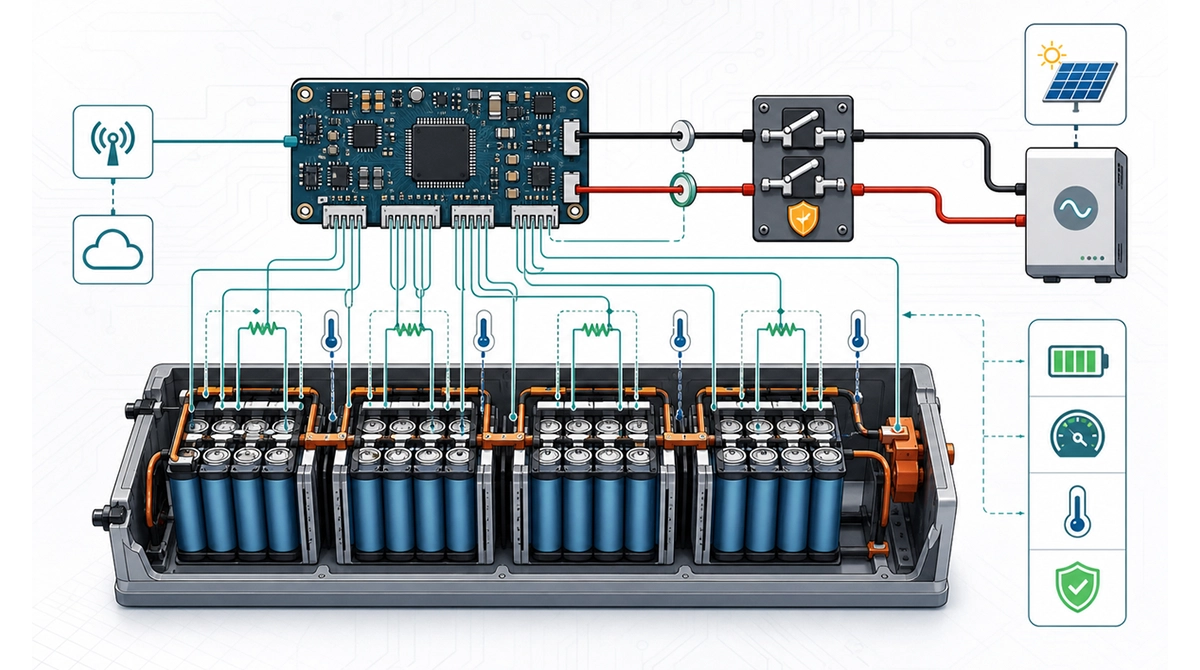
A BMS, or battery management system, is the electronic control layer that monitors and protects a rechargeable battery pack. In lithium battery storage, it helps keep cells within safe voltage, current, and temperature limits. It also reports status to chargers, inverters, displays, or monitoring systems.
A BMS does not make a poor battery pack good. It is one part of a safe battery design, along with cell quality, pack structure, enclosure, testing, charger settings, and installation.
Key Takeaways
- A BMS monitors voltage, current, temperature, state of charge, alarms, and cell balance.
- Texas Instruments describes BMS functions around monitoring, protection, balancing, gauges, and communication interfaces (Texas Instruments, data-as-of 2026).
- In solar storage, the BMS must work with the inverter or charger, not only the cells.
- For OEM/ODM buyers, BMS protocol, current rating, cell count, and documentation are purchase-critical items.
What Is a BMS for a Battery?
A BMS is a battery management system that monitors the battery pack and helps control charge, discharge, protection, balancing, and communication. It is especially important in lithium-ion packs, including LiFePO4 batteries, because cell limits must be managed carefully.
The BMS reads signals from cells and pack sensors. It can stop charging, stop discharging, limit current, trigger alarms, balance cells, and send data to another device. In an energy-storage system, that other device is often a hybrid inverter, off-grid inverter, charger, display, or monitoring platform.
For importers, the BMS is a warranty-control topic. If the BMS cannot communicate with common inverter brands in your market, installers may face alarms, charging limits, or customer complaints.
What Does a Battery BMS Monitor?
A battery BMS monitors the conditions that decide whether a pack can charge, discharge, or stay in standby. The exact measurement set depends on the product, but the buyer should understand the main functions before choosing a storage battery.
| BMS function | What it checks or controls | Buyer question |
|---|---|---|
| Cell voltage | Individual cell or cell-group voltage | What are the high/low cut-off limits? |
| Pack current | Charge and discharge current | Does it match the inverter power? |
| Temperature | Cell, MOSFET, or pack temperature | What happens in hot or cold sites? |
| Overcharge protection | Stops or limits charging above safe voltage | Is the charger/inverter setting matched? |
| Over-discharge protection | Stops discharge before cell damage | What is the low-voltage recovery process? |
| Overcurrent/short protection | Trips on abnormal current | Can the pack handle surge loads? |
| Cell balancing | Reduces cell imbalance over time | Passive or active balancing? |
| SOC/SOH estimation | Reports charge and health status | Is the display accurate enough for users? |
| Communication | Sends data or limits to other devices | CAN, RS485, UART, or brand-specific? |
Common chip-level BMS interfaces can include I2C, SPI, and UART; system-level storage packs may use CAN-based or vendor-specific communication. Do not assume RS485, Modbus, or CAN support unless the battery datasheet confirms it.
Why Does a BMS Matter in Solar Storage?
In solar storage, the BMS protects the battery while the inverter and charger respond to changing PV, grid, and load conditions. A weak-grid site may cycle the battery every day, charge from solar in the afternoon, and discharge during evening outages.
Without suitable protection and communication, the pack can operate outside its intended range. That does not mean every pack “explodes.” The practical risks are cell damage, premature capacity loss, sudden shutdown, imbalance, overheating, nuisance alarms, or warranty disputes.
The BMS also helps service teams. Fault logs, SOC display, temperature readings, and communication status can help a distributor identify whether a problem is cell-related, inverter-related, wiring-related, or caused by the user’s load.
How Does a BMS Communicate With an Inverter?
A storage BMS communicates limits and status so the inverter or charger can charge and discharge the battery correctly. Depending on the battery and inverter ecosystem, this may happen through CAN, RS485, UART, dry contact, or a brand-specific protocol.
A useful BMS-inverter link can share:
- battery SOC
- battery voltage
- allowed charge current
- allowed discharge current
- temperature alarms
- high-voltage or low-voltage alarms
- communication fault status
- protection trip status
For OEM/ODM projects, ask for the inverter compatibility list. A 48V LiFePO4 battery may be electrically correct but still difficult to use if the BMS protocol does not match the inverter menu.
What Should OEM/ODM Buyers Check in a BMS?
OEM/ODM buyers should check BMS current rating, cell count, communication protocol, protection thresholds, and service documentation before approving a battery model. These details affect real installation quality more than a glossy battery photo.
Use this purchasing checklist:
| Item | Why it matters |
|---|---|
| Cell count and voltage platform | Must match 24V, 48V, high-voltage, or custom design |
| Continuous current | Must support inverter output and normal loads |
| Peak current | Must support short surge demand where allowed |
| Charge current limit | Must match PV charger and inverter charger settings |
| Communication protocol | Must match target inverter brands |
| Temperature protection | Needed for hot warehouses and cold charging conditions |
| Balancing method | Affects long-term pack consistency |
| Fault-code list | Reduces after-sales confusion |
| Test report/manual | Helps distributors train installers |
If you are comparing chemistry choices, read LiFePO4 vs NMC lithium batteries. If you need the broader battery family map, see different types of lithium batteries.
What Happens if a Battery Has No Suitable BMS?
A lithium battery pack without suitable management can be damaged by overcharge, over-discharge, overheating, overcurrent, imbalance, or communication mismatch. The risk level depends on chemistry, pack design, charger behavior, installation, and how the user operates the system.
Use precise language here. A missing or poor BMS does not automatically mean immediate fire or explosion. It does mean the pack has fewer controls to keep cells inside their safe operating area. That can shorten life, cause shutdowns, and increase safety risk.
For distributors, the business problem is after-sales cost. A battery that shuts down without clear alarms is hard to support. A battery with a readable BMS, clear fault codes, and inverter communication is easier to diagnose and replace if needed.
FAQ: Battery BMS
Is a BMS only used for lithium batteries?
No, but it is most important in lithium battery packs because lithium cells need tighter voltage, temperature, current, and balancing control. Lead-acid systems may use simpler charge control, while LiFePO4 and NMC packs normally need more detailed management.
Does a BMS increase battery capacity?
No. A BMS does not add energy capacity. It helps the pack use its designed capacity safely by controlling limits, balancing cells, and reporting status. If the battery is undersized for the inverter, a BMS cannot fix the sizing mistake.
What is the difference between BMS and EMS?
A BMS manages the battery pack. An EMS, or energy management system, manages the wider energy system: solar, grid, battery, loads, and operating modes. In an all-in-one ESS, the two functions may work together but they are not the same thing.
What BMS communication should importers ask for?
Ask which inverters the battery has been tested with and what protocols are supported. CAN-based links, RS485, UART, or brand-specific communication may be used depending on the product. Do not market a protocol unless the datasheet or supplier confirms it.
How does Techfine use BMS in battery projects?
Techfine supplies LiFePO4 battery and energy-storage solutions for distributors and OEM/ODM partners. For a battery project, share the inverter brand, voltage platform, target current, battery capacity, installation environment, and required communication protocol before final model matching.