
Key Takeaways
- Hybrid inverters manage solar, battery, and grid simultaneously — string and grid-tie inverters only convert DC to AC with no storage capability
- The global hybrid inverter market reached $10.1 billion in 2025, growing at 14.4% CAGR (Emergen Research, 2025)
- Grid-tie inverters shut down completely during outages — a dealbreaker in markets where Delhi DISCOMs logged an average 13.59 cumulative outage hours per outage day in FY 2024–25 (The Leap Journal, December 2025)
- Battery pack prices fell a further 8% in 2025 to $108/kWh — down 93% since 2010 (BloombergNEF, December 2025)
- If your customers face frequent outages or plan to add batteries within 3 years, a hybrid inverter is the smarter long-term specification
📋 Sourcing for your market? Download Techfine’s Full Spec Sheet — including all OEM-customizable parameters, certifications by region, and product details. Download Spec Sheet → (PDF, no sign-up required)
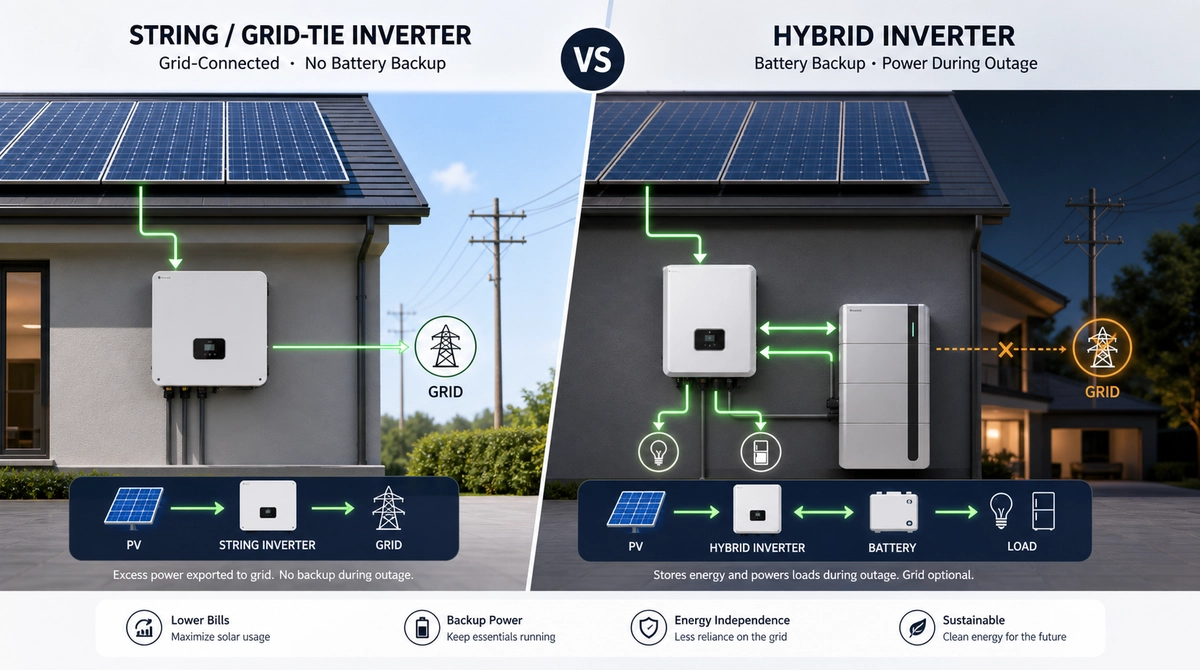
What’s the Real Difference? (Start Here)
People often use “string inverter” and “grid-tie inverter” interchangeably — and for most practical purposes, they’re the same product. Both convert solar DC power into AC electricity and feed it into the grid, with no battery capability. A hybrid inverter does all of that and more: it manages battery charging, provides backup power during outages, and decides in real time whether loads run on solar, stored energy, or grid power.
That’s the core split. The details matter a great deal when specifying systems for end markets — and the gap in real-world performance is wider than the spec sheet suggests. In our experience commissioning systems across South Asia and Africa, the inverter choice is the single most consequential specification decision a distributor makes.
What Is a String Inverter (Grid-Tie Inverter)?
A string inverter connects a series of solar panels, converts their combined DC output to AC, and sends that power to home loads or back to the grid. It’s the world’s most common inverter type, and has been the industry standard for over two decades. CEC-weighted efficiency for leading models ranges 97–98%, per California Energy Commission testing data (accessed June 2026).
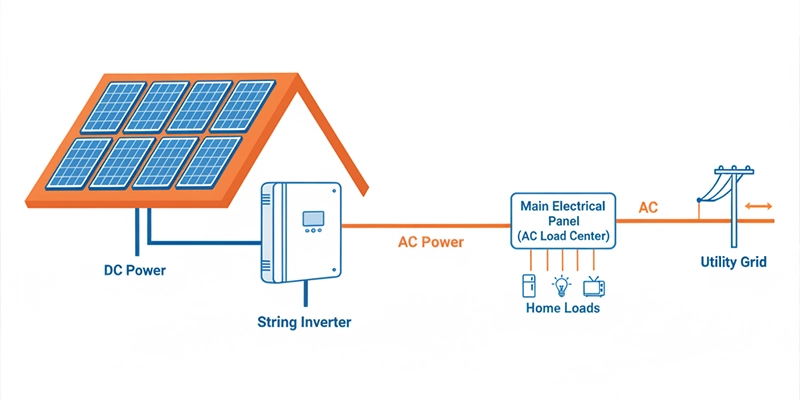
The limitation is what they can’t do. The moment grid voltage drops, anti-islanding protection disconnects the inverter within milliseconds. Panels keep generating, but the power goes nowhere. Home goes dark along with the grid — even in full sunshine. This isn’t a defect; it’s a fundamental safety requirement that prevents electricity from flowing into lines utility workers may be repairing.
String inverters are the right specification when:
- The end-user grid is stable with fewer than 4–5 outages per year
- Net metering rates make export financially worthwhile
- No battery storage is planned
- Minimizing upfront system cost is the top priority
What Is a Hybrid Inverter?
A hybrid inverter combines three functions in one unit: solar inverter (DC to AC), battery inverter (bidirectional charge/discharge), and energy management controller. Close to 45% of new solar projects now specify hybrid-ready configurations (Emergen Research, 2025, accessed June 2026) — a share that’s doubled in four years.
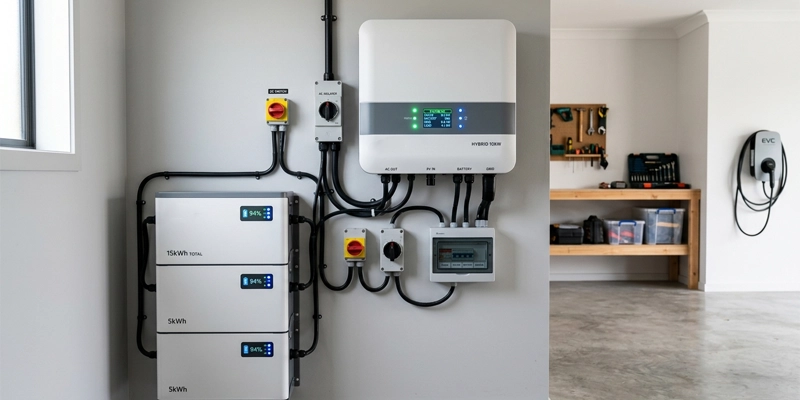
During a sunny afternoon it charges the battery with surplus solar. After sunset, it draws from stored power. When the battery’s empty, it pulls from the grid — all automatically, no user input required.
What does this mean in practice? When the grid fails, a hybrid inverter detects the fault and switches to island mode, typically within 10–20 ms (measured per IEC 62040-3 test methodology). Sensitive equipment — computers, routers, CCTV, medical devices — keeps running without interruption. We commissioned a 10kW hybrid system for a textile business in northern India that had experienced 6-hour daily outages. After installation, production downtime dropped to zero.
Hybrid inverters are the right specification when:
- End-user markets have frequent or prolonged outages (India, Pakistan, Nigeria, Southeast Asia)
- Time-of-use tariffs make battery dispatch financially beneficial
- Battery storage is planned now or within 1–3 years
- Business continuity or household safety requires uninterrupted power
💡 OEM/distribution partners: Techfine’s QA-series hybrid inverters (2kW–12kW) support LiFePO4, NMC, and lead-acid batteries. Transfer time, battery chemistry profile, grid export limits, and monitoring protocol are all adjustable for your target market’s grid regulations. View QA-series →
How Do Hybrid, String, and Grid-Tie Inverters Compare?
| Feature | String / Grid-Tie | Hybrid Inverter |
|---|---|---|
| Battery support | No | Yes (built-in BMS) |
| Backup during outage | No — shuts down | Yes — switches to battery |
| Conversion efficiency | 97–98% (CEC-weighted) | 93–97% |
| Upfront cost | Lower (20–30% less) | Higher |
| Installation complexity | Simple | More complex |
| Energy management | Convert and export only | Optimize storage, tariffs, export |
| Future battery addition | Not possible without hardware change | Battery-ready from day one |
| Best end markets | Europe, Australia, stable grids | India, Pakistan, Africa, SE Asia |
How Does Each Handle a Power Outage?
This is where the difference becomes most visible — and most commercially important for importers selling into South Asia, Southeast Asia, and Africa. Delhi distribution companies logged an average 13.59 cumulative outage hours per outage day in FY 2024–25, with 116 outage days recorded in the year (The Leap Journal, December 2025, accessed June 2026). In that context, the inverter’s outage response isn’t a spec-sheet footnote — it’s the product’s core value proposition.

String / grid-tie inverter: The moment grid voltage drops, anti-islanding protection disconnects the inverter. Panels keep generating, but power goes nowhere. The home goes dark with the grid — even in full sunshine.
Hybrid inverter: When grid power fails, the inverter detects the fault and enters island mode, switching to battery power within 10–20 ms (measured per IEC 62040-3). As long as the battery holds charge, the home or business keeps running. Customers never see an interruption.
For importers, this difference defines which product belongs in which market. Where grid reliability is the number one customer pain point, a hybrid inverter isn’t a premium — it’s the minimum viable specification.
What About Microinverters?
Microinverters are a third architecture worth understanding, though less common in the high-growth markets most of our distribution partners serve. Africa’s operational solar capacity reached 23.4 GWp by end-2025 — a 26% year-on-year increase, the highest growth rate of any global region (AFSIA / Pan African Visions, January 2026, accessed June 2026) — and nearly all of that growth has been in string and hybrid systems, not microinverters.
- String inverter: One unit for all panels. Cost-effective, but shading one panel reduces output for the whole string
- Microinverter: One small inverter per panel. More expensive, but panels operate independently — shading one panel doesn’t affect the others
- Hybrid inverter: One unit for all panels, plus full battery management and backup capability
For residential and small commercial systems across Asia and Africa, string and hybrid inverters remain the commercially dominant choice. Microinverters suit shading-heavy roofs in markets with reliable grids and strong net metering — a narrower use case than either alternative.
How Much Does a Hybrid System Cost Compared to String?
String inverters have a lower sticker price — but the total picture changes once storage enters the equation. Lithium-ion battery pack prices fell 8% in 2025 to a record low of $108/kWh, with stationary storage prices dropping 45% in a single year to $70/kWh (BloombergNEF Annual Battery Price Survey, December 2025, accessed June 2026). Those numbers change the hybrid value equation meaningfully.
For a 5kW residential system:
| Component | String System | Hybrid System |
|---|---|---|
| Inverter | $400–$800 | $800–$1,500 |
| Battery (10kWh) | Not compatible | $2,500–$4,500 |
| Separate battery inverter (retrofit) | $500–$1,000 + install | Not needed |
| Total with storage | $3,400–$6,300 (two steps) | $3,300–$6,000 (one step) |
The retrofit path costs more and introduces a second installation, a second warranty, and a second failure point. For importers building a product line, offering a hybrid-ready inverter now gives customers a clear upgrade path — and protects your brand from being undercut by storage-ready competitors.
What Should You Check Before Specifying Any Hybrid Inverter?
These five specifications separate quality inverters from low-cost units that fail when customers need them most. We’ve seen all five issues cause real-world failures in the field — and they’re also the questions your customers will eventually ask, so knowing the answers protects your brand.
1. Efficiency at partial load, not just peak
Inverters spend most of their time at 25–50% capacity. An inverter rated 97% peak but 91% at partial load underperforms in real conditions. Ask for the full efficiency curve, not just the headline number.
2. Transfer time (grid-to-battery switchover)
Under 20 ms means seamless operation for sensitive electronics. Over 100 ms produces visible interruptions — computers reboot, routers drop connections, CCTV footage gaps. Always request the datasheet figure measured per IEC 62040-3, not a verbal claim.
3. IP rating
IP65 minimum for outdoor installation. IP21 requires a protected indoor enclosure. This matters more in tropical and dusty markets than temperate ones. Techfine XA-series: IP66 standard.
4. Battery chemistry compatibility
Confirm LiFePO4 support explicitly. Some inverters only work with proprietary battery packs, which locks customers into expensive replacements and creates support headaches for distributors.
5. Certifications — request the certificate file, not just the logo
CE, IEC 62109, and UL 1741 are the key certifications for most markets. A certificate file from an accredited body is verifiable. A logo on a spec sheet is not. We’ve seen counterfeit certification documents from competitors — this is more common than importers expect.
Techfine certifications on file: CE, TUV, IEC , and RoHS. Full documentation available on request in your brand name for OEM orders. Request certification package →
Which Inverter Is Right for Your Market?
Specify string / grid-tie inverters when your end market has:
- Stable grid with fewer than 4–5 outages per year
- Strong net metering policy that rewards export
- Price-sensitive buyers with no storage plans
- Grid infrastructure that makes backup power a secondary concern
Specify hybrid inverters when your end market has:
- Frequent or prolonged outages (India, Pakistan, Nigeria, Southeast Asia)
- Rising electricity tariffs driving demand for self-consumption
- Customers asking about battery storage now or in the near future
- Commercial buyers where downtime has a direct cost
The global hybrid inverter market is projected to grow from $10.1 billion in 2025 to $25.9 billion by 2032 (Emergen Research, 2025, accessed June 2026). Battery costs continue to fall. The 18 African countries projected to install at least 100 MW of new solar in 2025 — up from just 2 countries in 2024 (Global Solar Council, 2025, accessed June 2026) — represent a fast-expanding market where hybrid specifications are increasingly the baseline. Importers who build their product line around hybrid-ready specifications now are positioning ahead of where the market is going, not chasing it.
FAQ
-
Is a grid-tie inverter the same as a string inverter?
Yes, in most practical contexts. Both convert solar DC power to AC and connect to the utility grid without battery storage. “String” refers to the panel wiring architecture; “grid-tie” describes the grid connection function. They’re usually the same product under two names.
-
Can I add a battery to a string inverter later?
Not directly. String inverters have no battery interface. Adding storage requires either an AC-coupled battery inverter or replacing the string inverter with a hybrid unit. In most cases, specifying a hybrid inverter from the start is more cost-effective if storage is in the plan.
-
Do hybrid inverters work without batteries installed?
Yes. A hybrid inverter runs in grid-tie mode without any battery connected, functioning exactly like a string inverter. Batteries can be added later — all the wiring and hardware is already in place.
-
Which inverter is better for Pakistan and India?
For most locations, a hybrid inverter is the clear specification. Delhi DISCOMs recorded an average 13.59 cumulative outage hours per outage day in FY 2024–25 (The Leap Journal, December 2025). Pakistan faces similar pressure. A hybrid system with adequate battery capacity keeps homes and businesses running through those windows; a string inverter shuts down completely when the grid fails.
-
How much more does a hybrid inverter cost than a string inverter?
Typically 20–30% more at the same power rating — roughly $400–$700 more for a 5kW inverter unit. That premium largely disappears when storage is factored in, since a hybrid eliminates the need for a separate battery inverter later. And with stationary battery prices now at $70/kWh after a 45% drop in 2025 (BloombergNEF, December 2025), the full system cost is lower than it’s ever been.
-
Can Techfine manufacture hybrid inverters under our brand?
Yes. Techfine is a full ODM/OEM manufacturer. We produce inverters under customer brand names with custom firmware, packaging, manuals, and certification documentation. Minimum order quantities and customization options are available on request.
Ready to Put Your Brand on a Certified Hybrid Inverter?
Techfine has manufactured solar inverters and battery systems for importers and distributors in 100+ countries since 2003. Our engineering team handles specification, customization, certification, and documentation — so you can bring a product to market under your brand without building a factory.
What we offer OEM/ODM partners:
- ✅ Custom firmware and monitoring app branding
- ✅ Private-label packaging and manuals in any language
- ✅ Certifications: CE, TUV, IEC, RoSH and others by market
- ✅ Technical support for your sales and installation teams