
A solar string inverter is usually the lower-cost and easier-to-service option for simple roofs and commercial arrays. A microinverter gives panel-level conversion, so it fits shaded or complex residential roofs where each panel needs to work independently.
For distributors and installers, this is also a channel decision. String inverters are easier to stock, size, and replace. Microinverters can solve difficult roof layouts, but they put more electronics on the roof.
Key Takeaways
- DOE explains that string inverters connect a set of panels to one inverter, while microinverters are placed on each panel (U.S. DOE, data-as-of 2026).
- String inverters usually win on upfront cost and centralized service.
- Microinverters win on panel-level independence, shading tolerance, and detailed monitoring.
- For C&I and simple rooftops, string inverters remain the practical default.
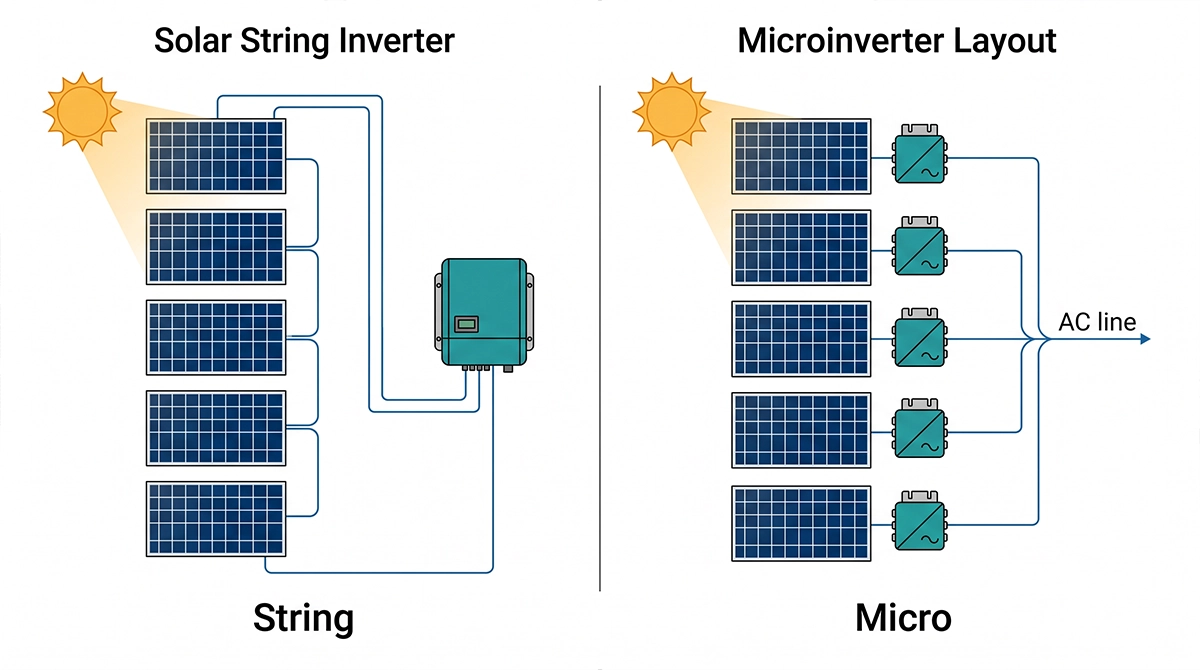
What Is a Solar String Inverter?
A solar string inverter connects several panels in series and converts the combined DC power into AC at one inverter location. DOE describes this architecture as a string of panels feeding one inverter.
String inverters are common because they keep the system simple. One inverter can serve multiple panels or multiple strings. The inverter is usually mounted on a wall or equipment area, which makes inspection, replacement, and communication wiring easier.
The trade-off is string behavior. If one panel in the string is shaded, mismatched, dirty, or damaged, the output of that string can fall. Modern string inverters with multiple MPPT inputs reduce the problem, but they do not give full panel-level independence.
What Is a Microinverter?
A microinverter is a small inverter installed at each solar panel, converting DC to AC at module level. Enphase describes microinverters as a distributed architecture where each panel operates independently and can be monitored at panel level.
This design fits roofs with shade, mixed orientations, dormers, or limited space. If one panel underperforms, the rest of the array can keep producing. Troubleshooting can also be more precise because monitoring can identify the affected panel.
The trade-off is cost and access. More devices sit on the roof. If one fails, a technician may need roof access to replace it. For large commercial projects, that can complicate service planning.
String Inverter vs Microinverter: Key Differences
The main choice is centralized simplicity versus panel-level control. Neither design is always better. The roof layout, project size, and service model decide the winner.
| Decision point | String inverter | Microinverter |
|---|---|---|
| System design | Multiple panels feed one inverter | One inverter per panel |
| Upfront cost | Usually lower | Usually higher |
| Shading response | One shaded panel can affect a string | Each panel works independently |
| Monitoring | Inverter or string level | Panel level |
| Maintenance access | Inverter is usually easy to reach | Roof access may be needed |
| Expansion | Add strings within inverter limits | Add panels more flexibly |
| Best fit | Simple roofs, C&I, larger arrays | Shaded or complex residential roofs |
The table is only a starting point. A simple commercial roof with no shade can waste money on panel-level electronics. A small residential roof with several orientations may lose too much energy on a basic string design.
Which Performs Better Under Shade?
Microinverters handle shade better because each panel converts power independently. DOE notes that a problem on one panel can reduce output from the whole string in string-inverter systems, while microinverters isolate that panel-level issue.
That does not mean every shaded site needs microinverters. If shade affects only a small morning or evening period, a string inverter with good MPPT design may still be the better value. If shade moves across many panels during peak hours, panel-level electronics become more attractive.
For importers, ask installers what roofs they see most. Simple metal roofs, C&I rooftops, and ground mounts often favor string inverters. Irregular residential roofs with trees, chimneys, and mixed slopes are where microinverters make their strongest case.
Which Is Easier to Maintain?
String inverters are usually easier to maintain because the main electronics sit in one accessible location. A technician can inspect wiring, read the display, replace the inverter, and check communication without climbing behind each module.
Microinverters reduce the single-inverter failure risk, because one failed unit affects one panel rather than the whole array. But replacement can require roof work, and there are more electronic devices exposed to outdoor heat and weather.
For B2B stocking, this matters. String inverter spare parts are simpler to manage. Microinverter projects may need more detailed monitoring support and installer training.
Which Should You Choose?
Choose a string inverter for simple layouts, larger arrays, lower upfront cost, and easier centralized service. Choose microinverters for complex roofs, shading, panel-level monitoring, and phased expansion. That rule handles most projects.
| Buyer situation | Better direction | Reason |
|---|---|---|
| C&I rooftop with uniform panels | String inverter | Lower cost and easier service |
| Ground-mounted array | String inverter | Simple layout and centralized maintenance |
| Residential roof with shade | Microinverter | Better panel-level independence |
| Mixed roof orientations | Microinverter | Each panel can operate separately |
| Importer serving weak-grid backup markets | String or hybrid inverter | Battery and backup functions matter more |
| Premium residential monitoring package | Microinverter | Panel-level monitoring is a selling point |
If you are also comparing inverter scale, read string inverter vs central inverter. For broader topology decisions, see hybrid vs grid-tie inverter and on-grid vs off-grid solar inverter.
FAQ: String Inverter vs Microinverter
Are microinverters always better than string inverters?
No. Microinverters are better for shading, complex roofs, and panel-level monitoring. String inverters are usually better for simple roofs, larger systems, and lower service cost. The best choice depends on layout, budget, and how the system will be maintained.
Does one shaded panel reduce the whole string inverter system?
It can reduce the output of the affected string, especially in older or simple string designs. Modern MPPT inputs and string design can limit the loss, but microinverters give stronger panel-level independence because each panel converts power separately.
Are microinverters harder to repair?
They can be harder to access because they sit behind or near panels on the roof. The failure may affect only one panel, which is good, but replacement still needs roof work. A string inverter is usually easier to reach from a wall or equipment area.
Which inverter type is better for commercial solar?
String inverters are usually the practical choice for commercial rooftops and many C&I systems because they balance cost, efficiency, monitoring, and service access. Microinverters can fit smaller commercial roofs with complex shading, but they are less common for large uniform arrays.
Does Techfine make microinverters?
This article does not claim Techfine manufactures microinverters. Techfine’s main inverter focus is hybrid and off-grid systems for backup and weak-grid markets. If your market needs panel-level residential microinverters, compare that category separately from backup inverter sourcing.
A Note on Techfine
Techfine helps distributors and OEM/ODM partners build hybrid and off-grid inverter lines for weak-grid and backup markets. If you are deciding between string, hybrid, and storage-focused products for import, share your target application, voltage, and support model.