
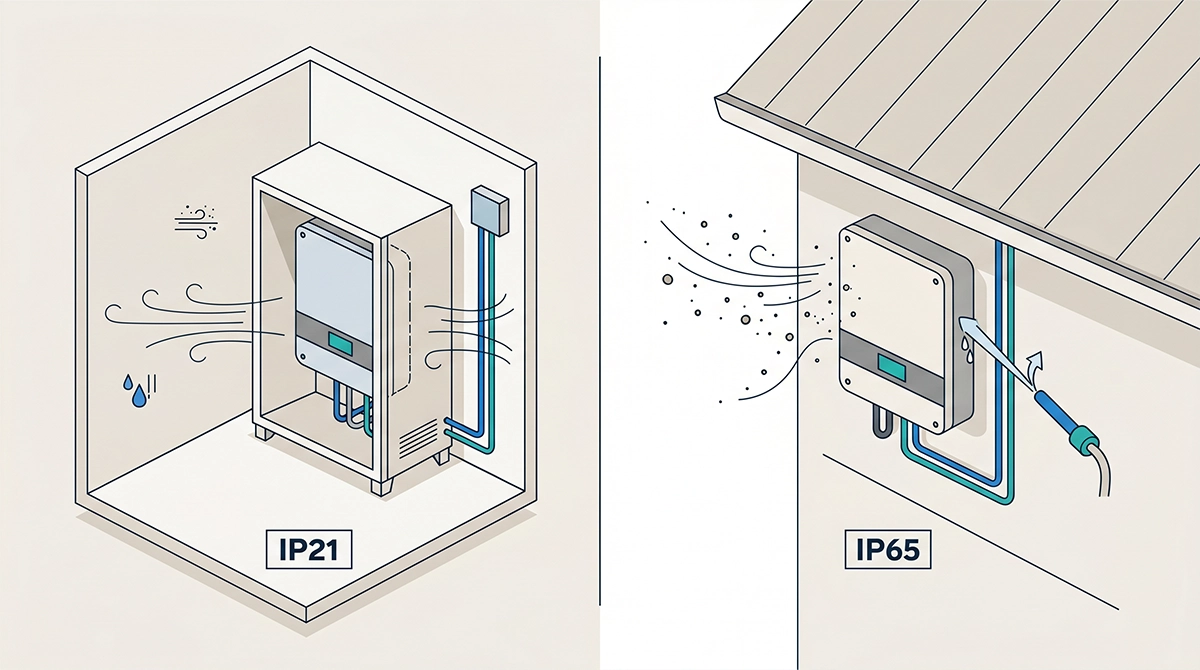
IP21 and IP65 inverters are built for different installation environments. IP21 is basic indoor enclosure protection. IP65 is dust-tight and protected against water jets, so it fits harsher dust or outdoor-exposed sites, but it still does not mean the inverter can be submerged.
For solar buyers, the right question is not “which IP rating is higher?” It is: where will the inverter be installed, how much dust and water can reach it, and can the enclosure still ventilate heat safely?
Key Takeaways
- IP ratings use two digits: the first covers solid objects and dust; the second covers water ingress (NEMA Enclosures, data-as-of 2026).
- IP21 is suitable only for clean indoor or protected equipment-room installs.
- IP65 is dust-tight and water-jet resistant, but it is not an immersion rating.
- Higher IP protection can add cost and heat-management limits, so match the rating to the site.
What Does an IP Rating Mean on an Inverter?
An IP rating tells you how well the inverter enclosure blocks solid objects, dust, and water from entering the equipment. The first digit covers solid ingress; the second digit covers liquid ingress. That two-digit structure is defined in the IP enclosure rating system used for electrical equipment.
| Digit position | What it measures | Buyer meaning |
|---|---|---|
| First digit | Solid objects and dust | Can fingers, tools, wire, or dust reach live parts? |
| Second digit | Water ingress | Can dripping water, spray, splashing, or jets enter the enclosure? |
A higher number usually means stronger enclosure protection, but it does not automatically make the product better for every installation. A sealed inverter still needs correct cable glands, drainage, mounting clearance, and heat dissipation. If installers drill extra holes or use the wrong gland, the real protection can fall below the printed rating.
For B2B buyers, treat the IP rating as a site-risk filter. A dry equipment room, a covered balcony, a dusty workshop, and a flood-prone utility space are four different environments. The same inverter enclosure will not behave the same way in all four.
What Does IP21 Mean for a Solar Inverter?
An IP21 inverter has basic indoor protection: the “2” protects against finger-sized objects, and the “1” protects against vertically dripping water. It is not designed for rain, wash-down, outdoor wall mounting, or dusty industrial yards.
IP21 can still be the right choice when the inverter sits inside a dry room, cabinet, or power closet with controlled airflow. In many residential and light commercial backup systems, that is enough. The advantage is simple service access and easier ventilation.
Use IP21 only when these site conditions are true:
- The inverter is indoors or inside a weather-protected enclosure.
- No rain, hose water, or roof leakage can reach it.
- Dust is low or the room is cleaned regularly.
- Cable entries are protected from condensation.
- There is enough space around the inverter for cooling.
This is where many buyers get caught. They read “indoor inverter” and install it under a half-open shed or balcony. That is not the same as an indoor equipment room. If wind-driven rain, insects, or condensation can reach the enclosure, treat the location as semi-outdoor and step up the protection plan.
What Does IP65 Mean for an Inverter?
An IP65 inverter is dust-tight and protected against water jets from normal directions. The “6” means full dust-tight protection, while the “5” means water-jet protection, not temporary or continuous immersion.
IP65 is usually the better fit for outdoor walls, dusty workshops, farm sites, exposed C&I projects, and markets where installers cannot always guarantee a clean equipment room. It is also useful near coastal air or wind-blown dust, although corrosion protection and material quality still matter.
IP65 does not remove the need for correct installation. The rating assumes the enclosure, covers, cable glands, seals, and mounting points stay as designed. If a technician removes a blanking plug, leaves a communication cover loose, or routes cables through an unsealed hole, the rating no longer protects the system.
It also does not solve flooding. A flood-prone room needs mounting height, drainage, enclosure planning, and site redesign. Do not treat IP65 as a shortcut for submersion risk.
IP21 vs IP65: Which One Fits Your Site?
Choose IP21 for clean indoor locations; choose IP65 when dust, splash, or outdoor exposure is realistic. The wrong rating can create two different failures: water/dust damage from under-protection, or unnecessary cost and heat stress from over-specifying.
| Installation site | Better fit | Why |
|---|---|---|
| Indoor utility room | IP21 or higher | Low dust and no water jets |
| Covered balcony with wind-driven rain risk | IP65 | Splash and dust can reach the enclosure |
| Farm or dusty workshop | IP65 | Dust-tight enclosure reduces internal contamination |
| Outdoor wall under eave | IP65 | Weather exposure is still possible |
| Direct wash-down zone | Check product manual | IP65 handles jets, not pressure washing at all angles |
| Flood-prone room | Neither rating alone | IP65 is not an immersion rating |
For importers, stock planning matters too. If most customers install indoors, IP21 or IP20-class models can keep price competitive. If customers often mount inverters outdoors because utility rooms are unavailable, an IP65 line may reduce warranty risk.
What Is IP56 Protection?
IP56 means dust-protected and protected against powerful water jets. Compared with IP65, it is weaker on dust protection but stronger on the water-jet digit. That makes it useful for some industrial equipment, but it is not automatically better than IP65 for every solar inverter.
The difference is simple:
| Rating | Dust protection | Water protection | Practical meaning |
|---|---|---|---|
| IP21 | Finger/object protection | Vertical dripping water | Basic indoor use |
| IP56 | Dust-protected | Powerful water jets | Industrial splash/dust exposure |
| IP65 | Dust-tight | Water jets | Outdoor/dusty inverter installs |
For solar inverters, dust often matters as much as water. In desert, warehouse, and roadside installations, dust-tight protection can be more valuable than a stronger jet rating, especially when cooling channels and electronics are exposed to fine particles.
Buyer Checks Before Choosing an IP Rating
The enclosure rating is only one line in the purchase decision; installation quality decides whether that rating survives the first year. Before ordering, check the environment, accessories, and service plan.
- Cable glands: use the correct gland size and seal unused ports.
- Mounting angle: follow the manual so water cannot sit on covers or cable entries.
- Ventilation: leave clearance around heat sinks and fan paths.
- Sun exposure: outdoor-rated does not mean heat-proof; shade may still be needed.
- Maintenance access: a very sealed outdoor install can still fail if technicians cannot inspect it.
- Warranty scope: ask whether water ingress from incorrect installation is excluded.
If you are also comparing overload, short-circuit, low-voltage, and over-temperature protection, see our solar inverter protection overview. For long-term upkeep, pair the enclosure choice with a clear solar inverter maintenance schedule.
FAQ: IP21 vs IP65 Inverters
Is IP65 good enough for an outdoor solar inverter?
Yes, IP65 is commonly suitable for outdoor inverter locations exposed to dust and normal water jets, provided the product manual allows outdoor installation. It is not suitable for flooding or immersion. Use correct cable glands, close all covers, and keep required cooling clearance.
Can I install an IP21 inverter outside if it is under a roof?
Usually no. A roof does not stop wind-driven rain, dust, insects, or condensation. IP21 is best treated as an indoor or fully protected-cabinet rating. If the inverter must sit under a balcony, shed, or wall canopy, check whether an IP65 model is available.
Is IP65 better than IP56?
Not always. IP65 is dust-tight and water-jet resistant. IP56 is dust-protected, not dust-tight, but has stronger water-jet protection. For dusty solar inverter sites, IP65 is often the more balanced choice. For wash-down industrial equipment, the product manual matters more than the headline number.
Does a higher IP rating reduce inverter cooling?
It can. More sealed enclosures can make heat management harder, so good products use heat sinks, airflow paths, or derating rules. Do not choose a high IP number alone. Check operating temperature, installation clearance, and whether the inverter derates in hot climates.
What IP rating should importers stock?
Stock depends on the common installation pattern in your market. Indoor backup systems can use lower IP-rated models where properly protected. Outdoor and dusty weak-grid markets often justify IP65 models because fewer enclosure failures can offset the higher unit cost.
A Note on Techfine
Techfine supplies hybrid and off-grid inverter solutions for distributors, installers, and OEM/ODM partners in weak-grid markets. If your market needs indoor and outdoor model planning, share the target voltage, mounting environment, and monthly volume. We can help map suitable inverter categories without guessing on site protection.