
MPPT and PWM controllers both charge a battery from a solar panel, but MPPT typically harvests 15-30% more energy from the same array, with the biggest gains in cold weather and high-voltage strings (Renogy). That single number decides most purchases: pay more for MPPT and recover it in yield, or save money with PWM only when conditions suit it.
This guide explains why the gap exists, exactly when it’s large and when it shrinks to near zero, and how to pick the right controller for your system.
Key Takeaways
- MPPT harvests roughly 15-30% more energy than PWM from the same panels; the advantage is largest in cold or cloudy weather and with high-voltage arrays.
- The gap narrows below 10% in hot climates when panel voltage already sits close to battery voltage, which is where PWM still makes sense.
- PWM connects panel to battery almost directly; MPPT converts excess panel voltage into extra charging current.
- Above ~200W, or at 24V/48V, or with lithium storage, MPPT is the standard choice.
What’s the Real Difference Between MPPT and PWM?
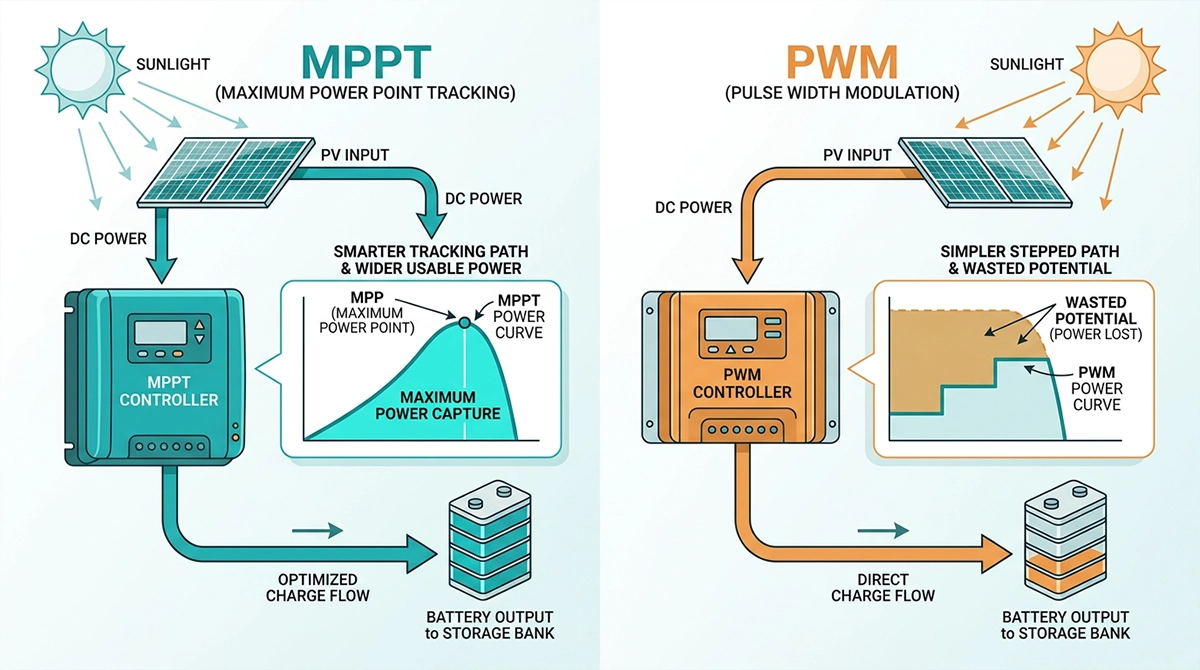
PWM (Pulse Width Modulation) connects the panel almost directly to the battery and switches the current on and off to regulate charging. MPPT (Maximum Power Point Tracking) actively converts excess panel voltage into additional charging current. That conversion is the whole story.
A PWM controller pulls the panel down to battery voltage. A “12V” panel actually produces around 18V at its maximum power point, but on PWM feeding a 12V battery, that extra voltage is simply lost, the panel is forced to operate at battery voltage instead of its optimal point.
An MPPT controller instead finds the panel’s maximum power point (the voltage × current combination that yields the most watts) and converts the surplus voltage into current. A worked example makes it concrete:
- Solar panel output: 36V at the maximum power point
- Battery bank: 12V
- PWM: forces the panel to ~13V, wasting the voltage headroom
- MPPT: takes the full 36V of power and converts it to a higher charging current at 12V
The result is more amps into the battery from the same sunlight. For the sizing math once you’ve chosen MPPT, see our MPPT controller sizing guide.
How Much More Energy Does MPPT Actually Harvest?
Industry testing and manufacturer data put the MPPT advantage at 15-30% in typical use, rising above 30% in cold climates and falling under 10% in hot weather with a well-matched panel and battery (Renogy, Morningstar). The variation is not marketing spin; it follows directly from physics.
The driver is temperature. A solar panel’s open-circuit voltage rises as it gets colder (the Voc temperature coefficient is negative). A panel rated 37.5V Voc at standard test conditions can reach 41V at 0°C. That extra voltage is exactly what MPPT captures and PWM discards, so:
- Cold or cloudy climates: MPPT gains are largest, often 20-30%+, because there’s more surplus voltage to convert.
- Moderate climates: expect mid-range gains around 15%.
- Hot climates with matched voltages: the gap can drop below 10%, because the panel voltage is already near battery voltage and there’s little surplus to reclaim.
So the honest answer to “is MPPT worth it?” is: it depends on your climate and array design. In the weak-grid, warm-climate markets we serve most, the gain sits in the middle of the range, still enough to justify MPPT on any system above a small light kit.
When Is PWM Still the Right Choice?
PWM remains sensible for small, low-voltage systems where cost matters most and panel voltage closely matches battery voltage. It is not obsolete, just narrow in scope.
Good PWM cases:
- Small 12V systems: a single panel charging a 12V battery for lights or a gate motor.
- Budget-first builds where the array is small enough that a 10-15% loss is a few watts, not kilowatt-hours.
- Matched voltage: a 12V-nominal panel (around 18V) on a 12V battery, where surplus voltage is minimal.
Once you move to 24V or 48V banks, wire panels in series, or add lithium storage, PWM’s limitations start costing real energy and the case for MPPT becomes clear.
MPPT vs PWM: Side-by-Side
| Feature | MPPT Controller | PWM Controller |
|---|---|---|
| Energy harvest | 15-30% more (climate-dependent) | Baseline |
| Cold / cloudy performance | Strong (largest advantage) | Weak |
| PV voltage flexibility | High: panels in series, high Voc | Low: panel voltage must match battery |
| Lithium storage | Well suited | Basic support |
| Cost | Higher | Lower |
| Best fit | 200W+, 24V/48V, off-grid, storage | Small 12V, matched-voltage kits |
| Wiring cost | Lower (series strings, thinner cable) | Higher current, thicker cable |
How to Choose the Right MPPT Controller
If MPPT is the answer, size it properly rather than buying on price:
- Battery voltage: confirm 12V, 24V, or 48V.
- Maximum PV input voltage: the array’s cold-weather Voc must stay under the controller’s limit (this is the one spec that damages hardware if exceeded).
- Charge current: panel watts ÷ battery voltage × 1.25 sets the amp rating; our sizing guide walks through it.
- Battery type: match the charge profile to lithium or lead-acid.
- Design margin: leave headroom for future expansion.
Still deciding whether you even need a separate controller? Many hybrid inverters include MPPT already; see MPPT controller vs inverter with built-in MPPT. For a broader buying view, our guide on how to choose a solar charge controller covers the full decision, and controller maintenance tips keep it running.
In complete storage systems, MPPT controllers pair with an off-grid inverter and a lithium battery bank.
FAQ: MPPT vs PWM
Is MPPT really worth the extra cost?
Usually yes, on any system above a small 12V kit. A 15-30% energy gain typically pays back the price difference within the first year or two, and more in cold climates. PWM only wins on very small, matched-voltage systems where the absolute energy lost is trivial.
Can I use a PWM controller with lithium batteries?
Technically some can, but it’s rarely the right choice. Lithium storage systems usually run at higher voltages and benefit from MPPT’s efficiency and charge control. For a lithium bank, budget for MPPT.
Why does MPPT perform better in cold weather?
Panel voltage rises as temperature drops (a negative Voc temperature coefficient). That extra voltage is surplus that MPPT converts into charging current, while PWM discards it. So the colder and clearer the day, the bigger MPPT’s advantage, sometimes over 30%.
Does MPPT let me wire panels in series?
Yes, and that’s a real advantage. MPPT accepts high-voltage series strings and converts down to battery voltage, which means thinner PV cable and lower installation cost over distance. PWM requires panel voltage to stay near battery voltage, ruling out long series strings.
Conclusion
MPPT and PWM both charge batteries, but MPPT’s 15-30% higher harvest, largest in cold weather and high-voltage arrays, makes it the default for anything beyond a small matched-voltage kit. Reserve PWM for the cases where its lower cost genuinely outweighs a modest energy loss.
Techfine manufactures 12/24/36/48V MPPT charge controllers from 20A to 120A, plus hybrid inverters with built-in MPPT, as OEM/ODM product lines. Tell us your target array size and battery voltage and we can match a controller or an integrated hybrid unit to your market.