
Pick an MPPT charge controller one size too small and it will spend every sunny afternoon limiting your array’s output, wasting the panels you paid for. The sizing math takes two minutes. Divide your solar array wattage by battery bank voltage, add a 25% margin, and round up to the next standard rating.
This guide gives you the formula, three worked examples with different results, and a quick-reference table covering 100W to 1200W arrays at 12V, 24V, 36V, and 48V.
Key Takeaways
- Required current (A) = total panel watts ÷ battery voltage × 1.25, rounded up to the next standard size.
- The ×1.25 is the same 125% continuous-duty factor used in the US National Electrical Code (NEC 690.8).
- Also check the controller’s maximum PV input voltage against your array’s Voc, with a 10-12% cold-weather margin.
- Above roughly 1000W at 12V, charge current passes 100A. Move to 24V or 48V instead.
The MPPT Sizing Formula
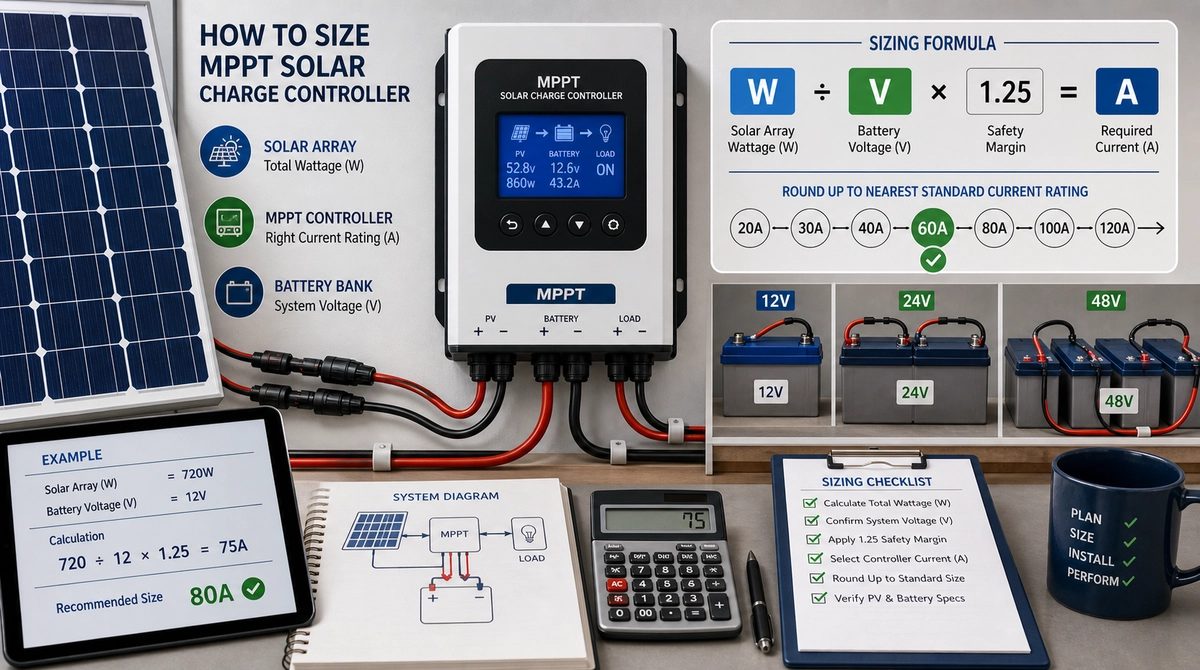
Required controller current (A) = total panel watts ÷ battery bank voltage × 1.25. Then round up to the next standard controller size: 20A, 30A, 40A, 60A, 80A, 100A, or 120A.
Two details matter here:
- Use battery voltage, not panel voltage. An MPPT controller converts high panel voltage down to battery voltage, so its amp rating describes output current on the battery side. Sizing by panel voltage is the most common mistake we see in buyer inquiries.
- Use the array’s rated (STC) wattage. Total watts of all panels connected to this controller, not the wattage of one panel.
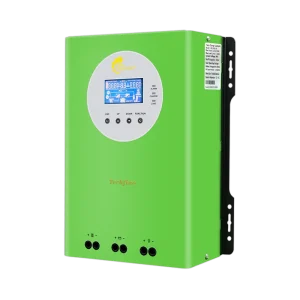
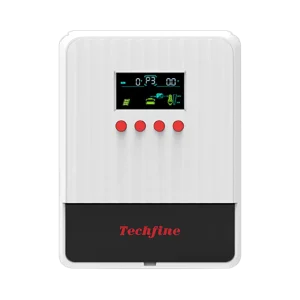
Our MPPT solar charge controllers auto-adapt to 12V, 24V, 36V, and 48V battery banks and come in 20A through 120A ratings, which is why the examples below round to those sizes.
Why Multiply by 1.25?
The 1.25 factor adds a 25% safety margin, the same 125% continuous-duty factor the US National Electrical Code applies to PV circuits (NEC 690.8). Solar panels can briefly exceed their rated output: cold panels perform above STC ratings, and cloud-edge reflection can push irradiance past 1000W/m² for short periods.
What happens if you skip the margin? Most MPPT controllers won’t be damaged, they simply limit output current. But a controller that limits output every clear afternoon is throwing away energy you paid for in panels. The 25% margin is cheaper than the wasted output.
Three Worked Examples
Each example below produces a different result, so you can see how the numbers move with array size and system voltage.
Example 1: 300W array on a 12V battery bank
- Current: 300W ÷ 12V = 25A
- With margin: 25A × 1.25 = 31.3A
- Choose: 40A MPPT controller (30A would current-limit on strong days)
Example 2: 800W array on a 24V battery bank
- Current: 800W ÷ 24V = 33.3A
- With margin: 33.3A × 1.25 = 41.7A
- Choose: 60A MPPT controller, or a 40A unit if you accept slight output limiting on peak afternoons
Example 3: 2000W array on a 48V battery bank
- Current: 2000W ÷ 48V = 41.7A
- With margin: 41.7A × 1.25 = 52.1A
- Choose: 60A MPPT controller
Notice the pattern: doubling system voltage halves the required current for the same wattage. That single fact drives most of the sizing decisions below.
Quick Reference: Controller Size for 100W-1200W Panels
The table shows the calculated requirement (watts ÷ voltage × 1.25) and the next standard controller size up. Cells marked * can also run on one size smaller if you accept minor output limiting at peak; MPPT controllers limit current safely.
| Panel Power | 12V System | 24V System | 36V System | 48V System |
|---|---|---|---|---|
| 100W | 10.4 → 20A | 5.2 → 20A | 3.5 → 20A | 2.6 → 20A |
| 150W | 15.6 → 20A | 7.8 → 20A | 5.2 → 20A | 3.9 → 20A |
| 200W | 20.8 → 30A | 10.4 → 20A | 6.9 → 20A | 5.2 → 20A |
| 250W | 26.0 → 30A | 13.0 → 20A | 8.7 → 20A | 6.5 → 20A |
| 300W | 31.3 → 40A | 15.6 → 20A | 10.4 → 20A | 7.8 → 20A |
| 350W | 36.5 → 40A | 18.2 → 20A | 12.2 → 20A | 9.1 → 20A |
| 400W | 41.7 → 60A* | 20.8 → 30A | 13.9 → 20A | 10.4 → 20A |
| 500W | 52.1 → 60A | 26.0 → 30A | 17.4 → 20A | 13.0 → 20A |
| 600W | 62.5 → 80A | 31.3 → 40A | 20.8 → 30A | 15.6 → 20A |
| 700W | 72.9 → 80A | 36.5 → 40A | 24.3 → 30A | 18.2 → 20A |
| 800W | 83.3 → 100A | 41.7 → 60A* | 27.8 → 30A | 20.8 → 30A |
| 1000W | 104.2 → 120A | 52.1 → 60A | 34.7 → 40A | 26.0 → 30A |
| 1200W | 125.0 → use 24V+ | 62.5 → 80A | 41.7 → 60A* | 31.3 → 40A |
Every cell is computed with the same formula, so you can extend it to any array size. If your wattage falls between rows, calculate directly rather than guessing.
What About Maximum Input Voltage (Voc)?
Amp rating is only half the check. The controller’s maximum PV input voltage must stay above your array’s total open-circuit voltage (Voc), including a cold-weather margin of 10-12%. Voc rises as temperature falls, and the highest voltage of the day arrives on cold, clear mornings before the controller starts loading the array.
Add up the Voc of every panel wired in series in one string. Multiply by roughly 1.12 for cold climates (this mirrors the temperature-correction method in NEC 690.7). If the result exceeds the controller’s maximum PV input, reduce panels per string or choose a higher-voltage controller. Exceeding maximum input voltage is one of the few sizing mistakes that permanently damages hardware.
When Is 12V the Wrong Choice?
Above roughly 1000W of solar, a 12V system needs more than 100A of charge current, and cable cost, fuse cost, and connection heating all climb with it. At that point, moving to 24V or 48V halves or quarters the current for the same power.
In OEM orders, we often see this play out at the distributor level: markets that standardize on 24V and 48V systems report fewer warranty claims tied to undersized cabling and overheated terminals. If you’re building a product mix for import, the 12V tier belongs to small backup kits, not kilowatt-scale arrays.
For the full system picture (battery bank and inverter sizing, not just the controller), see our guide on how to calculate solar panel, battery, and inverter sizes. If you’re still choosing between controller technologies, start with MPPT vs PWM solar charge controllers, and if you’re weighing a separate controller against a built-in one, read MPPT controller vs inverter with built-in MPPT.
FAQ: MPPT Controller Sizing
What size MPPT controller do I need for a 400W solar panel?
On a 12V battery bank: 400W ÷ 12V × 1.25 = 41.7A, so choose a 60A controller, or a 40A unit if slight peak limiting is acceptable. On a 24V bank the same array needs only 20.8A, so a 30A controller covers it.
Can a solar charge controller be too big?
Electrically, no. An oversized controller runs cooler and leaves room to add panels later. The only cost is price. Many buyers deliberately size one step up when they expect to expand the array within a year or two, which is usually cheaper than replacing the controller.
Do I size by panel voltage or battery voltage?
Battery voltage. An MPPT controller steps panel voltage down to battery voltage, so its amp rating refers to output current into the battery. Panel voltage only matters for the separate maximum-input-voltage (Voc) check.
Is sizing different for a PWM controller?
Yes. A PWM controller can’t convert voltage, so you size it from the array’s short-circuit current: total Isc × 1.25. It also requires the panel’s nominal voltage to match the battery bank. That’s one reason MPPT is the default choice above 200W or at 36V/48V.
Final Thoughts
Sizing an MPPT controller comes down to one formula, one voltage check, and one honest question about whether your system voltage still makes sense. Get those three right and the controller will never be your system’s weak point.
Techfine manufactures 12/24/36/48V auto-adaptive MPPT controllers from 20A to 120A. For distributors and brands that need custom specifications, branding, or packaging, our OEM/ODM services cover controller and inverter lines together; contact us with your target market and monthly quantities.