
To calculate solar panel, battery, and inverter size, start with the load. Add daily watt-hours, choose battery capacity by depth of discharge and backup days, size the inverter by continuous and surge load, then size the PV array and MPPT controller around local sun hours and equipment limits.
The formula is simple. The assumptions are not. A house with a refrigerator and lights is different from a shop with pumps, air conditioners, and weak-grid charging windows.
Key Takeaways
- NREL’s PVWatts calculator estimates PV output from system size, location, tilt, azimuth, and losses (NREL PVWatts, data-as-of 2026).
- Battery capacity should be calculated in usable kWh, not only nominal Ah.
- Inverter size must cover both continuous load and startup surge from motors or compressors.
- MPPT sizing must check PV open-circuit voltage, current, controller power limit, and battery voltage.
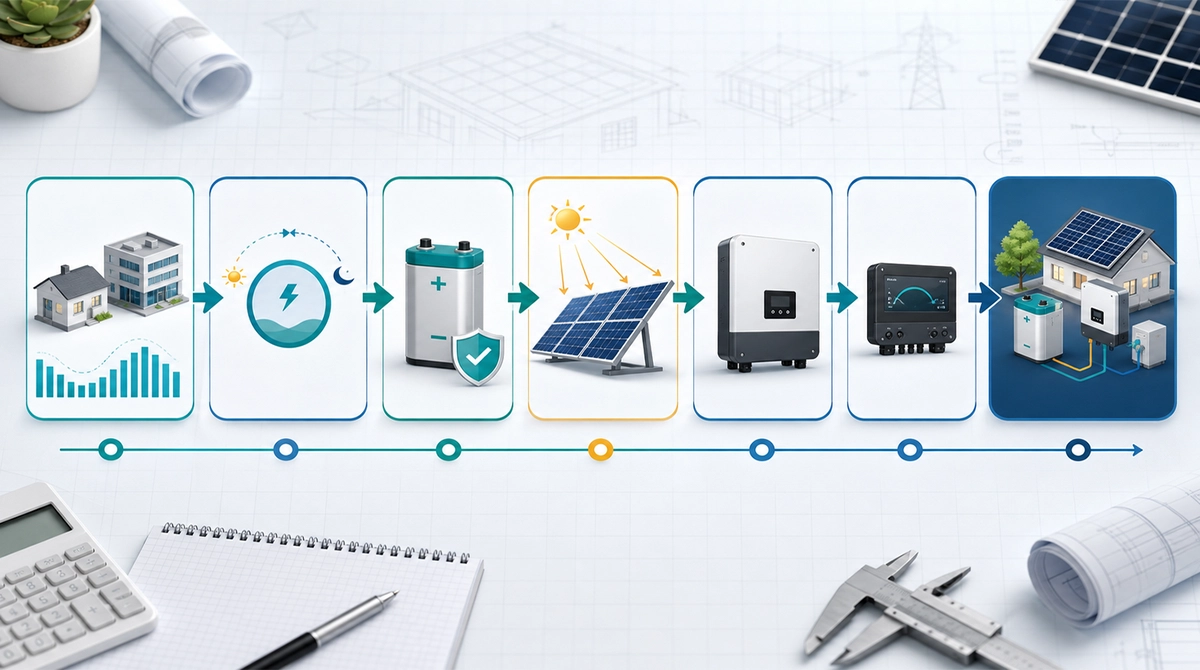
Step 1: Calculate Daily Energy Use
Daily energy use is the sum of each load’s watts multiplied by its hours of use. This gives watt-hours (Wh) or kilowatt-hours (kWh), the base number for battery and solar-panel sizing.
| Load | Power | Hours/day | Daily energy |
|---|---|---|---|
| Refrigerator | 150W | 24h | 3,600Wh |
| TV | 100W | 4h | 400Wh |
| Computer | 100W | 4h | 400Wh |
| Air conditioner | 1,500W | 5h | 7,500Wh |
| 5 LED lights | 50W total | 5h | 250Wh |
| Total | 12,150Wh / 12.15kWh |
In a real project, use the buyer’s actual appliance list. Motors, pumps, refrigerators, and air conditioners also need surge checks later.
Step 2: Calculate Battery Capacity
Battery capacity should cover the daily load, backup time, and usable depth of discharge. Do not size only by nominal battery label. A 48V 200Ah battery is 9.6kWh nominal, but usable energy depends on the allowed DoD and BMS settings.
Use this formula:
Battery kWh = Daily load kWh × backup days ÷ usable DoD
For the example:
12.15kWh × 1 day ÷ 0.8 = 15.19kWh usable-design requirement
If the project wants 1.5 days of nominal storage before applying other margins:
12.15kWh × 1.5 = 18.225kWh nominal storage target
A 48V 200Ah battery gives about 9.6kWh nominal energy. So:
18.225kWh ÷ 9.6kWh = 1.9 batteries
That means 2 batteries meet the mathematical nominal target. A third battery is not “required” by this calculation; it is an optional reserve for future load growth, lower DoD, cloudy periods, or weaker battery performance in harsh conditions.
Step 3: Size the Inverter by Continuous and Surge Load
The inverter must handle the loads that run at the same time, plus startup surge from motor loads. Continuous wattage alone can undersize a system when refrigerators, pumps, and air conditioners start.
In the example, a simple simultaneous load might be:
| Load running together | Running power |
|---|---|
| Air conditioner | 1,500W |
| Refrigerator | 150W |
| TV | 100W |
| Computer | 100W |
| Lights | 50W |
| Total running load | 1,900W |
A 3,000W pure sine wave inverter can cover this running load with margin. The missing question is surge. If the air conditioner or refrigerator has a high starting current, a larger inverter or soft-start plan may be needed.
For importers, this is a common warranty problem. Customers buy by watts, then connect a pump or compressor that trips the inverter. Ask about load type, not only total wattage.
Step 4: Calculate Solar Panel Size
PV array size depends on daily energy demand, local solar resource, and system losses. NREL’s PVWatts tool exists because location, tilt, azimuth, weather, module type, and losses change real production.
A quick estimate uses:
PV watts = Daily Wh ÷ (peak sun hours × system efficiency)
Using the original example assumption of 5 peak sun hours and 80% system efficiency:
12,150Wh ÷ (5 × 0.8) = 3,037.5W
So a 3.0-3.2kW PV array is a reasonable starting estimate for daily energy replacement. In a cloudy region, dusty site, or winter-heavy load profile, the buyer should run location-specific production estimates instead of relying on 5 sun hours.
NREL’s PVWatts model is designed for these production estimates and accounts for losses in the conversion from array size to AC energy (NREL PVWatts Manual, 2014).
Step 5: Check the MPPT Charge Controller or Built-in MPPT
The MPPT controller must fit the PV array’s voltage, current, and power, not just the total panel wattage. A 3,000W array on a 48V battery suggests about 62.5A before losses and charging limits, so a “60A controller” may be tight depending on the model.
Check these items:
| MPPT check | What to verify |
|---|---|
| Max PV open-circuit voltage | Cold-weather Voc must stay below the controller limit |
| PV operating voltage | Must sit inside the MPPT working range |
| Max PV input current | Array current must stay inside controller rating |
| Max PV input power | Some controllers limit watts by battery voltage |
| Battery voltage | 12V, 24V, 48V, or other platform must match |
| Charge current | Must fit battery/BMS charge limit |
Victron’s SmartSolar manual gives a clear example of voltage boundaries: the PV open-circuit voltage must not exceed the controller’s limit, and PV voltage must be high enough above battery voltage for charging (Victron Energy, data-as-of 2026). The exact limits depend on the controller model.
For controller-specific math, use our MPPT charge controller sizing guide and compare MPPT vs PWM charge controllers.
Step 6: Put the Example Together
For the example household, the base design is about 12.15kWh/day, a 3kW-class PV array, 2 × 48V 200Ah batteries as the nominal minimum, and a 3kW inverter only if surge loads are acceptable. A third battery is a reserve choice, not a math requirement.
| System part | Example result | Notes |
|---|---|---|
| Daily load | 12.15kWh/day | Based on listed appliances |
| PV array | About 3.0-3.2kW | Assumes 5 sun hours and 80% efficiency |
| Battery minimum | 2 × 48V 200Ah | About 19.2kWh nominal |
| Optional reserve | 3 × 48V 200Ah | More autonomy and lower DoD |
| Inverter | 3,000W+ | Confirm surge from AC/fridge/pump |
| MPPT | Model-dependent | Check voltage/current/power limits |
If the buyer is planning a 24V system, read our 24V solar inverter setup guide. If the buyer is choosing a home inverter type first, start with our solar inverter for home use guide.
FAQ: Solar Panel, Battery, and Inverter Calculation
What is the basic formula for solar panel size?
Use daily Wh divided by peak sun hours and system efficiency. For example, 12,150Wh divided by 5 sun hours and 0.8 efficiency equals about 3,038W of panels. For real projects, use local solar data or PVWatts instead of a fixed sun-hour assumption.
How many batteries do I need for a 12.15kWh daily load?
With a nominal 18.225kWh storage target and 48V 200Ah batteries at 9.6kWh each, the math gives 1.9 batteries, so 2 batteries meet the nominal target. Use 3 batteries only if you want extra reserve, lower DoD, or future expansion.
Is a 3,000W inverter enough for this example?
It may be enough for the listed running load, but only if startup surge is within the inverter’s surge rating. Air conditioners, refrigerators, pumps, and compressors can need much higher startup power. Always check the largest motor load before choosing the inverter.
Can I size the MPPT controller by amps only?
No. MPPT sizing must check amps, PV open-circuit voltage, PV working voltage, maximum PV input power, battery voltage, and battery charge-current limit. A controller that looks correct by amp rating can still be wrong if the PV string voltage is outside its range.
What should distributors ask before quoting a system?
Ask for the load list, appliance surge loads, backup hours, battery chemistry, site voltage, local sun conditions, installation type, and monthly quantity. For OEM/ODM projects, also ask whether the buyer needs 24V, 48V, split-phase, or three-phase options.