

An all-in-one energy storage system combines the main parts of a solar storage setup into one cabinet or matched enclosure: battery modules, inverter or PCS, battery management, system controls, protection, and monitoring. For distributors and installers, the appeal is simple. Fewer separate boxes can mean faster installation, cleaner wiring, and easier stock planning.
It is not the right answer for every project. A split system may still be better when a buyer needs unusual battery capacity, difficult service access, or separate inverter and battery brands.
Key Takeaways
- DOE describes energy storage as a way to improve electric reliability, resilience, and grid flexibility (Energy.gov, data-as-of 2026).
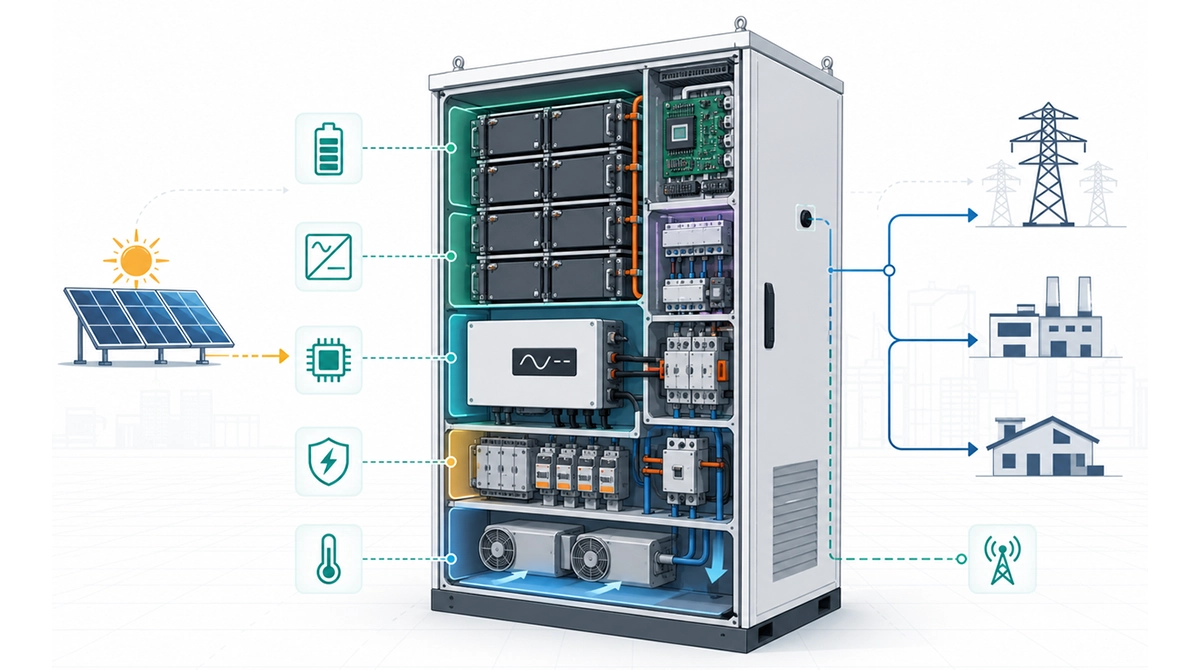
- An all-in-one ESS usually integrates the battery, inverter/PCS, BMS, EMS or controller, protection, and monitoring.
- It fits residential backup, small commercial backup, weak-grid markets, and OEM/ODM programs that need repeatable installation.
- It does not replace site design, battery sizing, ventilation, local code checks, or after-sales planning.
What Is an All-in-One Energy Storage System?
An all-in-one energy storage system is a pre-integrated storage product that packages several power-conversion and battery-control functions together. Instead of buying a separate inverter, battery cabinet, BMS interface, controller, and monitoring gateway, the buyer receives one matched system or one coordinated product family.
In solar use, the system stores PV or grid energy when power is available, then releases it to loads when needed. DOE explains that modern inverters do more than convert DC to AC; they can also help manage interaction between solar, storage, loads, and the grid (DOE Solar Energy Technologies Office, data-as-of 2026).
For an importer, the value is not only technical. It can reduce training time for installers, simplify spare-parts planning, and make the product easier to explain in a showroom. The risk is lock-in: if one integrated part is poorly matched, the whole system suffers.
What Parts Are Inside an All-in-One ESS?
Most all-in-one ESS products combine 6 core functions: battery storage, power conversion, battery protection, system control, electrical protection, and monitoring. The exact design varies by brand, voltage platform, and whether the system is residential, commercial, or cabinet-style.
| Component | What it does | Buyer check |
|---|---|---|
| Battery modules | Store energy, usually lithium-based in modern systems | Chemistry, usable kWh, service access |
| Inverter or PCS | Converts DC battery/PV power to AC load power | Output voltage, surge rating, grid mode |
| BMS | Monitors cells and protects the battery pack | Communication, current limit, alarm logic |
| EMS or controller | Decides when to charge, discharge, or bypass | Operating modes and setup interface |
| Protection devices | Help manage faults and isolation | Breakers, fuses, SPD, emergency stop where needed |
| Monitoring | Shows energy flow, alarms, and history | App, display, remote support, language options |
This is where many buyers get confused. “All-in-one” does not mean every project uses the same wiring, battery capacity, or grid rule. It means the product supplier has already matched many of the internal building blocks.
How Does an All-in-One ESS Work With Solar Power?
In a solar storage system, the all-in-one ESS receives energy from PV, the grid, or both, then manages how that energy is stored and delivered. The inverter side converts power for AC loads, while the battery and BMS side keeps storage inside safe operating limits.
A common weak-grid sequence looks like this:
- Solar panels supply daytime power.
- The inverter serves loads first, when the system is set that way.
- Extra energy charges the battery.
- During an outage, the system supplies selected loads from the battery.
- When grid power returns, the system can recharge or return to normal operation.
The exact behavior depends on the product mode, grid code, battery capacity, and local wiring. That is why importers should ask for mode diagrams, not only a product photo. A good diagram should show PV input, battery path, AC input, AC output, bypass, grounding, and monitoring.
When Does an Integrated ESS Fit Better Than Separate Components?
An integrated ESS fits best when the buyer wants repeatable installation, compact layout, and one supplier responsible for matching the inverter and battery interface. It is especially useful for residential backup programs, small shops, clinics, telecom rooms, and distributors building a standard weak-grid product package.
| Project condition | All-in-one ESS fit | Why it matters |
|---|---|---|
| Standard residential backup | Strong fit | Faster installation and easier sales training |
| Small commercial load | Often good | Cleaner cabinet layout and fewer separate boxes |
| Remote off-grid site | Depends | Service access and expansion may matter more |
| Large C&I project | Usually limited | Separate PCS and battery cabinets may scale better |
| OEM/ODM residential line | Strong fit | Repeatable cabinet, label, and documentation package |
| Mixed-brand expansion | Weaker fit | Split systems give more component flexibility |
For a deeper comparison between integrated and split architectures, read our guide to all-in-one ESS vs inverter and battery systems. Keep this page as the definition and architecture overview; use the comparison page when choosing between product styles.
What Should Importers Check Before Buying an All-in-One ESS?
Importers should check more than capacity and price; the real questions are battery serviceability, inverter compatibility, documentation, after-sales support, and market voltage. A cabinet that looks clean in a catalog can still create warranty problems if installers cannot diagnose faults quickly.
Use this short purchasing checklist:
- Voltage platform: confirm 110/120Vac, 220/230Vac, or split-phase requirements for your market.
- Battery chemistry: confirm whether the pack is LiFePO4, NMC, or another chemistry.
- Usable capacity: ask for nominal kWh and usable kWh, not only cell capacity.
- BMS communication: check CAN, RS485, or brand-specific protocols.
- Installation manual: require wiring, grounding, ventilation, and fault-code documentation.
- Spare parts: ask which boards, fans, breakers, displays, or battery modules are serviceable.
- Certification documents: confirm only the certificates needed in your market, and verify them before marketing.
An all-in-one ESS can reduce installation complexity, but it does not remove installer responsibility. Site load calculation, grounding, cable sizing, protection coordination, and local rules still decide whether the system works safely.
How Does an All-in-One ESS Differ From a Hybrid Inverter?
A hybrid inverter is one component; an all-in-one ESS is a system package built around storage and power conversion. A hybrid inverter can work with batteries, solar input, and grid input, but it may still require a separate battery cabinet, external protection, and a separate monitoring setup.
Think of the difference this way:
| Item | Hybrid inverter | All-in-one ESS |
|---|---|---|
| Main identity | Power-conversion device | Integrated storage system |
| Battery | Usually external | Often built in or cabinet-matched |
| BMS | In battery pack, external to inverter | Integrated interface expected |
| Installation | More component matching | More pre-integrated |
| Expansion | Often more flexible | Depends on cabinet design |
| Best fit | Custom system design | Standardized backup package |
If the buyer mainly asks about grid export, battery backup, and PV input, start with our hybrid inverter vs grid-tie inverter guide. If the buyer asks about cabinet packages and simple deployment, an all-in-one ESS discussion is more useful.
What Can Go Wrong With an All-in-One ESS?
Most all-in-one ESS problems come from oversizing expectations, poor ventilation, weak documentation, or unclear after-sales responsibility. The integrated format makes the system easier to sell, but it can also hide details that buyers should check before ordering.
Watch these risks:
- Undersized inverter output: the battery may be large, but the AC output still limits real load support.
- Poor surge handling: refrigerators, pumps, and compressors can need much higher startup power.
- Thermal limits: compact cabinets still need airflow and temperature management.
- Single-supplier dependency: replacement parts must be available from the system supplier.
- Unclear warranty scope: water ingress, wrong wiring, and overload may be excluded.
- Protocol mismatch: battery and inverter communication must be tested, not assumed.
For battery-control details, see our explanation of what a BMS does for a battery. For inverter basics, see what an inverter is and how it works.
FAQ: All-in-One Energy Storage Systems
Is an all-in-one ESS the same as a battery?
No. A battery stores energy, while an all-in-one ESS usually includes the battery plus power conversion, BMS, controls, protection, and monitoring. Some products use separate battery modules inside a matched cabinet. Ask for a block diagram before treating it as “just a battery.”
Is an all-in-one ESS better than a separate inverter and battery?
It depends on the project. An all-in-one ESS can be easier to install and sell as a standard package. A separate inverter and battery system can be better when the buyer needs unusual capacity, brand flexibility, or easier component replacement.
Can all-in-one ESS products work off-grid?
Many can support off-grid or backup operation, but only if the model is designed for that mode and the load is sized correctly. Check continuous output, surge rating, battery capacity, generator input, grounding rules, and the product manual before using it for off-grid sites.
What should distributors ask before importing all-in-one ESS units?
Ask for the battery chemistry, usable kWh, inverter output, surge capacity, BMS protocol, wiring diagram, fault-code list, spare-parts plan, warranty terms, and required market certificates. For OEM/ODM orders, also confirm label, enclosure, language, packaging, and minimum order quantity.
Where does Techfine fit in all-in-one ESS sourcing?
Techfine supplies all-in-one ESS, hybrid inverter, off-grid inverter, and LiFePO4 battery options for distributors and OEM/ODM partners. If you are building a standard backup-power line, share your market voltage, target kWh, load profile, and expected monthly volume.