

High-frequency and low-frequency inverters both convert DC power into AC power. The difference is the power-stage and transformer design, which changes size, weight, surge behavior, repair approach, and the loads each design can suit. Neither design is automatically better: the right choice starts with the load profile, installation space, grid condition, and service plan.
For importers, the important question is not the label on a catalog. It is whether the exact model can handle the customer’s continuous load, motor-starting surge, battery system, and field environment.
Key Takeaways
- High-frequency designs are commonly more compact and lighter because they use high-frequency switching and smaller magnetic components.
- Low-frequency transformer designs are often selected where a larger surge margin for motor loads is required, but exact surge ratings vary by model.
- Do not compare only rated watts. Check surge duration, overload behavior, PV and battery limits, protection, and after-sales documentation.
- “High frequency” and “low frequency” describe design approaches, not a universal quality ranking.
What Is a High-Frequency Inverter?
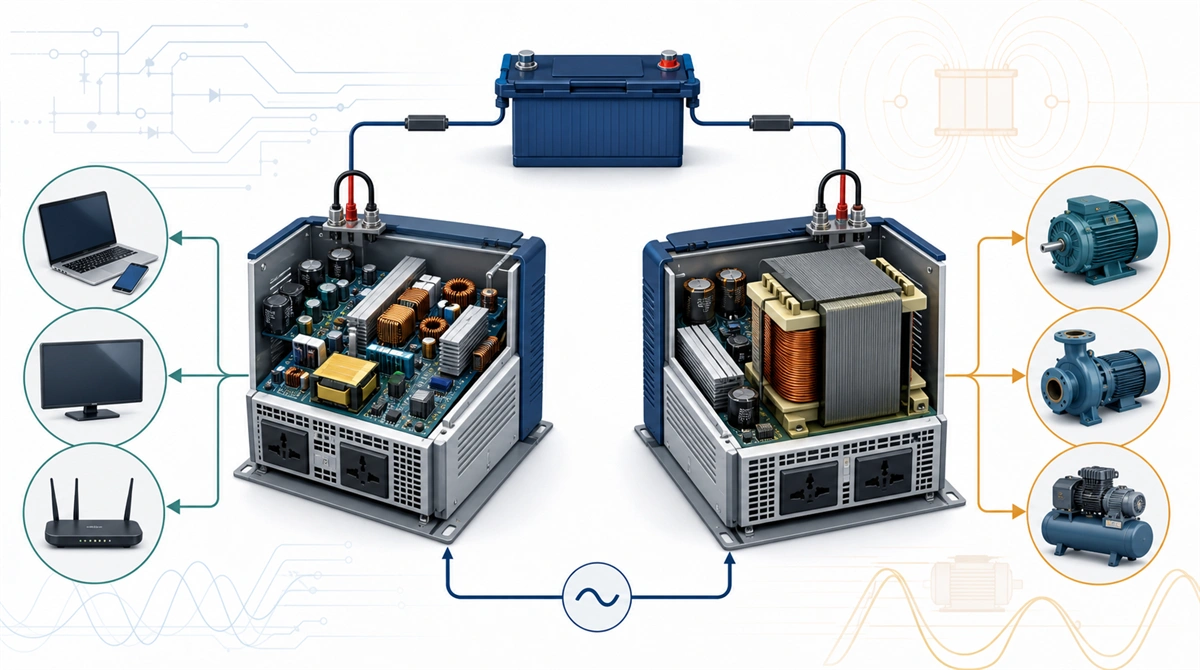
A high-frequency inverter uses fast switching and a compact high-frequency transformer or transformerless power stage. This can reduce weight and enclosure size, which is useful where wall space, shipping volume, or portability matter.
High-frequency products are common in residential solar storage, compact backup systems, RV applications, and light commercial use. Their suitability for a load still depends on the exact model’s surge rating, thermal design, and overload response.
What Is a Low-Frequency Inverter?
A low-frequency inverter commonly uses a larger transformer operating at grid frequency, usually 50Hz or 60Hz. The transformer adds weight and volume, but the design is often chosen for applications with difficult motor starts, pumps, compressors, or other inductive loads.
This does not mean every low-frequency inverter will start every motor. A buyer must check the appliance starting demand, inverter surge specification, cable voltage drop, battery capability, and protection settings.
High Frequency vs Low Frequency: What Changes for Buyers?
The comparison below is a sourcing framework, not a product datasheet. Confirm all values against the exact model manual.
| Buyer factor | High-frequency design | Low-frequency design | What to verify |
|---|---|---|---|
| Size and shipping | Often more compact and lighter | Often larger and heavier | Dimensions, net weight, carton and container plan |
| Motor-starting loads | Depends strongly on model surge rating | Often chosen for higher surge demand | Surge watts, duration, battery current capability |
| Light-load efficiency | Often favorable in compact systems | Depends on transformer and load profile | Efficiency curve, not only peak efficiency |
| Installation space | Easier for wall-mount or compact cabinets | Needs more mounting support and space | Clearance, mounting surface, cooling path |
| Service approach | Power electronics may need board-level diagnosis | Transformer design changes repair/spare approach | Fault-code guide, spare parts, service training |
| Best-fit question | Is compact size and standard backup load the priority? | Are pumps/compressors and high starting current the priority? | Actual load list and start sequence |
When Is a High-Frequency Inverter a Better Fit?
A high-frequency design can be a good fit when installation space, weight, and standard residential or light-commercial loads matter more than extreme motor-starting demand. It is often relevant for wall-mounted storage systems, small shops, mobile systems, and distributors managing shipping volume.
Before selecting one, list the loads that operate together and separate continuous watts from starting surge. For load sizing, see how to calculate solar panel, battery, and inverter capacity.
When Is a Low-Frequency Inverter a Better Fit?
A low-frequency design may be a better fit where pumps, compressors, workshop tools, or other inductive loads dominate the backup plan. The transformer-based approach is often valued for surge handling, but the final choice still depends on the exact surge duration and battery-bank capability.
Weak-grid or off-grid projects should also check generator compatibility, AC input range, low-battery behavior, and field-service support. Read on-grid vs off-grid solar inverters for the system-level decision.
What Mistakes Should Importers Avoid?
The main mistake is choosing by inverter label or rated power alone. A compact inverter can be the right choice for a simple load profile; a heavy transformer unit can be unnecessary if the load has no large starting surge.
- Promising motor-starting capability without testing the actual appliance and battery configuration
- Treating peak efficiency as real operating efficiency at every load level
- Ignoring shipping weight, wall strength, ventilation, and technician access
- Matching a large inverter to an undersized battery bank or weak cabling
- Assuming high frequency or low frequency proves a particular certification or protection feature
- Skipping the fault-code guide and spare-parts discussion before launching a product line
Protection design also matters. Use solar inverter protection to build a specification checklist before sourcing.
How Should a Distributor Build the Product Mix?
A practical portfolio can include compact models for standard home backup and selected higher-surge options for pump, compressor, and workshop applications. Do not market the two designs as rivals in every case. Market fit depends on the customer’s loads, voltage, battery plan, and service capability.
Techfine can help OEM/ODM buyers review target voltage, expected load types, battery configuration, and monthly quantity before choosing an inverter category. The exact product datasheet should be the final reference for surge, efficiency, protection, communication, and certification claims.
Sources
- U.S. Department of Energy, Solar Integration: Inverters and Grid Services Basics, accessed July 2026 — general inverter and grid-service background.
- Exact high-frequency and low-frequency topology behavior varies by product; validate model-specific surge, efficiency, protection, and environmental limits against the manufacturer datasheet before publishing or quoting.
FAQ: High Frequency vs Low Frequency Inverters
Is a high-frequency inverter always more efficient?
No. High-frequency designs are often selected for compact size and can show strong efficiency, but the useful comparison is the exact model’s efficiency curve at the loads customers will use. Peak efficiency alone does not show performance at light load, high temperature, or motor startup.
Is a low-frequency inverter always better for pumps?
Not always. Low-frequency units are often selected for demanding motor loads, but a pump’s starting demand, the inverter’s surge duration, cable voltage drop, and the battery bank all matter. Check the pump nameplate and test or validate the exact configuration before making a sales claim.
Can two same-rated inverters handle the same load?
Not necessarily. Two units with the same continuous watt rating can have different surge behavior, thermal derating, input limits, overload shutdown logic, and battery-current requirements. Compare the complete datasheet and load profile.
What should an OEM buyer request before choosing an inverter design?
Request the full datasheet, overload and surge curve, installation manual, fault-code table, battery compatibility information, environmental limits, warranty conditions, spare-parts policy, and applicable certification documents for the exact model. Share expected loads and local voltage before finalizing a product mix.