
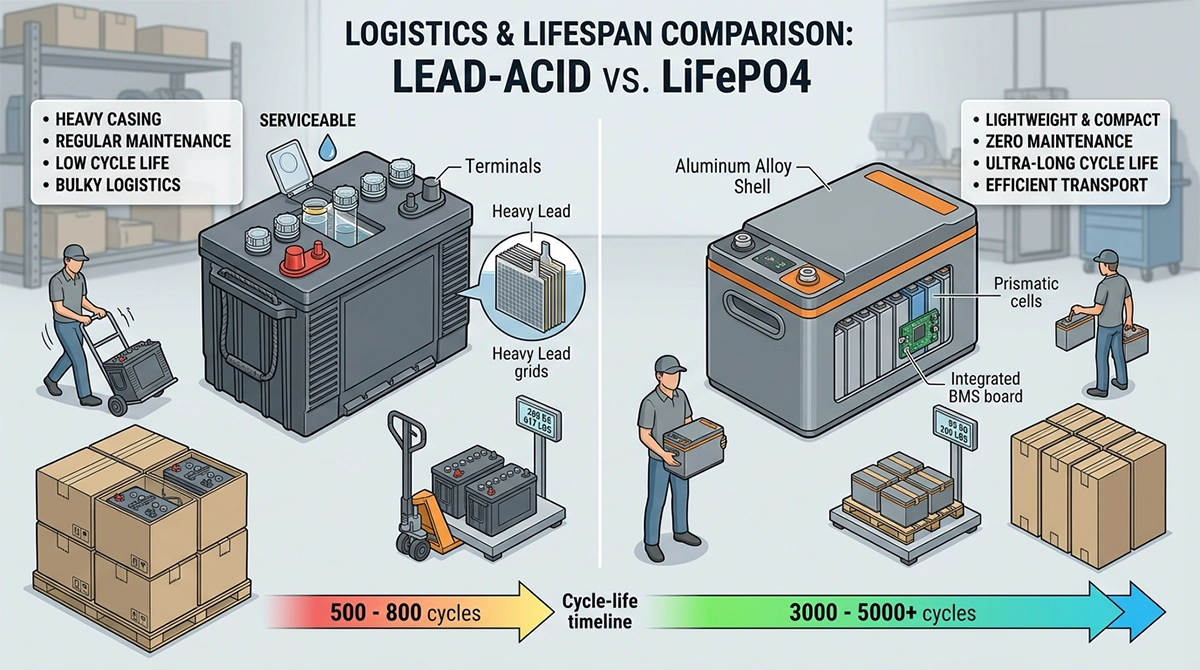
The headline difference between lead acid and lithium ion batteries is lifespan: a LiFePO4 battery typically delivers 3,000-6,000 cycles versus 300-500 for lead acid, roughly ten times as many (SolaxPower). That single fact reshapes the cost comparison, because the cheaper battery is often the more expensive one over a system’s life.
This guide compares the two on cycle life, usable capacity, weight, and true cost, then adds the part that matters to importers and distributors: how the choice affects shipping, storage, and warranty economics. For solar storage, “lithium” almost always means LiFePO4, so this comparison focuses there.
Key Takeaways
- LiFePO4 lasts about 10x longer: 3,000-6,000 cycles vs 300-500 for lead acid (SolaxPower).
- Usable capacity differs: a 100Ah lead acid gives ~50Ah usable (50% DoD); a 100Ah LiFePO4 gives ~80Ah (80% DoD).
- Lead acid wins only on upfront price. Over total cycles, LiFePO4 usually costs less per kWh delivered.
- For importers, LiFePO4’s lighter weight and lower failure rate cut shipping and warranty costs, but add battery transport documentation.
Lead Acid vs Lithium Ion: The Numbers
Lead acid wins on upfront price; LiFePO4 wins on almost everything else that affects long-term cost. The table below uses typical figures for solar-grade batteries of each chemistry.
| Feature | Lead Acid | Lithium Ion (LiFePO4) |
|---|---|---|
| Cycle life | 300-500 cycles | 3,000-6,000 cycles |
| Safe depth of discharge (DoD) | ~50% | 80-90% |
| Usable capacity (per 100Ah) | ~50Ah | ~80Ah |
| Weight (same usable energy) | Heavier | ~1/3 the weight |
| Charging speed | Slower | Faster |
| Maintenance | Flooded types need topping up | Maintenance-free |
| Upfront cost | Lower | Higher |
| Cost per kWh delivered | Higher over life | Lower over life |
Figures are typical industry ranges (varies by grade, temperature, and duty cycle). DoD (depth of discharge) means how much of the battery you actually use before recharging.
Why the Cheaper Battery Often Costs More
A battery’s real cost is not its price tag; it’s the price divided by the energy it delivers over its life. On that measure, LiFePO4 usually comes out cheaper despite costing more upfront. This is the concept behind levelized cost of storage (LCOS): total cost of ownership spread across every kWh the battery will ever deliver.
Work it through. A lead acid battery at 300-500 cycles will be replaced several times over the 10-15 year life of a LiFePO4 unit. Each replacement is not just the battery cost, it’s shipping, labor, downtime, and disposal, repeated. In load-shedding markets where batteries cycle daily, lead acid can reach end of life in two to three years, while LiFePO4 keeps going.
Lead acid still makes sense when cycling is rare (standby-only backup) or when the upfront budget is a hard ceiling. But for daily solar storage, choosing lead acid to “save money” often costs more within five years.
Usable Capacity: Why 100Ah Is Not 100Ah
Depth of discharge means a 100Ah lead acid battery safely delivers only about 50Ah, while a 100Ah LiFePO4 delivers about 80Ah, so lithium gives roughly 60% more usable energy from the same nameplate rating. Discharging lead acid below 50% sharply shortens its life; LiFePO4 tolerates 80-90% routinely.
This changes system sizing. To get the same usable energy, a lead acid bank needs a larger nameplate capacity, more batteries, more weight, and more space. When buyers compare only the Ah number and the price, they miss that they’re comparing different amounts of actually usable energy. For how to verify usable capacity on delivery, see our lithium battery testing guide.
The Importer’s View: Shipping, Storage, and Warranty
Beyond the technical specs, the chemistry choice hits an importer’s cost structure in three places: freight weight, warranty failure rate, and transport compliance. This is the angle a spec sheet won’t show you.
- Freight and handling. LiFePO4 weighs roughly a third of lead acid for the same usable energy. On container economics and last-mile delivery in markets with poor roads, that weight difference is real money.
- Warranty exposure. Lead acid’s shorter life and sensitivity to deep discharge and heat mean higher field failure rates in hot, weak-grid markets, exactly the conditions many distributors sell into. Fewer returns is a margin lever.
- Transport compliance. Lithium batteries are classed as dangerous goods for shipping and need UN38.3 test documentation and proper packaging. This adds a paperwork step lead acid doesn’t, so factor it into lead times. (Ask your supplier for the transport documentation up front.)
- Shelf storage. Both chemistries need care in the warehouse; our guides on storing lithium batteries and battery maintenance cover SOC and temperature targets.
When Does Lead Acid Still Make Sense?
Lead acid is not obsolete. It remains the practical choice when:
- The system is standby-only and rarely cycles (some UPS and backup roles).
- The upfront budget is a hard limit and the buyer accepts shorter life.
- Very high surge currents are needed at low cost (some starting applications).
For automotive starting, lead acid is still standard, since starter batteries aren’t deeply discharged and lead acid handles high cranking current well. Within the lead acid family, the AGM vs GEL and AGM vs deep-cycle guides help narrow the type, and what a lead acid battery is covers the basics.
FAQ: Lead Acid vs Lithium
Is lithium always better than lead acid?
No. LiFePO4 is better for daily-cycling solar storage on almost every measure except upfront price. But for rare-use standby backup or a strict budget ceiling, lead acid can still be the sensible choice. The deciding factor is how often the battery cycles.
How much longer does a LiFePO4 battery last?
Typically about ten times the cycle count: 3,000-6,000 cycles versus 300-500 for lead acid, and often 10-15 years versus 2-5 in daily use. Actual life depends on temperature, depth of discharge, and charge quality.
Why can’t I discharge a lead acid battery fully?
Discharging lead acid below about 50% causes sulfation and rapid capacity loss, cutting its already-short cycle life further. That’s why a 100Ah lead acid battery only gives about 50Ah of usable energy. LiFePO4 safely uses 80-90%.
Do lithium batteries need a special inverter?
They need an inverter or charger set to a LiFePO4 charge profile and, ideally, BMS communication for protection and monitoring. Many hybrid inverters support this directly. Confirm battery-inverter compatibility, including communication protocol, before ordering.
Are lithium batteries harder to ship?
They require dangerous-goods handling and UN38.3 transport documentation, which lead acid doesn’t. Reputable suppliers provide the paperwork and compliant packaging, so it’s a planning step, not a barrier. Their lighter weight often offsets the extra process on total freight cost.
Conclusion
Lead acid wins the price tag; LiFePO4 wins the life. With roughly ten times the cycles, 60% more usable capacity per nameplate Ah, and a third of the weight, lithium is the better long-term choice for daily solar storage, while lead acid holds on for standby and strict-budget roles.
Techfine manufactures LiFePO4 storage batteries (including 100Ah/51.2V, 230Ah/51.2V, 300Ah/51.2V, and 200Ah/25.6V) using Grade A cells, with CE certification and multi-protocol BMS communication for inverter compatibility. As both a battery and inverter manufacturer, we match the two for you. Send your market, cycling profile, and volume for OEM/ODM battery configurations.