
AGM and GEL batteries are both valve-regulated lead-acid (VRLA) batteries, but they are not interchangeable by default. AGM is often selected for standby backup and higher-current discharge, while GEL is often considered for cycling applications that use the correct charging profile. The battery datasheet, not the label alone, should decide the final choice.
For importers and installers, the most expensive mistake is using a generic lead-acid charging setting for a battery that needs a different voltage, current limit, temperature compensation, or equalization rule.
Key Takeaways
- AGM and GEL are both sealed VRLA lead-acid designs; neither one automatically means “deep-cycle.”
- AGM is often used for UPS, standby, and higher-current applications; GEL is often selected for cyclic service, but model design varies.
- GEL batteries can be sensitive to excessive charging voltage/current. Use the exact battery manual.
- Compare use case, charge profile, discharge demand, ambient conditions, service support, and replacement cost — not only purchase price.
What Is an AGM Battery?
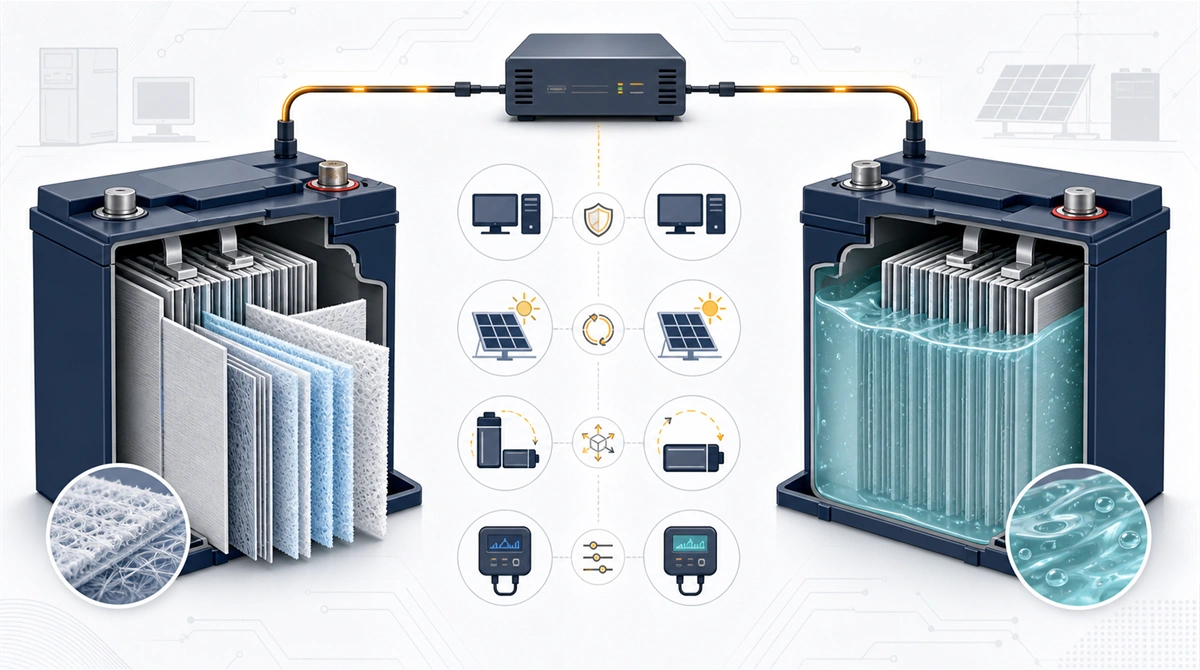
AGM stands for Absorbent Glass Mat: its electrolyte is held in fiberglass separators between the plates. This VRLA design is sealed and does not need routine water addition under normal intended use.
AGM batteries are commonly used in UPS systems, emergency backup, telecom, vehicles, and other applications where compact sealed construction and higher-current discharge are relevant. This does not make every AGM battery a high-cycle solar battery; check the model’s intended use and cycle data.
What Is a GEL Battery?
A GEL battery is a VRLA lead-acid battery with electrolyte immobilized in a gel. The construction is also sealed, but its charging requirements can differ from an AGM design.
GEL batteries are often considered for deep-cycle, solar, marine, and telecom applications. Their real performance still depends on plate design, charge control, operating temperature, discharge depth, and the exact manufacturer specification.
AGM vs GEL: What Is the Practical Difference?
The table is a buyer framework. It does not replace a model-specific datasheet.
| Buyer factor | AGM VRLA | GEL VRLA | What to check |
|---|---|---|---|
| Electrolyte | Absorbed in glass mat | Immobilized gel | Exact construction and intended use |
| Typical focus | Standby, UPS, higher-current discharge | Cyclic use, solar/telecom applications | Manufacturer’s application guide |
| Charge acceptance | Often supports higher charge current by model | May require more controlled charging | Absorption/float voltage, current limit, temperature compensation |
| High-current load | Often a strong fit | Depends on model and discharge rate | Discharge curve and surge demand |
| Installation | Sealed design; follow manual ventilation/orientation rules | Sealed design; follow manual ventilation/orientation rules | Approved mounting orientation and enclosure |
| Cost decision | Often lower initial cost | Often higher initial cost | Lifecycle cost, availability, replacement time |
Why Do Charging Settings Matter So Much?
Incorrect charging is one of the quickest ways to reduce VRLA battery life. East Penn’s VRLA technical manual notes that charging must be well regulated, and it warns that conventional alternator regulation can be too high for some GEL batteries. Rolls Battery similarly notes that both undercharging and overcharging shorten AGM VRLA cycle life.
Do not copy generic settings from another battery. Confirm absorption voltage, float voltage, charging-current limit, temperature compensation, and any equalization instruction from the exact battery datasheet. In many cases, equalization settings appropriate for flooded lead-acid should not be assumed for VRLA batteries.
A charge controller must also match the battery. See solar charge controller maintenance and MPPT vs PWM controllers before configuring a solar system.
Which Battery Fits UPS and Short Backup Loads?
AGM is often the practical starting point for UPS, standby, and higher-current backup loads, provided the exact discharge rating and charging requirements match the application. It can be a useful option where buyers need sealed lead-acid technology, compact installation, and familiar service procedures.
But do not choose AGM only because a load has a high starting current. Confirm the load duration, inverter surge demand, cable voltage drop, ambient temperature, and the battery’s published discharge curve.
Which Battery Fits Solar and Repeated Cycling?
A GEL battery may suit repeated cycling where its specified charge profile can be maintained, but it is not automatically superior for every solar installation. A poorly configured controller can shorten GEL battery life as quickly as any other lead-acid design.
For small, budget-sensitive systems, either type may fit when the cycle duty is modest and the charging system is correct. For daily solar storage, also compare lifecycle cost against LiFePO4. See lead-acid vs lithium-ion batteries and how to store lithium-ion batteries.
Are AGM and GEL the Same as Deep-Cycle Batteries?
No. AGM and GEL describe VRLA electrolyte designs, while “deep-cycle” describes a battery’s intended cycling duty and construction. Some AGM and GEL products are designed for cyclic service; others are primarily for standby use.
Before sourcing, request cycle-life data at the stated depth of discharge, the discharge curve, recommended charge settings, storage guidance, and warranty terms. Our AGM vs deep-cycle battery guide explains this distinction in more detail.
What Should Importers Ask a Supplier?
- Intended use: standby, cyclic, or both
- Recommended absorption, float, and temperature-compensation values
- Charge-current limit and equalization guidance
- Published discharge curves and cycle-life test conditions
- Approved installation orientation, ventilation, and storage requirements
- Warranty conditions and local return/after-sales process
- Availability of matching chargers, controllers, and documentation
Conclusion
AGM and GEL are both useful sealed lead-acid options, but they fit different operating priorities. AGM is often used for standby and higher-current backup; GEL can fit cyclic applications when the charge system follows the exact battery requirements.
For a B2B product decision, do not compare only the initial price. Compare the load, cycling duty, controller configuration, temperature, documentation, and total replacement cost. Techfine can help distributors review battery and inverter matching for solar-storage projects, while the final settings must follow the exact model manuals.
Sources
- East Penn / Deka, VRLA Technical Manual, accessed July 2026 — AGM/GEL construction and regulated-charging guidance.
- Victron Energy, GEL and AGM Batteries Datasheet, accessed July 2026 — cyclic-service and charge-curve background.
- Rolls Battery, AGM Charging Technical Support, accessed July 2026 — under/overcharging and model-specific charge settings.
FAQ: AGM vs GEL Batteries
Is GEL better than AGM for solar storage?
Not automatically. GEL can be a good cyclic-use option when its required charging settings are maintained. AGM can also work in solar systems when the duty cycle and charge profile match the battery. Compare the exact battery’s cycle data, charging requirements, temperature conditions, and replacement cost before choosing.
Can I use the same charger setting for AGM and GEL batteries?
Do not assume so. Both are VRLA batteries, but their recommended absorption, float, current-limit, temperature-compensation, and equalization rules can differ. Use the exact battery datasheet and the controller or charger’s approved battery profile.
Can AGM and GEL batteries be installed in any orientation?
Do not assume every orientation is approved. Both are sealed designs, but mounting, ventilation, and clearance requirements still depend on the model and manufacturer. Follow the exact installation manual.
When should a buyer choose LiFePO4 instead?
LiFePO4 may be a stronger lifecycle option for frequent daily cycling, low maintenance, and higher usable capacity, if its higher initial cost and BMS/controller compatibility fit the project. It is not automatically the right choice for every budget or standby application.