
Let’s fix a common and costly mistake first: split-phase is not three-phase. A split-phase inverter produces 120/240V single-phase power with two hot lines, the standard in North America and parts of Latin America. Confusing it with three-phase (a different system entirely) leads importers to buy the wrong equipment for their market.
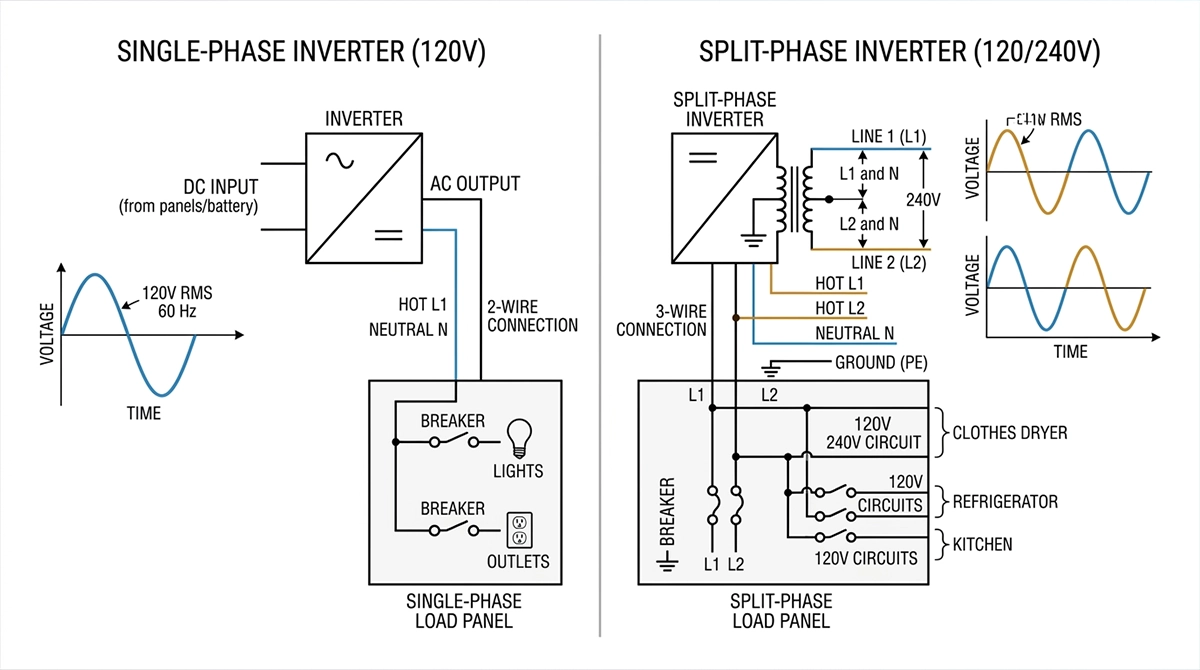
Both single-phase and split-phase inverters are single-phase devices. The difference is that a standard single-phase inverter gives one voltage (usually 230V), while a split-phase inverter splits its output into two 120V hot lines that also combine to 240V. This guide explains how, and which one your market actually needs.
Key Takeaways
- Split-phase is 120/240V dual-hot single-phase, not two-phase or three-phase. It’s the Americas residential standard.
- Standard single-phase gives one voltage (commonly 230V in Europe, Asia, Africa); split-phase gives both 120V and 240V.
- Split-phase uses two hot lines 180° out of phase plus neutral; three-phase uses three lines 120° apart. Different systems.
- Match the inverter to your market’s grid: 230V single-phase for most of the world, 120/240V split-phase for the US, Canada, and parts of Latin America.
What Is a Split-Phase Inverter?
A split-phase inverter creates two live output lines that are 180 degrees out of phase, giving 120V from either line to neutral and 240V across the two lines. That’s what lets one inverter run standard 120V outlets and 240V appliances (dryers, water heaters, air conditioners, well pumps) at the same time.
The voltages break down like this:
- Line 1 to Neutral = 120V
- Line 2 to Neutral = 120V
- Line 1 to Line 2 = 240V
It’s called “split” phase because a single phase is split at a center-tapped neutral into two halves. Despite sometimes being called “two-phase,” it is not a true two-phase or three-phase system. This is exactly the point buyers get wrong, and getting it wrong means ordering incompatible hardware. Split-phase inverters are standard in off-grid homes, solar battery systems, RVs, farms, and backup power across the United States, Canada, and parts of Latin America.
What Is a Standard Single-Phase Inverter?
A standard single-phase inverter produces one AC voltage from a single hot line and a neutral, commonly 220-240V in Europe, Asia, Africa, and most of the world. It’s the simplest and most common inverter output, suited to homes and small businesses on a normal single-phase grid connection.
Its strengths are simplicity and cost: fewer output complications, a simpler circuit, and a lower price than an equivalent split-phase unit. The limit is that it offers only one voltage. If a site needs both 120V and 240V from the same system, a single-voltage inverter can’t do it, which is precisely the gap split-phase fills in the Americas.
Single-Phase vs Split-Phase: The Real Comparison
Both are single-phase systems; the difference is one voltage versus two, and which market’s wiring they match. The table below is the corrected comparison (an earlier version of this page mislabeled split-phase as three-phase, which it is not).
| Feature | Standard Single-Phase | Split-Phase |
|---|---|---|
| Output | One voltage (e.g. 230V) | 120V and 240V together |
| Hot lines | One (L) + neutral | Two (L1, L2) + neutral |
| Phase relationship | Single line | Two lines 180° apart |
| Typical markets | Europe, Asia, Africa, most of world | US, Canada, parts of Latin America |
| Runs 240V appliances | Only at 230V single supply | Yes, via L1-L2 |
| Cost | Lower | Higher |
| Is it three-phase? | No | No |
How Is Split-Phase Different from Three-Phase?
Split-phase has two hot lines 180 degrees apart (single-phase, 120/240V); three-phase has three lines 120 degrees apart (a different system, 380-415V for industry). They are not variations of the same thing.
Think of it by counting phases and their spacing. Split-phase is one phase divided in two, for residential dual-voltage. Three-phase is genuinely three separate phases, for motors and heavy commercial or industrial loads. If your project is a factory or has three-phase motors, you need a three-phase inverter, not split-phase. If you’re weighing residential single vs three-phase generally, see single-phase vs three-phase solar inverters. For the basics of all inverter types, start with what an inverter is.
Which One Does Your Market Need?
Match the inverter to your market’s residential wiring: standard single-phase 230V for most of the world, 120/240V split-phase for the US, Canada, and split-phase Latin American markets. For an importer, this is a hard requirement, not a preference.
- Selling into Europe, the Middle East, Africa, South Asia: standard single-phase 230V is the residential norm.
- Selling into the US, Canada, or 120/240V Latin American markets (parts of Mexico, Central America): split-phase 120/240V is required for homes to run both small appliances and 240V loads. Our overview of backup power demand in Latin America covers where split-phase applies.
- Industrial or C&I sites with three-phase motors: neither, you need three-phase.
Get this wrong and the product simply won’t fit the customer’s home wiring, so confirm the market’s residential voltage standard before ordering.
FAQ: Single-Phase vs Split-Phase
Is split-phase the same as two-phase or three-phase?
No. Split-phase is single-phase power divided into two 120V hot lines 180 degrees apart, giving 120V and 240V. True two-phase (90 degrees apart) is an obsolete historical system, and three-phase (three lines 120 degrees apart) is a separate system for industrial loads. Split-phase is neither.
Can a split-phase inverter power 240V appliances?
Yes. That’s its main advantage. The two hot lines combine to 240V for dryers, water heaters, air conditioners, and well pumps, while either line to neutral gives 120V for standard outlets. One inverter handles both.
Do I need a split-phase inverter in Europe or Africa?
No. Those markets use single-phase 230V for homes, so a standard single-phase inverter is correct. Split-phase is specific to 120/240V markets, mainly North America and parts of Latin America. Buying split-phase for a 230V market is a mismatch.
Why was this page’s old comparison wrong?
An earlier version described split-phase as three-phase (380V, three lines). That was incorrect. Split-phase is single-phase 120/240V with two hot lines. We’ve corrected it because the error could lead buyers to order the wrong inverter for their market.
Can I run a split-phase inverter on a single 120V circuit?
Either hot line to neutral provides 120V, so 120V loads work. But the inverter is designed to deliver 240V across both lines too. If you only ever need 120V, a standard single-voltage inverter is simpler and cheaper.
Conclusion
The one thing to remember: split-phase is 120/240V single-phase for the Americas, not three-phase. Choose standard single-phase (230V) for most of the world, split-phase (120/240V) for North America and split-phase Latin American markets, and three-phase only for genuine industrial loads.
Techfine manufactures both single-phase and split-phase hybrid and off-grid inverters, with OEM/ODM options for market-specific voltage configuration. Sourcing for a 120/240V market? Tell us your target country and load profile and we’ll match the right output configuration.